Showing posts with label 12 December. Show all posts

Sunday, December 8, 2019

An Advent Appetizer for Feast of Immaculate Conception


This simple appetizer with its combination of ingredients: goat cheese, pomegranates, thyme, and honey - holds symbolism for the Feast of the Immaculate Conception and the Advent season. It is a yummy flavor combination, too, with the tangy sweetness of the pomegranates contrasting to the tartness of the goat cheese. Just top your favorite cracker and enjoy.

The pomegranate is often depicted in paintings of the the Madonna and Child. It's availability during the months around Christmas also make it a great food for the Advent and Christmas season.  While suggested for today, it is actually a fitting appetizer for anytime during the Advent or Christmas season.
Madonna of the Pomegranate ~ Sandro Botticelli

The four ingredients all have a symbolism or connection to make them fitting for this feast:
Pomegranate – fruit that is a symbol of the hope of eternal life through Christ the Word made flesh White (goat cheese) - symbol of Our Lady’s purity/Immaculate Conception
Thyme – herb that is a symbol of Mary’s humility
Honey – a “locust and honey” nod to St. John (2nd Sunday of Advent)

Pomegranate & Thyme Goat Cheese Log

Ingredients:
4 oz. goat cheese log
~ 1/2 cup of pomegranate arils
fresh thyme sprigs
honey

Directions:
Allow the goat cheese to sit at room temperature for about 15 minutes to soften. Add pomegranate arils to top and sides - gently pressing in to hold. Strip the thyme leaves from the stem. Sprinkle thyme leaves over the cheese log. Drizzle with honey. Serve with crackers.


Pin It

Monday, December 18, 2017

O is for Bagels and O Antiphons


This week the Church celebrates the "O Antiphons" - the Magnificat antiphons used at Vespers of the last seven days of Advent.  I love an easy idea to make these days memorable.  It is a busy week so I thought this would be a perfect way to celebrate the Great Os - with some yummy O-shaped bagels. We took advantage of Einstein's Bagels Monday $7 Deal to pick up a dozen for our family and a couple dozen for some of our seminarian friends.


What I love about this (besides being easy) is that since it is not day specific can be done for any of the O Antiphon days. We still have all week. [Oh - and donuts work, too! ;  ) ]

Pin It

Saturday, December 10, 2016

Sancta Lucia Martinis

This recipe in honor of St. Lucy was submitted by Kim Loney. Thank you, Kim! 


Here is my non alcoholic version of the SANCTA LUCIA MARTINIS!

The idea came from Drinking with the Saints: The Sinner's Guide to a Holy Happy Hour by Michael P. Foley. The book contains "saintly" alcoholic drinks for every day of the liturgical year.

Sancta Lucia Martinis 

Ingredients:


Pin It

Wednesday, December 7, 2016

St. Ambrose and the Bees Honeycomb Cake


The feast of St. Ambrose, patron saint of beekeepers, bees, and candlemakers, is celebrated on December 7th. Here is a recipe for Honey Bun Cake baked in a Honeycomb Cake Pan in honor of St. Ambrose, the honey-tongued doctor.


St. Ambrose and the Bees Honeycomb Cake
adapted from The Cake Mix Doctor

Cake:
  • baking spray for cake pan
  • 1 package (18.25) oz plain yellow cake mix
  • 1 cup sour cream
  • 3/4 cup canola oil
  • 4 large eggs

Filling:
  • 1/3 cup honey
  • 1/3 cup packed brown sugar
  • 1 tablespoons ground cinnamon
  • 1/2 cup finely chopped pecans (optional)

Sugar Glaze:
  • 2 cups confectioners' sugar
  • 1/3 cup milk
  • 1 teaspoon pure vanilla extract
Note: I only used half of the glaze after baking the cake in the Honeycomb Pull Apart Cake Pan. This cake can also be baked in a 13-by-9 inch baking pan. 

Honeycomb Pull Apart Cake Pan

Directions:

Preheat oven to 350˚F. Coat pan with non-stick baking spray. Set the pan aside.

Place the cake mix, sour cream, oil, and eggs in a large mixing bowl. Blend with an electric mixer on low speed for 1 minute. Stop the mixer and scrape down the sides of the bowl with a rubber spatula. Increase the mixer speed to medium and beat for 2 minutes more, scraping the sides down again if needed. The batter should look thick and well blended.


Pour the batter into the prepared pan, smoothing it out with the rubber spatula.

Tip: If using the Honeycomb Pan, don't fill the pan more than 3/4 of the way full, otherwise you may end up needing to remove a scoop or two of batter while it's baking to prevent it from overflowing! ;) 

Add the filling. Drizzle the honey on top of the batter, then sprinkle on the brown sugar, cinnamon and pecans if desired.


With a dinner knife, swirl through these ingredients blend them slightly. Place the pan in the oven. 

Bake the cake until it is golden brown and springs back when lightly pressed with your finger, 38 to 40 minutes. Remove the pan from the oven and place it on a wire rack to cool for 10 minutes while you prepare the glaze.  


For the glaze, place the confectioners' sugar, milk, and vanilla in a small mixing bowl and stir until the mixture is well combined. 


Flip the Honeycomb Cake onto serving platter and pour the glaze over the top of the hot cake. 

Note: If you used a 9x13 pan, leave the cake in the pan and pour the glaze over the top of the cake, spreading it to the sides with a spoon. 

Allow the cake to cool for 20 minutes more before serving warm. 

Saint Ambrose and the Bees from Brother Wolf, Sister Sparrow: Stories about Saints and Animals


Pin It

Thursday, December 17, 2015

The Great O Antiphons


Catholic Cuisine contributor, Jennifer Gregory Miller has a great article on Observing the O Antiphons over at Catholic Culture. 

From the Archives here at Catholic Cuisine:

O Antiphons (also by Jennifer Gregory Miller)


O Come, O Come, Emmanuel...

Pin It

Saturday, December 13, 2014

Feta Cream Cheese Olive Appetizers on St. Lucy Day


I know there are many cultural recipes and lovely baked sweets traditions associated with St. Lucy's feast day. Many have been posted here in past and recently for St. Lucy day celebrations. I saw these appetizers on Pinterest (from blog Diethood) and in my mind made a link to St. Lucy. Wanting to make sure I wasn't stretching it, I asked my son to look at the picture, too. "Hey, what do these look like?" "Eye balls," he replied and he knew if I was doing a post for Catholic Cuisine, it was for St. Lucy. So if a 15 year old sees it, they must look like an eye.

St. Lucy is often pictured in paintings holding a plate with two eyeballs. One of the legends associated with her indicates that as part of her torture, Diocletian had her eyes put out. According to those stories her sight was later restored to her by God.

These are a simple appetizer and actually quite tasty. They may be a more grown up fare as mine were never fond of feta when they were younger. I assume the recipe could be modified to exclude the feta and just use the cream cheese.

Ingredients & Directions:

1 can medium olives
8 ounces cream cheese
1 cup crumbled feta
1/2 cup crushed nuts

Drain olives and dry with paper towel.  Mix cream cheese and feta at room temperature.  Crush nuts and place in shallow bowl. Mold about 1 teaspoon of cheese mixture around olive.  Shape until rounded. Roll each in chopped nuts until covered. Set on plate and refrigerate 1/2 hour until chilled. Cut in half, through olive, making sure to leave the circle of black intact - looks like the iris of the eye and the hole looks like the pupil. Pin It

Wednesday, December 10, 2014

Santa Lucia Leves (St. Lucy Soup)

The following recipe, adapted from Cooking with the Saints, was submitted by Hi Cookery for the feast of St. Lucy on December 13th. Thank you Highlander and Islander!


December 13: Feast Day of St. Lucy

Warm up during the winter weather with a saintly soup! On those darker, depressing December days in the northern hemisphere, we like to lighten up with leves (soup) of Santa Lucia.

St. Lucy, whose name means “light” in Latin, was a third-century saint from Sicily, Italy. Legends state that she was tortured to death by having her eyes gouged out and being burned at the stake for her Christian faith. St. Lucy is the patron saint of the blind and those with eye problems, as she gives hope to see the Light and Savior of the World—Jesus!

Santa Lucia Leves is a Hungarian recipe. This soup can be served during the season of Advent and Christmas and on the Feast Day of St. Lucy.

Recipe

(Adapted from Cooking With the Saints by Ernst Scheugraf)

Ingredients
  • ½ cup rice, uncooked
  • 8 cups water
  • 1 teaspoon salt
  • ½ cup (1 stick) butter
  • ¼ cup onion, minced
  • 1 cup fully-cooked ham, chopped
  • ½ cup flour

Directions

Boil the rice in salted water until soft, about 30 minutes. Drain the rice-flavored water into a large bowl. Save the rice for another recipe, if desired (see Notes).


Mince the onions and chop the ham into tiny pieces. In a large pot, melt the butter over low heat.


Saute the onions and ham until shiny. Mix in the flour until smooth. Pour in the rice-flavored water and simmer to thicken. Stir and ladle into soup bowls. Garnish with parsley flakes (optional). Serve hot with bread or crackers.


Notes
  • Use the leftover boiled rice to make Italian-style arancini (recipe is posted on National Rice Month in September). These Sicilian rice balls are normally filled with a tomato or meat sauce, mozzarella cheese and/or peas. But on the Feast Day of St. Lucy, Sicilians celebrate with sweetened rice arancini filled with chocolate.

Pin It

Friday, December 5, 2014

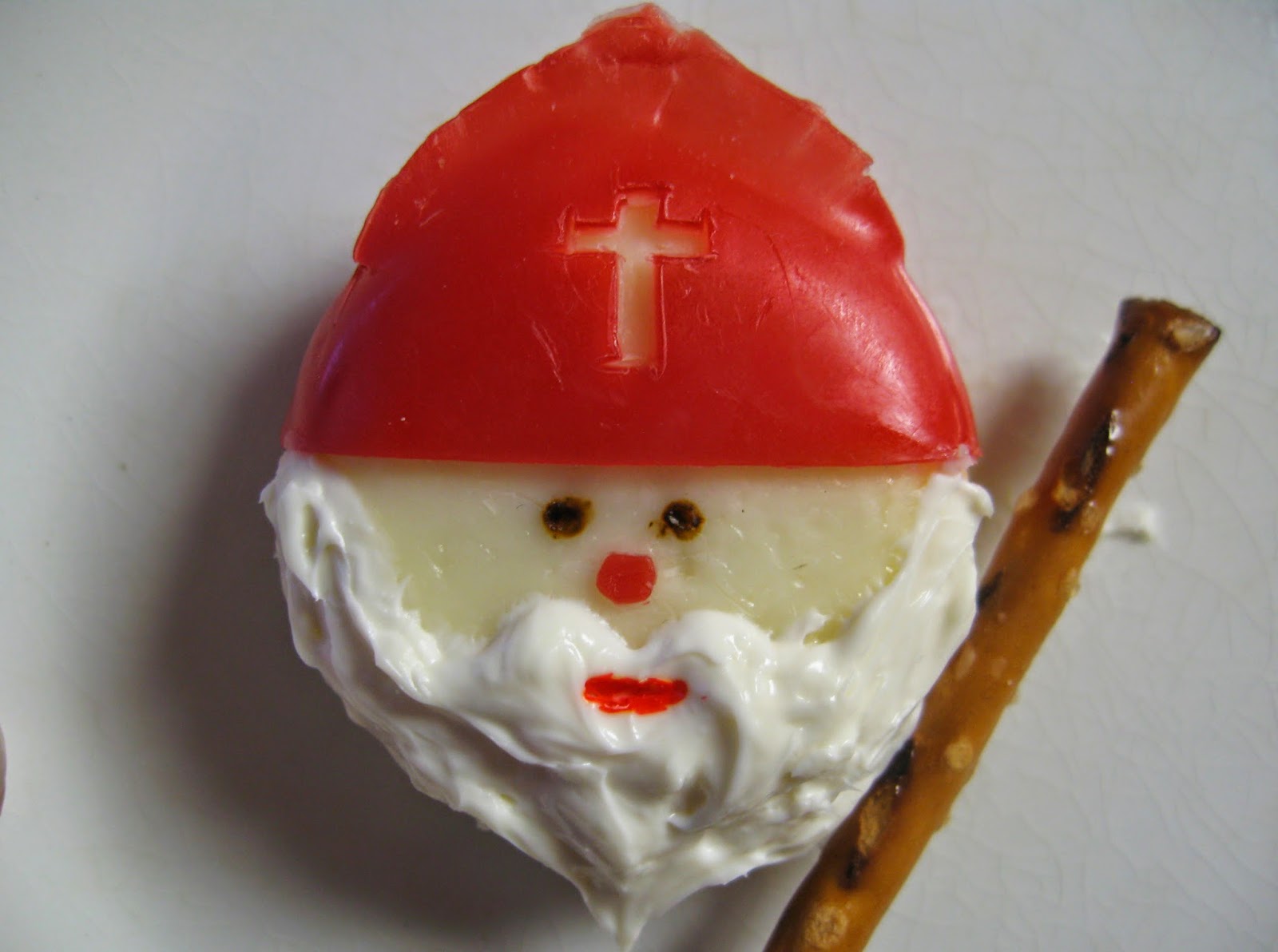
Babybel Cheese St. Nicholas


I have seen these cute Babybel Santas online for several years. I thought he could be converted to St. Nicholas with a few modifications. Most of the instructions are the same as those in the link, which are so nicely detailed. 


For the St. Nicholas modification:
  • Use Mini Babybel cheese rounds.
  • After opening the wax covering and removing half of it from the cheese round, you have his mitre left. Using a sharp tipped paring knife or x-acto knife, cut from the side up to a point toward back of top. Do other side to middle also. Approximate cut lines drawn in below. Bend that section forward to make the mitre pointed and standing upright in front. 

  • Cut out a small cross from the red wax mitre with x-acto or paring knife. 
  • From the bottom wax covering that was removed, cut a small circle for the nose. 
  • The original instructions indicate using a food marker for the eyes (and mouth). I found that a toothpick dipped in concentrated gel food coloring (ex: Wilton brand icing color) could be used to add the eyes (and mouth) if you don't have a food marker.
  • Dip bottom half of cheese in softened or whipped cream cheese. For the St. Nicholas I made the beard longer and pointier than the Santa version.  You can shape and texture beard with toothpick or pretzel.
  • Draw in a mouth with marker or food coloring on toothpick. 
  • Add a pretzel (or mini candy cane) crozier to the side.

St. Nicholas Day Blessing

Gracious and good Lord, we bless you on this feast of St. Nicholas, your servant, who is an example to us of a life of charity and love. May we see in his life an invitation to imitate his good deeds. Make us always mindful of the needs of others and help us rejoice in the abundance of your goodness around us. Through Jesus our Lord.


Pin It

Tuesday, December 2, 2014

St. Francis Xavier Fortune Cookies


As most of you know, fortune cookies are thin, folded cookies with a paper saying inside. They are associated with Asian restaurants and recipes. I thought it would be fun to make fortune cookies for a saint feast day who has a connection to Asia. In place of fortunes inside the cookies, it would be a good opportunity to put quotes or saying associated with the saint. St. Francis Xavier is an excellent choice as he was a missionary to Japan and China. His feast day is this week, December 3.  St. Francis spent time in the Philippines, India, and Japan, baptizing tens of thousands. He set sail for China but died on the island of Sancian within sight of China. For his travels and zealous missionary efforts in the far east he is associated with that area and is a patron of several of those countries. Other saints that could be included if you were to do this at a different time are St. Paul Miki and the Japanese Matryrs, the Chinese Martyrs, etc.  Now, the actual truth of fortune cookies as being from these Asian cultures is not accurate. It seems that they were first made in the United States for Chinese restaurants. But they are significantly associated with the food of the culture to most of us now, so fit this activity, I believe.

For some saints or martyrs from China and other southeast Asian countries there is little available of their teaching or writing to use as quotes, but St. Francis has some and that is why it made sense to target his feast day initially. Here is a link to a document of quotes that you can download and print off to use for making your fortune cookies. Just print and cut them into strips.

I had previously tried making fortune cookies many years ago and knew that they are a bit tricky. It takes a quick hand to maneuver the cookies before they set and can no longer be shaped. The batter and baked cookie have to be just right, so it won't crack or harden to quickly.  This time, with a couple of early ones for practice, I got the hang of it and they turned out okay.  Don't let this intimidate you. It really was easier than my previous experience.  You can check out some YouTube videos which walk you through the process.  There are slight variations on the ingredients, but this is what I used.

How to make home-made fortune cookies:

Ingredients:
  • 3 tablespoons butter, softened
  • 3 tablespoons sugar
  • 1 egg white
  • 1/2 teaspoon vanilla extract
  • 1/3 cup all-purpose flour

Directions:
  • Print and cut out quotes so they are on small strips of paper. 
  • Line a baking sheet with parchment paper. Draw two 3-1/2-in. circles on parchment paper.
  • In a small bowl, beat the butter, sugar, egg white and vanilla until frothy. Add flour and mix until just blended in. 
  • Spread 1 T. batter over each circle. 
  • Bake at 400° for 4-5 minutes or until lightly browned.
  • Cover one cookie with a kitchen towel (to help keep it soft while working with other). 
  • Loosen other cookie from parchment paper with a thin spatula and flip over onto work surface. 
  • Place a fortune in the center of that cookie.
  • Fold cookie in half over paper so the edges meet and hold edges together for few seconds.
  • Place center of cookie over the rim of a mug.
  • Gently press ends down to bend cookie in middle.  Hold and let set a few seconds. 
  • Set inside muffin tin cup to cool and retain shape. 
  • Repeat with second cookie. 
  • Repeat with remaining batter and paper quotes. 
Yield: 10-12 cookies.

St. Francis Xavier, Pray for us!

Ad Majorem Dei Gloriam


Pin It

Monday, January 6, 2014

Eggnog Cupcakes with Eggnog & Rum Buttercream Frosting


Eggnog Cupcakes
adapted from Wendy Paul

Ingredients:
  • 1 box yellow cake mix
  • 1 cup eggnog
  • 3 eggs
  • 1/2 tsp rum extract
  • 1 tsp vanilla extract
  • 1/2 tsp ground nutmeg
  • 1/2 tsp ground cinnamon

Directions:

In a large bowl, beat together the cake mix, eggnog, eggs, extracts and spices for two minutes. Batter will be thick. Fill paper cupcake liners 3/4 full. Bake at 350 degrees for 15-18 minutes, or until lightly golden and springs back when lightly touched. Cool completely.


Eggnog & Rum Buttercream Frosting

Ingredients:
  • 2/3 cup butter, softened
  • 1/2 tsp rum extract
  • 1/4 tsp vanilla extract
  • 3-4 Tbsp eggnog
  • nutmeg
  • 5 cups powdered sugar

Directions:

In the bowl of a stand mixer, beat together butter and extracts until blended and creamy. Gradually add powdered sugar in, about 1 cup at a time, until frosting forms a paste. Add eggnog in between powdered sugar additions until the frosting begins to come together and make the frosting stiff yet spreadable and creamy. Blend in the pinch of nutmeg, if desired.


Frost cupcakes with eggnog buttercream and sprinkle with additional nutmeg.


Pin It

Saturday, December 28, 2013

Cathedral Window Cookies


December 29th is the memorial of St. Thomas Becket, the Archbishop of Canterbury.  He was martyred for the Catholic Faith in his cathedral on December 29, 1170.  You can read more about this holy saint here.

Our family celebrates a name-day in our home on this day, so I usually try and serve a little treat in his honor.  One year we made Sword and Miter Cookies, last year we made a Martyr's Crown Cake, and this year I had planned to make another Cathedral Cake using this pan, until I ran across the following recipe for Cathedral Cookies!


Cathedral Window Cookies
adapted from Taste of Home

Ingredients
  • 1 cup (6 ounces) semisweet chocolate chips
  • 2 tablespoons butter
  • 1 egg, lightly beaten
  • 3 cups pastel miniature marshmallows 
  • 1/2 cup chopped pecans or walnuts (optional) 
  • 1 cup flaked coconut

Directions

In a heavy saucepan, melt chocolate chips and butter over low heat, stirring occasionally. Stir a small amount into the egg, then return all to pan. Cook and stir over low heat for 2 minutes. Pour into a bowl; let cool for 15 minutes. Gently stir in marshmallows and nuts.

Chill for 30 minutes.

On a sheet of waxed paper, shape dough into a 1-1/2" diameter log.
Place coconut on another sheet of waxed paper. Gently roll log over
coconut to coat sides. Wrap up tightly, twisting ends to seal.Freeze for 4 hours or overnight.

Remove waxed paper. Cut into 1/4" slices. Store in an airtight container in the refrigerator.

Yield: about 5 dozen. (I cut mine a bit thicker and made about 3 dozen.) 

Note:  I just used what I had on hand and substituted 1 cup of white marshmallows, along with the 2 cups of pastel marshmallows that were in the cupboard.  For those that don't like coconut, you could also roll the log in chopped nuts to coat the sides as well!


Let us all rejoice in the Lord, celebrating a festival-day in honor of the blessed martyr Thomas: at whose martyrdom the angels rejoice, and give praise to the Son of God. 

St. Thomas Becket, Pray for us! 

Pin It

Friday, December 27, 2013

"Drink you the love of St. John."


The following text was submitted by the editor of Advent and Christmas in a Catholic Home, Katherine Zehnder.  It is from the 1950's "Advent and Christmas in a Catholic Home" by Helen McLoughlin and includes a variation of the recipe that can be found in the archives.  Thank you Katherine! 

There is a beautiful Catholic custom for St. John's feast day - the blessing of wine. It is in honor of him remaining unharmed after drinking a poisoned cup of wine over which he made the Sign of the Cross. The father of the family can read Psalm 22 and then recite this prayer: " Lord Jesus Christ, Thou didst call Thyself the vine and Thy holy apostles the branches; and out of all those who love Thee, Thou didst desire to make a good vineyard. Bless this wine and pour into it the might of Thy benediction so that everyone who drinks or takes of it, may through the intercession of Thy beloved disciple the holy apostle and evangelist John, be freed from every disease or attack of illness and obtain health of body and soul. Who livest and reignest forever. Amen."

A toast to the love of St. John is then pledged by all the family. The father touches his glass of wine to his wife and says: "I drink to you the love of St. John" and she in turn touches the children's (watered down wine) goblets and says "drink you the love of St. John."

St. John's Wine

2 cups wine
2 whole cloves
2 pinches cinnamon
1 cardamon seed
1/4 tsp nutmeg

Boil the spices in the wine for about five minutes. Strain the wine. Serve hot.

Happy Feast of St. John!

Pin It

Thursday, December 26, 2013

Podkovy :: St. Stephen's Horseshoes

St. Stephen from Saints: Lives and Illuminations and Stephen's Feast

On December 26th we celebrate the feast of St. Stephen, the first Christmas Martyr!  In honor of St. Stephen's patronage over horses, special breads filled with chopped nuts and sugar and shaped in the form of horseshoes are traditionally baked on this day in Poland and other Slavic countries.  The following recipe for Podkovy (St. Stephen's Horseshoes) is adapted from Cooking with the Saints.

Podkovy (St. Stephen's Horseshoes)

Dough Ingredients

  • 1 tablespoon dry yeast
  • 1/2 cup milk, lukewarm
  • 3 eggs, small
  • 1 cup sour cream
  • 2 teaspoons lemon juice
  • 2 tablespoons lemon rind, grated
  • 1 cup butter
  • 5 cups flour
  • 1/2 cup sugar
  • 1/2 teaspoon salt
  • 1/2 cup shortening


Filling Ingredients

  • 1 /2 cups walnuts, finely chopped
  • 3/4 cup brown sugar
  • 1 egg
  • 1/2 teaspoon vanilla
  • grated rind of 1 orange
  • grated rind of 1 lemon


Directions

Dissolve yeast in the lukewarm milk and let stand for 10 minutes.

In a large mixing bowl, beat the eggs until light and fluffy.  Stir in the sour cream, yeast mixture, lemon juice and rind.

In another mixing bowl, combine the flour, sugar, and salt.  Cut the cold butter into small pieces.  Using either a pastry blender, two knives, or your hands, work the butter and shortening into the flour mixture until it resembles coarse bread crumbs.

Add the flour mixture to the moist ingredients and beat well.  You may need to add more flour, just enough to make a fairly soft and non-sticky dough, depending on the size of the eggs.

Knead dough briefly. Wrap in plastic wrap and chill for 1 hour.

While the dough is chilling prepare the filling.  Chop the nuts finely.  (We used walnuts, but hazelnuts or almonds would work great too!) Combine the brown sugar, egg, vanilla and rinds, then stir in the nuts.

On a lightly floured surface, roll the dough out to about 1/8 inch thickness and cut into 4x6 inch rectangles.

Brush the rectangles with some melted butte (I actually skipped this step) and spread a thin layer of filling in the middle.  Starting on the long side, roll each rectangle and form into the shape of a horseshoe.  (Note: As you can see in my pictures above, the filling did ooze out of some of the horseshoes in my first batch.  On the following batches, I made sure the dough was pinched together to prevent this from happening again.)

Place on a lightly greased baking sheet.  Bake at 375˚F for about 15 minutes or until the horseshoes are nicely browned.

Dust with powdered sugar or glaze with a mixture of lemon juice and powdered sugar if desired.


St. Stephen, Pray for us! 

Pin It

Tuesday, December 24, 2013

His name shall be called Jesus

Spectacular Nativity Cookie Mold and Silent Night Table Runner (also available here)
Come, sweet Lord Jesus, 
Into the hearts and lives of all our dearest
Priests, Religious, families and friends.

Wishing you all a Blessed and Joyful Christmas! 

Pin It

Monday, December 9, 2013

White Chocolate Cream Cake for the Feast of the Immaculate Conception

O God, who by the Immaculate Conception of the Blessed Virgin
prepared a worthy dwelling for your Son,
grant, we pray,
that, as you preserved her from every stain
by virtue of the Death of your Son, which you foresaw,
so, through her intercession,
we, too, may be cleansed and admitted to your presence.

 White Chocolate Cream Cake

Cake:
3 oz. squares white chocolate, chopped
2 1/4 C. all-purpose flour
1 1/2 C. white sugar
2 1/4 tsp. baking powder
1/2 tsp. salt
1 2/3 C. heavy cream
3 eggs
1 tsp. almond extract

Frosting:
3 oz. white chocolate, chopped
3 1/2 C. confectioner's sugar
1/4 C. butter, softened
4 Tbl. water
1/2 tsp. almond extract

Preheat oven to 350. Grease and flour two 8 or 9 inch round pans. For the cake, melt white chocolate, set aside to cool to lukewarm. In a small bowl, mix flour, sugar, baking powder and salt; set aside. In a large chilled bowl, whip heavy cream until stiff peaks form; set aside.
In a large bowl, beat eggs for about 5 minutes until light lemon colored. Beat in 1 tsp. almond flavoring and melted white chocolate. Fold in whipped cream. Fold in flour mixture, about 1/2 a cup at a time. Divide batter into prepared pans. Bake in over for 35-40 minutes or until toothpick comes clean. Let cool in pan for 10 minutes then turn out onto wire rack and cool completely.

For Frosting: In a large bowl, beat 3 oz. of white chocolate over low heat or in microwave, stirring occasionally, until melted; cool to lukewarm. Combine on medium speed, white chocolate, confectioners sugar, butter, water and 1/2 tsp. almond extract. Beat until smooth and of spreading consistency. Pin It

Monday, January 7, 2013

Turtle Dove Chocolates


Another fun recipe we made for our Twelve Days of Christmas Dinner Party were these delicious Turtle Dove Chocolates!   They are similar to the Pretzel Dots, made with Dove Caramels and Pecan Halves, instead of the Hershey Kisses and M&M's.  You just can't go wrong with salty caramels and chocolate.  YUM!!! These things are very dangerous to have in the house, especially with my New Year's resolutions and goals. Thankfully our children made sure they didn't last long!

Turtle Dove Chocolates

Ingredients:
  • 1 bag of Dove Caramel Milk Chocolates
  • 1 bag of Butter Snap pretzels
  • 1 bag of whole pecan halves (about 30-40 pieces)
  • Pretzel Sticks (optional)


Directions:

Preheat oven to 300 degrees.  Cover a cookie sheet with parchment paper or aluminum foil.  Unwrap each Dove Chocolate. Lay out pretzels and put one chocolate on each pretzel.


Bake in oven for 3 minutes. After removing from oven, gently press pecan into chocolate, but not hard enough for caramel to come out of the chocolate. Transfer pan to refrigerator for chocolates to harden.


Note: Can you tell that I got distracted talking to a friend on the telephone?  They were left in the oven for about 4-5 minutes and I had caramel oozing everywhere... Whoops!

Optional: Before placing the candies in the refrigerator to harden you can insert pieces of Pretzel Sticks to create a head and legs for your "turtles." Or just leave them as pictured above, with the turtle tucked into his shell!


Pin It

Thursday, January 3, 2013

Cookie Cutters Tell the Story of Christmas


Back in November Debbie shared an article with me (over at Shower of Roses) that was written by Iris Hammett in the 1940's titled "Cookie Cutters Tell the Story of Christmas."  We have made Nativity Cookies and Starlight Cookies in the past, but I thought this story would be a fun alternative for this year and we finally had a chance to make them today!   We also spent some time making cookies to go along with a couple more of our Christmas picture books, but I'll post about those later.


Cookie Cutters Tell the Story of Christmas
By Iris Hammett, written in the 1940’s
(Published in the Mansfield News Journal)

"It is a story, as suggested by cookie cutters, which are familiar to the younger generation both for their utilization purpose in shaping sweets and as playthings for toddlers. This is their message as interpreted by Mrs. Iris Hammett."


"The oven is heated, the dough is made, and the kitchen table is spread with an array of cookie cutters. But theses are not just ordinary cookie cutters, for they have a story to tell."


"Three (Seven in our case!) anxious little faces look on with great anticipation of receiving a sweet morsel when it is baked. Their dark eyes glisten as they listen to the story of the Christ child as each cutter tells his part."


"First, we make an angel, for it was an angel who came to Mary and told her that she would have a baby boy and should call his name Jesus, for he would save his people from their sins."


"Second, we make a donkey, for it was a little donkey that Mary rode into Bethlehem where the baby Jesus was to be born."


"Third, we cut a star for the star that shone in the East to guide the Shepherds to where they would find the Baby Jesus. The wise men had seen this star in the East and knew it told of the birth of the Savior."


"Fourth, we cut more angels for the angels who sang Glory to God in the highest, and on earth peace, good will toward men. The angels also brought the good news to the shepherds as they watched their sheep during the night."


"So we make candy cane cookies to represent the shepherd’s staff."


"Fifth, we make a camel because the wise men traveled over many miles of sandy desert on camels that they might find the young child."


"Then we come to some of the cookie cutters which we can’t find in the Bible, but which have wonderful meaning by which we tell God’s love for us. We make a wreath for it is round and has no end, even as God’s love has no end. He gave to us eternal life which has no end. We think of the wreath being made of evergreen and so we frost it green. The evergreen is a symbol of the eternal life which Christ bought for us on Calvary. Then comes the Christmas tree, again an evergreen tree, the symbol of everlasting life. It stays green winter and summer as no other tree. It tells of the love of Christ which goes on and on, and of the eternal life which he gives us if we believe in him as our Savior. And last of all we make the bells, for the bells ring out the glad news that a savior is born this day in the City of David."


"And so, as we bake our Christmas cookies, we see the story of the Savior's birth and purpose in our lives. What a wonderful way to gather the little ones around and tell them of God’s love for us. As we roll and cut the dough and mold it into shape, we tell over and over the story that never grows old."


"Then breathe a little prayer that we are molding young and pliable lives, minds, and hearts into the right form, that they might come to know and love this Christ that was born on Christmas Day."


"My prayer is that my children shall never forget the cookie cutters and the story they told of Jesus, His birth and purpose."


"Thus we keep Christ in Christmas even with the cookie cutters."


Recipe:
The Best Rolled Sugar Cookies (Found in the Archives)

Our Cookie Cutters:


Our Christmas Story Picture Books:


Wishing you all a very Merry 10th Day of Christmas and a Blessed Feast of the Most Holy Name of Jesus!
  
Pin It