Showing posts with label Herbs. Show all posts

Sunday, December 8, 2019

An Advent Appetizer for Feast of Immaculate Conception


This simple appetizer with its combination of ingredients: goat cheese, pomegranates, thyme, and honey - holds symbolism for the Feast of the Immaculate Conception and the Advent season. It is a yummy flavor combination, too, with the tangy sweetness of the pomegranates contrasting to the tartness of the goat cheese. Just top your favorite cracker and enjoy.

The pomegranate is often depicted in paintings of the the Madonna and Child. It's availability during the months around Christmas also make it a great food for the Advent and Christmas season.  While suggested for today, it is actually a fitting appetizer for anytime during the Advent or Christmas season.
Madonna of the Pomegranate ~ Sandro Botticelli

The four ingredients all have a symbolism or connection to make them fitting for this feast:
Pomegranate – fruit that is a symbol of the hope of eternal life through Christ the Word made flesh White (goat cheese) - symbol of Our Lady’s purity/Immaculate Conception
Thyme – herb that is a symbol of Mary’s humility
Honey – a “locust and honey” nod to St. John (2nd Sunday of Advent)

Pomegranate & Thyme Goat Cheese Log

Ingredients:
4 oz. goat cheese log
~ 1/2 cup of pomegranate arils
fresh thyme sprigs
honey

Directions:
Allow the goat cheese to sit at room temperature for about 15 minutes to soften. Add pomegranate arils to top and sides - gently pressing in to hold. Strip the thyme leaves from the stem. Sprinkle thyme leaves over the cheese log. Drizzle with honey. Serve with crackers.


Pin It

Thursday, August 14, 2014

Infused Water - Refreshing Drink for Summer Feasts


Infusing your water with fruits, herbs, or veggies not only adds flavor to the water, but also adds essential vitamins and nutrients that help your body.  It is a great way to quench your thirst and keep you hydrated on a hot, late summer day. They can be helpful for getting children to increase their daily water intake. And they are pretty, too. 

Making your own is more cost friendly and healthier than purchased waters. So join in making some feast day themed waters with a hint of summer flavors for our August saints. 

Making infused water is very simple. Just add desired fruit, veggie, or herb or combination to a pitcher of water with ice. Muddle mixture a bit if you want to increase flavor and let steep for at least several hours, up to 24, depending on how strong you want the flavors.  For some mixtures you can pour directly from pitcher, for others you may want to strain ingredients first to remove small floaters. As long as you keep the water refrigerated, the fruit should stay fresh. And you can keep refilling the pitcher as you drink the water but, it will dilute the flavor each time you refill.  It should last several days before you need to remake with fresh fruit.

One way to make infused water is with a single ingredient. Citrus is a great, no lose option for adding a touch of flavor to water, so it can be a good one to start with.

St. Dominic – Orange

In her recent post for Catholic Culture, Jenn Miller alerted me to the connection of St. Dominic (August 8) to the orange. So orange infused water would be perfect for his feast day.  


You can also make infused waters that combine a variety of fruits, veggies or herbs.

St. Maximilian Kolbe – Coconut Strawberry or Blueberry Orange

Infused waters are simple, no frills refreshers and considering that St. Maximilian Kolbe (August 14) died in a concentration camp it is a simple, non-extravagant treat for an austere remembrance. St. Maximilian had a vision of Mary – she offered him two crowns – red for martyrdom and white for purity and asked which one he would accept.  He chose both. Making a coconut strawberry infusion represents the colors of the two crowns that he was shown and accepted.


Blueberry orange infused water incorporates blue for his Marian devotion and formation of the Militia of the Immaculata movement of Marian consecration. Orange trees and their blossoms are symbolic of purity, chastity and generosity so the addition of oranges for St. Maximilian represents three strong characteristics of this saint who gave his life to take the place of another prisoner.


Assumption – Blueberry Lemon

As mentioned since blue is a universal color associated with Mary, the blueberry is a great fruit to use on Marian feasts. The lemon is a symbol of fidelity in love, and, as such, is often associated with the Virgin Mary in art. A lemon blueberry infused water would be a refreshing addition to this Marian solemnity.

Saint Rose - Raspberry, Rose, & Vanilla

The rose is closely associated as a symbol for St. Rose of Lima (August 23) but could be used, too, for St. Clare (August 11) as she has a rose story. The vanilla bean and raspberries of this recipe don't necessarily represent anything about the saints but were a infused water combination I found with rose that sounds delicious.


Pin It

Saturday, August 25, 2012

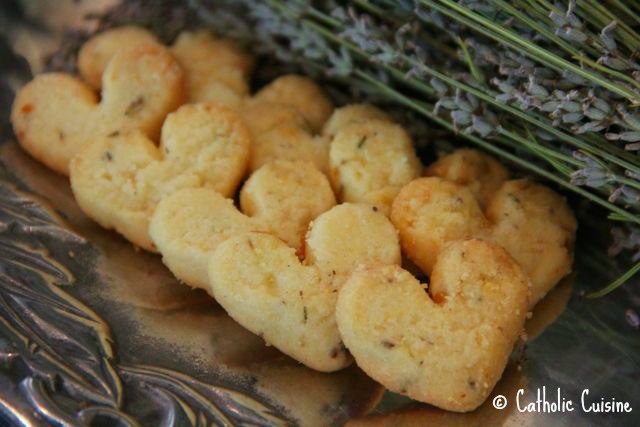
Lemon-Lavender Cookies in honor of Our Lady


Lavender:  Mary's Drying Plant
The Legend of Lavender

After Mary had washed Jesus' clothes and was looking for a place to hang them to dry, she saw a gray bush of lavender and on its branches she spread the snow-white baby clothes. The sun and the wind dried the clothes and when Mary came to gather them, the clothes smelled sweet and clean and the bushes were fragrant with a sweet scent that lavender now has. It is said that the fragrance which came from the earthly body of the Son of God was transferred to the plant, giving it its unique scent.  ~ Source

Lavender was said to be one of the plants most loved by the Blessed Virgin because it represented purity, cleanliness and virtue.


Lemon Lavender Cookies

I purchased the cookies pictured above at a local Lavender Farm last week, and they were a perfect afternoon treat to give the kids on the (traditional) feast of the Immaculate Heart this past Wednesday, after sharing the legend of lavender with them.

Since the whole month of August is dedicated to the Immaculate Heart of Mary, and since I happened to pick a bunch of lavender as well, I think we might try and make some more of our own using a recipe from Better Homes & Gardens.  

  Ingredients:
  • 1 1/2 cups all-purpose flour
  • 1 teaspoon dried lavender buds, ground with mortar and pestle
  • 1 teaspoon finely shredded lemon peel
  • 1/4 teaspoon salt
  • 3/4 cup butter, softened
  • 1 cup powdered sugar

Directions:

1. In a medium bowl, combine flour, ground lavender buds, finely shredded lemon peel, and salt. In a large mixing bowl beat the 3/4 cup butter with an electric mixer on medium to high speed for 30 seconds. Add 1 cup powdered sugar. Beat until combined. Beat in as much of the flour mixture as you can with the mixer. Stir in any remaining flour mixture.

2. On a lightly floured surface, roll dough into a 10-inch-long log. Wrap log in plastic wrap or waxed paper. Chill for 2 to 24 hours or until firm. 3. Preheat oven to 350 degrees F. Cut roll into 1/4-inch slices. (We will probably then cut out heart shapes with a cookie cutter.) Place slices 2 inches apart on ungreased cookie sheet. Bake in preheated oven about 10 minutes or until edges are lightly browned. Transfer cookies to a wire rack and let cool.  Makes 3 dozen cookies.

Optional Frosting & Garnish:
1/4 cup butter, softened
1 cup powdered sugar
1 tablespoon milk
Dried lavender buds 
Thin strips of lemon peel

In a small bowl, combine the 1/4 cup butter, 1 cup powdered sugar, and the milk. Beat with a wooden spoon until smooth. If necessary, stir in additional milk, 1 teaspoon at a time, to make a frosting of spreading consistency. Spread frosting on tops of cookies and, if desired, garnish with additional lavender buds and thin strips of lemon peel.

Note:  If frosted, place in single layer in an airtight container; cover. Store at room temperature for up to 3 days. Or freeze unfrosted cookies for up to 3 months; thaw and frost.

Elana's Pantry also has a recipe for Gluten Free Lemon Lavender Cookies!


The Daily Offering to the Immaculate Heart of Mary

O Jesus, through the Immaculate Heart of Mary, I offer you my prayers, works, joys, and suffering of this day in union with the Holy Sacrifice of the Mass throughout the world. I offer them for all the intentions of Your Sacred Heart: the salvation of souls, reparation for sins, the reunion of all Christians; I offer them for the intentions of our Bishops and of all Apostles of Prayer and in particular for those recommended by our Holy Father this month.


Pin It

Wednesday, May 27, 2009

Summer Herbal Drinks with Mint and Lemon Balm

Spearmint (Mentha viridis or Mentha spicata) was particularly dedicated to the Virgin Mary, and its common names include Our Lady’s Mint, Mary’s Mint, Mary’s Leaf, Lady’s Leaf. These names are very similar in other languages illustrating the universality of naming specific plants for Our Lady. In the various names for spearmint in other languages we can see an example of this universality - in French, Menthe Notre Dame and Herba Santa Maria in Spanish. Also, according to information I read on Ann Ball' s website, mint was one of the favorite strewing herbs in the Middle Ages; it was strewn on the floors of churches and banquet halls to furnish a pleasant odor. It was used by the monks in cooking and medicinally.

Another Marian herb also in the mint family is lemon balm (Melissa officinalis) which was known in medieval Mary garden’s as Sweet Mary. Its lovely fragrance fills the air and could be a reminder to help us be aware of Mary's presence in our life. Lemon balm has a strong history in Catholic religious settings. It is the principal ingredient in Carmelite Water or “Eau de Melisse de Carmes” which was invented by Carmelite nuns and used both medicinally, and externally as a perfume or Eau de Toilette. Lemon balm is also an ingredient in the liquor, Benedictine, which was first made by Dom Bernardo Vincelli, a monk at the Benedictine Abbey of Fecamp in Normandy in the 16th century.

As we enter the season of summer in the northern hemisphere, cool beverages are a great way to beat the heat and find refreshment. A couple sample iced drinks which use these herbs of Our Lady are shared here.


Strawberry Mint Lemonade

Ingredients
4 cups water
1 cup sugar
4 cups fresh mint leaves, lightly packed
1 quart strawberry hulled, halved
1 cup lemon juice, fresh squeezed

Directions
Place 2 cups water, sugar and mint in a small saucepan, bring to a boil and simmer for 10 minutes. Strain and discard mint. Thinly slice about 1 cup of strawberries and set aside. Add 1/2 of the remaining strawberries to a blender and blend until smooth; pour into 2 quarter pitcher. Stir in sliced strawberries and remaining water. Cover and chill until serving.


Lemon Balm Iced Tea

Ingredients
approx. 2 ounces fresh lemon balm leaves
6 cups water
1 small lemon, thinly sliced
4 tea bags (black tea)
3 T honey

Directions
Combine lemon balm, the lemon slices, and tea bags in a teapot or bowl. Pour in 2 cups boiling water to cover. Cover and let steep for 5 minutes. Remove and discard the tea bags. Stir the honey and set aside to cool. Strain the tea into a large pitcher and discard the solids. Add 4 cups cold water and stir well. Refrigerate the tea until ready to serve. Pour the chilled tea over ice in glasses and garnish with lemon balm sprigs. Pin It

Tuesday, May 19, 2009

St. Anthony of Padua Basil Pots


And since we are talking about herbs, let's look at another herb, one associated with a June saint, St. Anthony of Padua. We have just under a month to grow some pots of basil to help celebrate his feast day in a unique way. According to the Saint Anthony of Padua website, it is customary to decorate with pots of sweet basil (Ocimum basilicum) on that day and to give some away to friends with prayers invoking this Saint. Hopefully posting now gives you plenty of time to get some ready and embrace this tradition.

We purchased some small terra cotta pots at the craft store and painted them to remind us of St. Anthony. His symbols include the lily, bread, Christ Child, book, fish. We used acrylic paints and Sharpie markers to decorate the basil pots. To help keep paints from fading or wearing away (especially if pots will be used outside), use 2 coats of a clear acrylic indoor/outdoor sealant such as Krylon spray to coat after painting.


After filling them with potting soil we planted some Sweet Basil. Now we will tend the pots for the next several weeks and hopefully by June 13 have some decent basil plants to decorate our table and to give away to friends for their kitchens or patios. Keep a pot of basil nearby and you'll always have some of this fresh herb to add to your cooking.


Some basil growing tips:

*Basil is sentivite to cold and is best grown in hot, dry conditions.
*Basil will grow best outdoors, but can be grown inside placed in window with lots of sun.
*Pinch off the growing tips to make the plants bushier.
*Remove flower spikes to prolong your harvest.
*Add a small amount of fertilizer every month or so.
*Water at the base of the plant avoiding showering the leaves and stems.
*Basil can also be propagated very reliably from cuttings.
Pin It

Thursday, May 14, 2009

Thyme - The Virgin's Humility


Thyme (Thymus vulgaris) is a delicate green, perennial herb with a faint clove aftertaste. It is often used herb in French cuisine. Leaves and sprigs are used in salads as garnishes, in clam chowder, and French, Creole, and Cajun cuisines. Thyme works well with veal, lamb, beef, poultry, fish, poultry stuffing, pâtés, sausages, stews, soups, stocks, bread, herbed butters, herbed mayonnaise, flavored vinegars, mustard, and bean and lentil casseroles and its flavor blends well with those of lemon, garlic, and basil.

Thyme is indigenous to the Mediterranean area. It came to America with the first settlers. Recognizing the antiseptic properties of thyme, the Egyptians used it in the embalming process and the Ancient Greeks found it to be a good fumigant.

There are many plants and herbs associated with the nativity. One legend has it that thyme was included among the hay used to make a bed for the Virgin Mary and the Christ Child, so it is often considered one of “Mary’s bedstraws” of which there are several.

The thyme was on Sweet Mary’s Bed,
To bring her courage rare,
While shepherds lifted up their hearts,
In silent joyful prayer.
~From Herbs and Herb Lore of Colonial America by the Colonial Dames of America.

In Marian Garden literature, thyme is commonly referred to as The Virgin’s Humility. It is one of those cases where an attribute of the plant seemed to symbolize a virtue of the Blessed Mother. Am still looking for the specific explanations of connections of thyme to this virtue of Mary’s humility. Most likely is seems that as a plant that is a delicate creeping plant that lies low to the ground it would be symbolic of the lowly nature of humility.

St. Alphonse Ligouri writes beautifully and in depth of the humility of Mary in The Glories of Mary. Speaking of a revelation to St. Bridget, he says, “God was pleased to make known to us that the humility of His Blessed Mother was such that she was humility itself.”

Mary’s Magnificat reflects most profoundly her deep humility of heart, open to divine grace.
Because he hath regarded the humility of his handmaid; for behold from henceforth all generations shall call me blessed.
~Douay-Rheims translation

So as you use this herb in your kitchen's it can be a time to meditate on the Our Lady's humility, for as St. Bernard says, "Humility is the foundation and guardian of all virtues."


Creamy Baked Fettuccine with Asiago and Thyme
1/2 pound fettuccine pasta
1 cup grated Asiago cheese, plus 1/4 cup
1 (8-ounce) containers creme fraiche
1/2 cup grated Parmesan
1 tablespoons fresh chopped thyme leaves
1/2 teaspoon salt
1/2 teaspoon freshly ground black pepper

Reserve 1/3 cup of the pasta cooking water

Directions
Preheat the oven to 375 degrees F.

Add fettuccine to boiling water and cook until tender but still firm, about 8 to 10 minutes. Drain pasta. Reserve 1/3 cup of the pasta cooking water.


Combine the 1 cups Asiago cheese, creme fraiche, Parmesan, thyme, salt, pepper, cooked pasta, and pasta cooking liquid. Toss gently until all the ingredients are combined and the pasta is coated. Place in a buttered baking dish. Sprinkle with 1/4 cup Asiago cheese. Bake about 25 minutes, until golden brown on top. Let sit for a few minutes before serving. Makes approx. 4 servings (recipe easily doubled).

Edited to add:

I meant to add some information about creme fraiche as I had never cooked with this before and know that it might be challening to find. Creme faraiche is a traditional soured cream commonly used in Europe. It's more diffiuclt to find in US except in specialty stores and is quite expensive, I guess. On-line I found many "recipes" for making a suitable variation to use in recipes which call for it. Basically you take a cup of heavy cream, heat on low until it is tepid, add a tablespoon of cultured buttermilk. Stir together and pour into a glass jar or bowl. Partially cover and let stand at room temperature for 8 to 24 hours, or until thickened. It keeps for about 2 weeks in the refrigerator.

Pin It

Thursday, May 7, 2009

Rosemary - Remembrance of Mary

Rosemary (Rosmarinus officinalis) is a hardy perennial herb and a member of the mint family. It has lovely smelling, thin evergreen leaves and light blue flowers. The flavor and aroma have a character similar to pine. This pungent taste lends itself easily to meats, potatoes and breads and it is a common ingredient in marinades and soups. Rosemary combines well with other herbs but has a tendency to dominate. You can use full sprigs for a nice garnish.

Mary’s association with rosemary comes from stories of the Holy Family’s escape into Egypt. It is said Mary rested under a rosemary bush and spread her cloak on it to dry. The flowers miraculously changed from white to the blue of Mary’s cloak. The Spanish name for rosemary is romero, or pilgrims plant, and derives from this legend. A variation of this legend says during the flight into Egypt, the Holy Family stopped to rest and Mary washed the baby Jesus’ clothes in a stream. She placed His garments on a bush to dry in the sun. For its humble service, the plant was named rosemary, and God rewarded it with delicate blossoms of the same heavenly blue as Mary’s robe. It is also considered a symbol of remembrance and of fidelity.

To use sprigs of fresh rosemary in cooking, strip the leaves from the main branch by holding the tip and pulling down on the leaves in the opposite direction they are growing. Chop the leaves before adding to a recipe. It can also be used dried.

GRILLED BALSAMIC ROSEMARY CHICKEN


chicken breast fillets
sea salt to taste
1 tablespoon balsamic vinegar
3 tablespoons olive oil
1/4 cup lemon juice
1 clove garlic, minced
1 sprig fresh rosemary, minced

DIRECTIONS
Cut chicken breast in fillets. Season lightly with sea salt and place in a shallow, glass dish. Whisk together vinegar, olive oil, lemon juice, garlic, and rosemary; pour over fillets. Cover and refrigerate at least 30 minutes.


Remove chicken from marinade. Cook on preheated grill. For a variation of the recipe, salmon fillets or thin pork loin chops could be substituted for the chicken - both are good with rosemary.


Rosemary

Rose of the World and Mary's Son,

Son of the Maid who when day was done

Washed the shift of her little One

Singing, O Rose of Mary

~From Our Ladye's Garlands, 1931
Pin It

Wednesday, May 6, 2009

Flavor the Month with Herbs for Our Lady

Since early days of Christianity and particularly during the Middle Ages, plants and flowers have been named and dedicated to Our Lady. As a way to honor Mary, people saw reminders of Mary in their daily lives and found special significance and symbolism in various flowers and herbs they associated with her. In addition to the numerous flowers, there are many herbs connected to Mary. Some have lovely legends associated with them – some just the name given for an attribute or characteristic of the plant that was associated with Mary. Other plants were dedicated to Mary because they may have been connected to some event in her life or flowered around the time of one of her feast days. Herbs are traditionally blessed on one of Mary's feast days - the Assumption.

Vincenzina Krymow, in the book, Mary's Flowers states, "Early Christians believed that fragrant herbs and flowers reflected May's spiritual sweetness, soothing and healing herbs reflected her heavenly mercy, while bitter and sour herbs mirrored her bitter sorrows. "

Those herbs whether sweet, savory, bitter, or healing - with their unique flavors and aromas - can add a spiritual dimension to our Catholic kitchens. Cooking with the herbs associated with Our Lady provides an opportunity to reflect on her nature and experiences. One idea is to bring Our Blessed Mother into the kitchen with a mini Mary garden - small potted herbs with a Marian statue. Fresh herbs that honor her will always be available to you for cooking.

In the month dedicated to Our Lady we are going to take a look at some of the culinary herbs associated with her, sharing recipes that use those herbs. Watch for those each week as Catholic Cuisine flavors the month of May with herbs for Our Lady. Pin It