Showing posts with label St. Rose of Lima. Show all posts

Monday, October 2, 2017

Cookies that Remind us of the Stigmata Saints


There are numerous examples of hand shaped sugar cookies decorated with "stigmata" in various places on the internet.  It is hard to track down where the idea originated. It has not been posted on Catholic Cuisine, and I wanted to share the easy version we created. The ones I have seen either used jam/jelly or a frosting to get the effect. I thought an easier alternative would be to just place a red hot in the center of the cut cookie and bake. No need for the more time consuming decorating.


We just passed the feast of one of the most well-known stigmatists, St. Pio of Pietrelcina but are coming up on the feast of St. Francis, the first recorded stigmatist.  St. Francis received his stigmata on the Feast of the Exultation of the Cross in 1224. There is a specific feast to commemorate that event - Septemper 17 though his October feast day is a good time to recall it as well. 

Some of the more well-known stigmata saints:
Gemma Galgani (April 11)
St. Catherine of Siena (April 29)
Veronica Giuliani (July 9)
Feast of the Stigmata of St. Francis (September 17)
St. Pio of Pietrelcina (September 23)
Francis of Assisi (October 4)

There are also many saints who recieved the invisible stigmata or only the crown of thorn head stigmata, including St. Faustina Kowalski, St. Rita of Cascia, St. Mary Margaret Alacoque, St. Rose of Lima.

One could also make these for feast of St. Thomas (who had to touch the wounds to believe) or any days around the Passion of Christ (Good Friday, Holy Saturday). 

The cookies are made using any standard sugar cookie dough recipe or even a prepared refigerator dough from the store. Using a hand (or foot) shaped cookie cutter (or paper pattern for cutting if you don't have a cookie cutter in this shape) cut out the dough. Place a red hot candy in the center of the cookie and bake as directed. And if you prefer there are also the options to decorate with jelly or frosting which give it a more realistic image of bleeding. 

Pin It

Tuesday, August 22, 2017

Peruvian Corn Snack for St. Rose Feast Day


St. Rose of Lima, partoness of South America, is celebrated August 23. An idea for a simple snack on the feast of St. Rose (or other Peruvian saints) is the traditional Peruvian cancha, a popular snack made with a special type of large-kerneled corn called maíz chulpe. The dried kernels are tossed with oil and toasted in a hot skillet until they are browned and puffed.Trader Joe's makes their version of this snack - a Giant Peruvian Inca Corn which is very tasty. 


We love snacking on it. Since it is a ready made snack would be really easy to pull out for the feast day as an alternative to making your own. We opted for the ready made Trader Joe's version, but if you want to make the homemade version, it is as easy as popping corn. See recipe for details.

Homemade Cancha

Ingredients
1 cup maíz chulpe (can usually be found at Hispanic grocers)
1-2 tablespoons oil
salt

Directions

Heat oil in large, heavy-bottomed skillet on medium heat. Add the chulpe corn and toss to coat with the oil. Cover and cook, shaking the pan periodically to keep the kernels from burning. The kernels will begin popping (without turning inside out like popcorn) and turn golden brown. Cook until popping subsides, about 5-8 minutes.  Drain on a plate lined with paper towels. Salt to taste.

St. Rose of Lima, Pray for us. 
Pin It

Monday, November 14, 2016

Trail Mix Variations for Rose Themed Saints

Last month I posted an idea for making a trail mix with a rose theme using this candy mold for mini roses.  
St. Elizabeth of Hungary variation which includes grains for the symbol of bread

The mix, which I made for St. Therese's (The Little Rose) feast day, would easily fit a variety of other feast days associated with the theme of roses. There are several saints associated with roses or have rose stories and a few feast days are coming up soon. While all would still have as a base the candy roses, I've compiled some ideas for ingredients which could be added to or substituted for other ingredients in trail mix recipes to make them more fitting symbolically for some of the other "rose" saints.


Our Lady of Guadalupe or St. Juan Diego (December 12, December 9)
Variations to add a Mexican flare:
~pecans - native to Mexico
~pine nuts - from Pinyon trees native to Mexico
~chocolate chips (or cocoa roses in addition to pink/red ones) since cocoa bean domestication originated in Mexico
~dried papaya, mango, or banana


St. Elizabeth of Hungary or St. Elizabeth of Portugal (November 17,  July 5)
Variations which include grains (since both of these saints stories are associated with bread and roses falling from their cloak):
~wheat chex
~rye crisps
~puffed wheat

St. Rose Philippine Duchesne (November 18)
Variations associated with the midwest and with the Native American tribe she ministered to:
~dried berries, seeds, and nuts - recalls typical food of the plains tribes
~corn nuts - corn is associated with Kansas where the spent time with the Potawatomi tribe

Our Lady of the Rosary (October 7)
Variations associated with Our Lady because of color or virtue of purity:
~dried blueberries - blue color associated w/ Our Lady
~coconut flakes - color symbolizes purity, Immaculate Conception
~white/light nuts like blanched almonds, cashew, macadamia - purity

St. Rose of Lima (August 23)
Variations to add Peruvian theme:
~dried papaya
~cancha - dried corn (is a Peruvian dried corn snack - recipe - or corn nuts could be used)
~cashew - nut native to S. America

St. Rita of Cascia (May 22)
Variation idea:
~figs or fig pieces (There is an old tradition that associates a miracle of roses and figs with St. Rita.)


Pin It

Friday, September 30, 2016

Trail (of Roses) Mix for the Little Flower's Feast

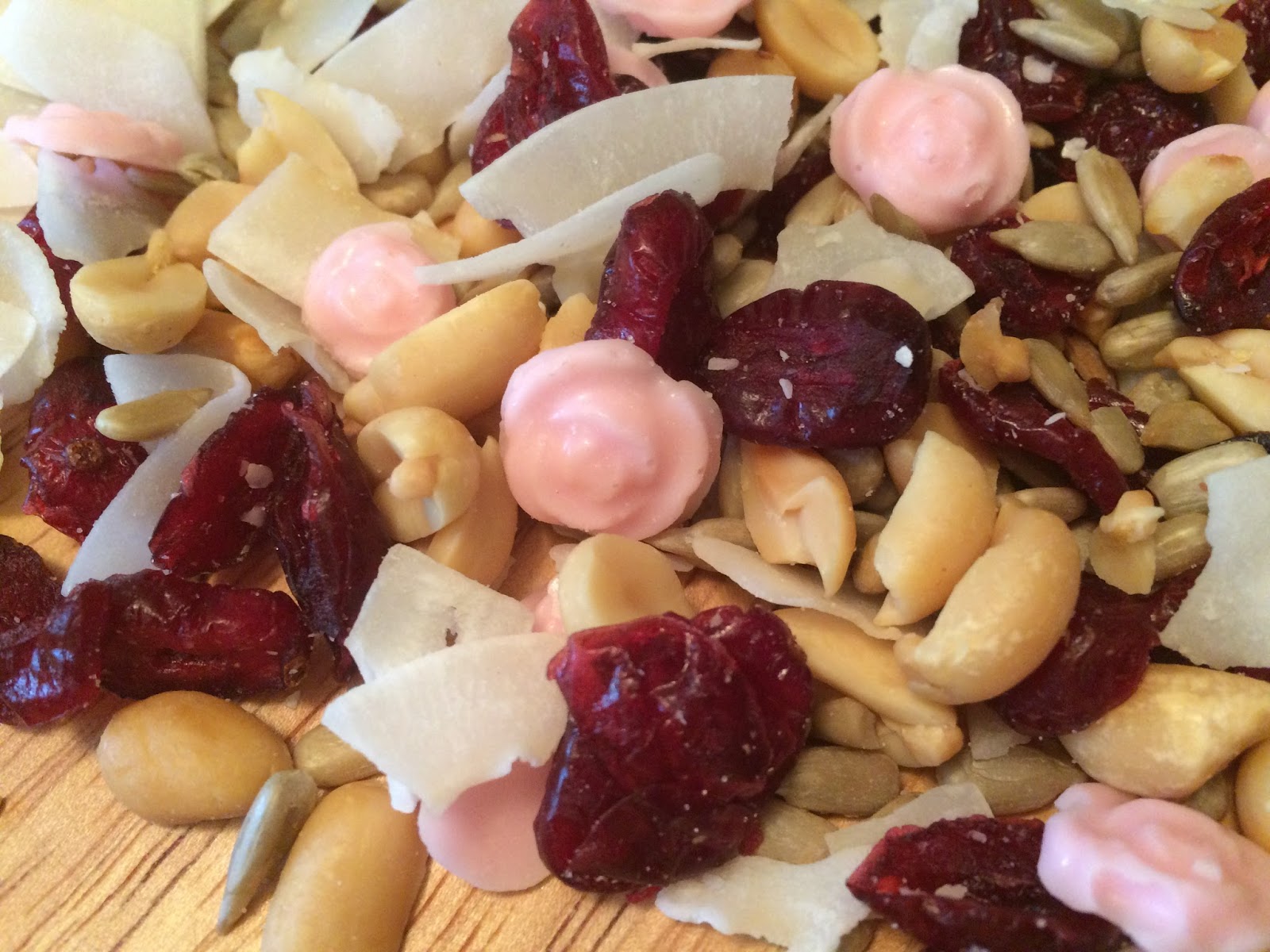
This summer I came across this cute candy mold for mini roses. I knew it would be fun for a variety of feast days.  They are cute for decorating cakes or cupcakes or just offering plain to snack on.  But The diminutive size reminded me of chocolate/baking chips and the idea of a rose themed trial mix came to mind. I had seen a Valentine themed trail mix recipe, with reds and whites added to the nuts. Based on St. Therese's shower of roses, I changed it to a "trail of roses".

The mix, which I made for St. Therese's (The Little Rose) feast day, would easily fit a variety of other feast days associated with the theme of roses. These are some saints associated with roses or have rose stories (several of which are upcoming this fall and winter):

St. Rita of Cascia (May 22)
St. Elizabeth/Isabel of Portugal (July 5)
St. Rose of Lima (August 23)
St. Therese  (October 1, traditional October 3)
Our Lady of the Rosary (October 7)
St. Elizabeth of Hungary (November 17)
St. Rose Philippine Duchesne (November 18)
St. Juan Diego (December 9)
Our Lady of Guadalupe (December 12)

Trail mix is easy to make and easy to transport, so is a great snack on the go. It is (overall) healthier and an alternative to typical baked or sweet treats for a feast day. I did not use specific measurements, but rather just eyeballed good proportions for each ingredient. Use the ingredients you like and seem fitting for the feast day. I kept it to pinks, whites and lighter colored nuts. The part taking the most time (but still super easy!) was making the candies. Use the manufacturer's instructions. Melt candy melts - I used pink but red or white could be used as well - and pour into molds. Allow time to solidify. It was helpful to place the molds with candy in the freezer for 15 minutes, which allowed the candy to release more easily from the hard plastic molds. 

Trail of Roses Mix


  • Dried cranberries
  • Coconut flakes, unsweetened
  • Rose candy (made with candy molds)
  • Peanuts, roasted & salted
  • Sunflower seeds, roasted & salted
Other possible ingredients for this theme: dried currants, dried cherries, cashews, sliced or blanched almonds, pine nuts, puffed rice cereal, rice chex

Authors note: I will be putting together some specific additional mix combos for the specific rose feasts and adding those here. 


St. Therese, Pray for us!


Pin It

Monday, November 16, 2015

St. Elizabeth Rose Rolls


Roses and bread are both symbols for St. Elizabeth of Hungary (November 17) and St. Elizabeth (Isabel) of Portugal (July 4) so a bread in shape of rose serves as a dual reminder for their feast days. Last year I shared a braided twist rose bread idea but here is another variation on the rose bread for the feasts of St. Elizabeth of Hungary and St. Elizabeth of Portugal. 

This recipe uses the same sweet roll dough from the previous St. Elizabeth Rose Bread idea.

Sweet Roll Dough
1 pkg. dry yeast
½ c. warm water
1/2 c. lukewarm milk (scalded then cooled)
1/3 c. butter, margarine or shortening
1/3 c. granulated sugar
1/2 tsp. salt
1 egg
3 ½ to 4 c. flour

Dissolve yeast in warm water in large bowl. Stir in milk sugar, butter, salt, egg, and 2 cups flour. Beat until smooth. Mix in enough remaining flour to make dough easy to handle. Turn onto lightly floured surface and knead until smooth and elastic. Place in greased bowl, turn greased side up. Cover and let rise in warm place until double, about 1 ½ hours.

Cinnamon Filling
2 T. butter, melted
1/2 c. sugar
2 T. cinnamon 

Mix until all sugar and cinnamon is moistened. 

Make 4 small balls (golf ball size) of dough and roll them out into 3 1/2 inch diameter circles. Overlap dough circles as shown. Sprinkle some of the cinnamon sugar mixture across middle, leaving curved edges clear. 

Roll circles up into rolls as shown. You should end up with rolled dough with both ends fluted. Cut roll in half. 


Place dough in greased muffin tins. Cut/flat end should be down and the pretty, fluted/curved end up. 


Let rise until double (30-40 minutes). Bake in 375 degree oven 14-18 minutes. 

St. Elizabeth, Pray for us!

Pin It

Monday, November 17, 2014

Rose Bread for St. Elizabeth of Hungary


Today, November 17, we celebrate the feast day of St. Elizabeth of Hungary. As a queen she felt that she should care for all her people as if they were her children. She was known for her generosity to the poor. Legend says that on one occasion in the middle of winter she left her castle with her apron filled with bread for the poor. On the way she met her husband. He opened her cape to see what she carried and found her apron full of roses, not bread. When he bent to kiss Elizabeth he found her face transfigured with the radiance of heaven. 

Both roses and bread are her symbols, so as we celebrate her today and recall her charity to the poor, what better way than with a rose shaped bread. Braided bread is associated with many Eastern European countries such as Hungary and while this particular style is referred to as Russian Rose Bread, it seems particularly fitting for St. Elizabeth since it is bread shaped in a rose. It can be filled with either a sweet or savory filling.  
This morning we made a cinnamon rose bread for breakfast. It can be made using a generic bread recipe. In this case I made a sweet bread dough. The recipe and ingredients for this one are similar to those shared a few years ago by Charlotte - Hungarian Cinnamon Bread. The main difference is the shaping technique used to end up with a rose shaped bread here. 

Sweet Roll Dough
1 pkg. dry yeast
½ c. warm water
1/2 c. lukewarm milk (scalded then cooled)
1/3 c. butter, margarine or shortening
1/3 c. granulated sugar
1/2 tsp. salt
1 egg
3 ½ to 4 c. flour

Dissolve yeast in warm water in large bowl. Stir in milk sugar, butter, salt, egg, and 2 cups flour. Beat until smooth. Mix in enough remaining flour to make dough easy to handle. Turn onto lightly floured surface and knead until smooth and elastic. Place in greased bowl, turn greased side up. Cover and let rise in warm place until double, about 1 ½ hours.

Cinnamon Filling
2-3 tbsp. butter, softened
1/4 c. brown sugar
2 tsp. cinnamon 

Roll dough into large rectangle. Spread butter over dough, sprinkle with brown sugar and cinnamon. 
Roll up dough tightly along lengthier side. Pinch edge of dough to seal well. Cut the roll in half lengthwise. 
Starting at the top, cross over the strands in an X, repeat crossover to twist the two lengths together into long braid. 
Wind braided strand into a circle keeping cinnamon slits facing upward. Fan open as needed to create rose/flower petal look. 
Place on bottom of greased springform pan. Add springform pan sides. Let rise until double (30-40 minutes). Bake in 375 degree oven 20-25 minutes. 

Additional idea: Make two, one to keep and one to share, in the spirit of Christian charity of St. Elizabeth. 


St. Elizabeth, pray for us.


Pin It

Monday, September 29, 2014

St. Therese Cupcakes

The end of September marks the beginning of a full week of very popular saint feast days. While it's not very healthy to enjoy dessert every night, there are a few weeks where I make an exception and this is one. For St. Therese of the Child Jesus I always make white cupcakes with roses on top. At least with cupcakes, you can easily share with the neighbors, right?

“When I die, I will send down a shower of roses from the heavens, I will spend my heaven by doing good on earth.” -- Thérèse de Lisieux

~~~~~


Just a note -- there are many more ways to top a cupcake with roses than by creating them with decorator frosting. If decorating just isn't your thing, try the baking aisle at the grocery store to see if they have candy roses for cake decorating. There is a candy store near my home that carries rose-shaped butter mints -- I think those will top my cupcakes this year. Wilton makes a rose mold for molding melted chocolate, and that's a great option. You can also make roses from fruit roll-ups, so there are lots of options and you are not to be put off by the roses!

White Cupcakes

1 cup white sugar
1/2 cup shortening
2 eggs
2 teaspoons vanilla extract
1 1/2 cups all-purpose flour
1 3/4 teaspoons baking powder
3/4 cup milk

Preheat oven to 350 degrees F.
Line a 12-cup muffin pan and a 6-cup muffin pan with paper liners.
In a medium bowl, cream together the shortening and sugar.
Beat in the eggs, one at a time, then stir in the vanilla.
Combine flour and baking powder, add to the creamed mixture and mix well.
Finally stir in the milk and beat until batter is smooth.
Pour or spoon batter into the liners (I like to use an ice cream scoop filled about 2/3).
Bake 15-20 minutes or until they test done with a toothpick.
Cool and frost with desired frosting.

For the St. Therese cupcakes I used a traditional decorator frosting to frost the cupcakes and then make the roses (clear vanilla is not necessary, just use ordinary vanilla extract -- most of the other ingredients you probably have on-hand).

Makes 18 cupcakes.

Pin It

Thursday, August 14, 2014

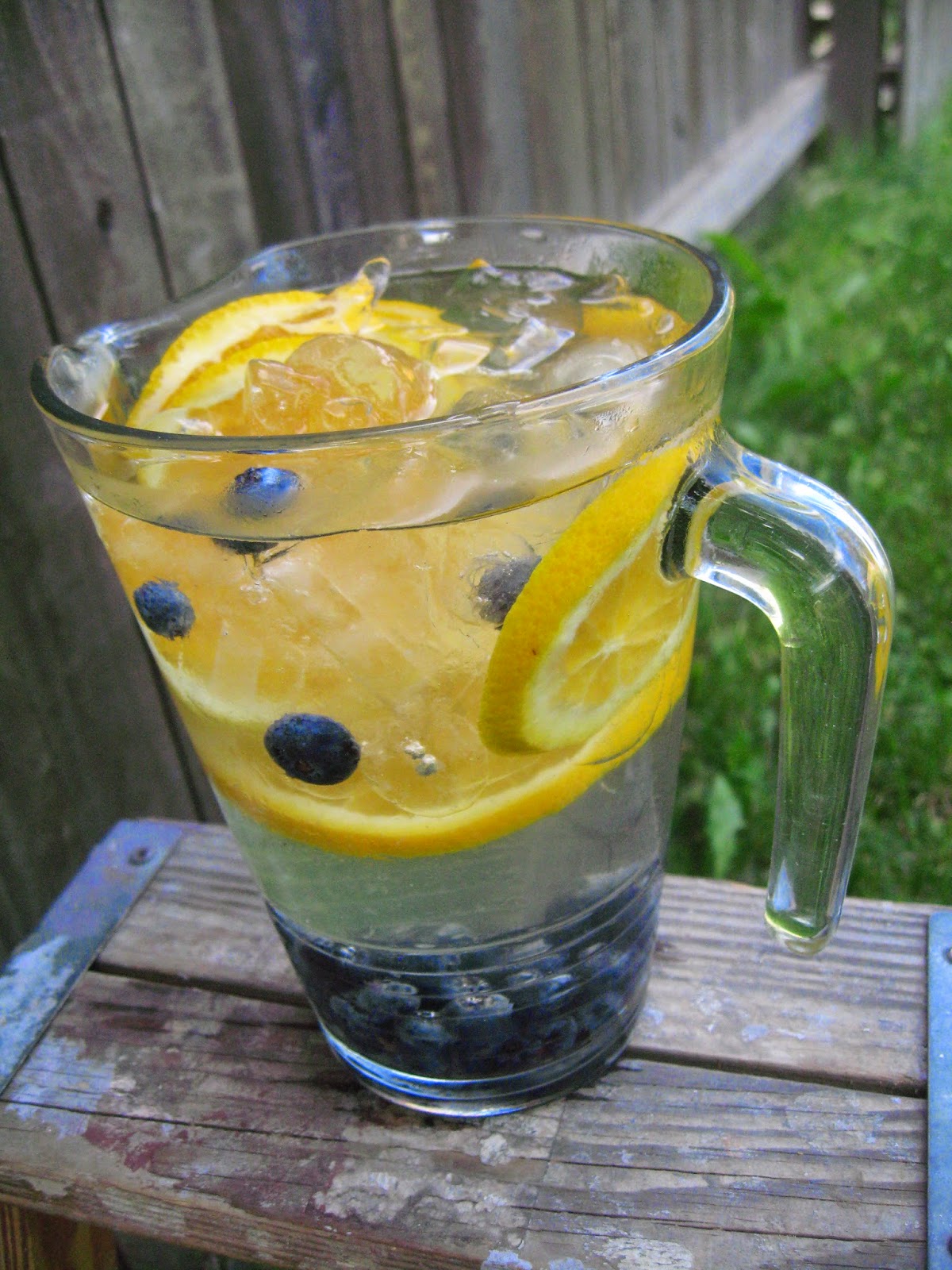
Infused Water - Refreshing Drink for Summer Feasts


Infusing your water with fruits, herbs, or veggies not only adds flavor to the water, but also adds essential vitamins and nutrients that help your body.  It is a great way to quench your thirst and keep you hydrated on a hot, late summer day. They can be helpful for getting children to increase their daily water intake. And they are pretty, too. 

Making your own is more cost friendly and healthier than purchased waters. So join in making some feast day themed waters with a hint of summer flavors for our August saints. 

Making infused water is very simple. Just add desired fruit, veggie, or herb or combination to a pitcher of water with ice. Muddle mixture a bit if you want to increase flavor and let steep for at least several hours, up to 24, depending on how strong you want the flavors.  For some mixtures you can pour directly from pitcher, for others you may want to strain ingredients first to remove small floaters. As long as you keep the water refrigerated, the fruit should stay fresh. And you can keep refilling the pitcher as you drink the water but, it will dilute the flavor each time you refill.  It should last several days before you need to remake with fresh fruit.

One way to make infused water is with a single ingredient. Citrus is a great, no lose option for adding a touch of flavor to water, so it can be a good one to start with.

St. Dominic – Orange

In her recent post for Catholic Culture, Jenn Miller alerted me to the connection of St. Dominic (August 8) to the orange. So orange infused water would be perfect for his feast day.  


You can also make infused waters that combine a variety of fruits, veggies or herbs.

St. Maximilian Kolbe – Coconut Strawberry or Blueberry Orange

Infused waters are simple, no frills refreshers and considering that St. Maximilian Kolbe (August 14) died in a concentration camp it is a simple, non-extravagant treat for an austere remembrance. St. Maximilian had a vision of Mary – she offered him two crowns – red for martyrdom and white for purity and asked which one he would accept.  He chose both. Making a coconut strawberry infusion represents the colors of the two crowns that he was shown and accepted.


Blueberry orange infused water incorporates blue for his Marian devotion and formation of the Militia of the Immaculata movement of Marian consecration. Orange trees and their blossoms are symbolic of purity, chastity and generosity so the addition of oranges for St. Maximilian represents three strong characteristics of this saint who gave his life to take the place of another prisoner.


Assumption – Blueberry Lemon

As mentioned since blue is a universal color associated with Mary, the blueberry is a great fruit to use on Marian feasts. The lemon is a symbol of fidelity in love, and, as such, is often associated with the Virgin Mary in art. A lemon blueberry infused water would be a refreshing addition to this Marian solemnity.

Saint Rose - Raspberry, Rose, & Vanilla

The rose is closely associated as a symbol for St. Rose of Lima (August 23) but could be used, too, for St. Clare (August 11) as she has a rose story. The vanilla bean and raspberries of this recipe don't necessarily represent anything about the saints but were a infused water combination I found with rose that sounds delicious.


Pin It

Tuesday, October 1, 2013

Pasta Roses for St. Therese

Shower your dinner table with delicious edible roses for St. Therese's feast day. This recipe for Rosette di Pasta or Pasta Roses is a variation on the traditional and unique dish from the Emilia-Romagna region of Italy.  The original recipes call for ham and fontina cheese. The finished product is a slightly rosey pasta flowerette. I decided to make some with this more traditional recipe and also a variation using a typical lasagna filling for a deeper color. 

While most of the recipes call for a homemade pasta cut into rectangles, I opted for using regular boxed lasagna noodles. Those were pre-cooked according to directions and then I cut off one edge so they would have a flatter base to set on after they were rolled. 

Ham & Fontina Variation:
On the pasta length I spread a cream sauce (Alfredo), placed thin slices of fontina on sauce, and thin sliced ham over that. 
The layered pasta was then rolled up and set upright in a baking dish, fluted side up. After all the rosettes were in place the additional sauce was poured around the base and brushed over the tops. 

Lasagna Filling Variation:
On the pasta length I spread a layer of ricotta cheese, then covered that with the meat and tomato sauce filling, grated mozzarella was sprinkled on top, and a bit of dried parsley over. 

The remaining sauce was again poured around the base of the completed rosettes. With the ham and fontina variation I cut the lasagna noodles in half before rolling. For these I used the entire length of lasagna noodle and the end product was a much fatter rosette. Both were fine - so it could be done either way.  With a paring knife (or kitchen scissors) make an X cut about 1/2 inch deep into top of each piece to make the roses bloom." Press down slightly to open them a little. 


Bake in 350 degree oven for 20 minutes. Let rest for 5 minutes before serving. 


There are several other filing variations you could use. In addition to being a meal option for St. Therese's feast it could also be used for other saints associated with roses; St. Rose, St. Rita, St. Rose Duchesne. Be creative and enjoy. 

St. Therese of Lisieux,
Pray for Us!

Pin It

Heavenly Garden Apple Rose Pastries


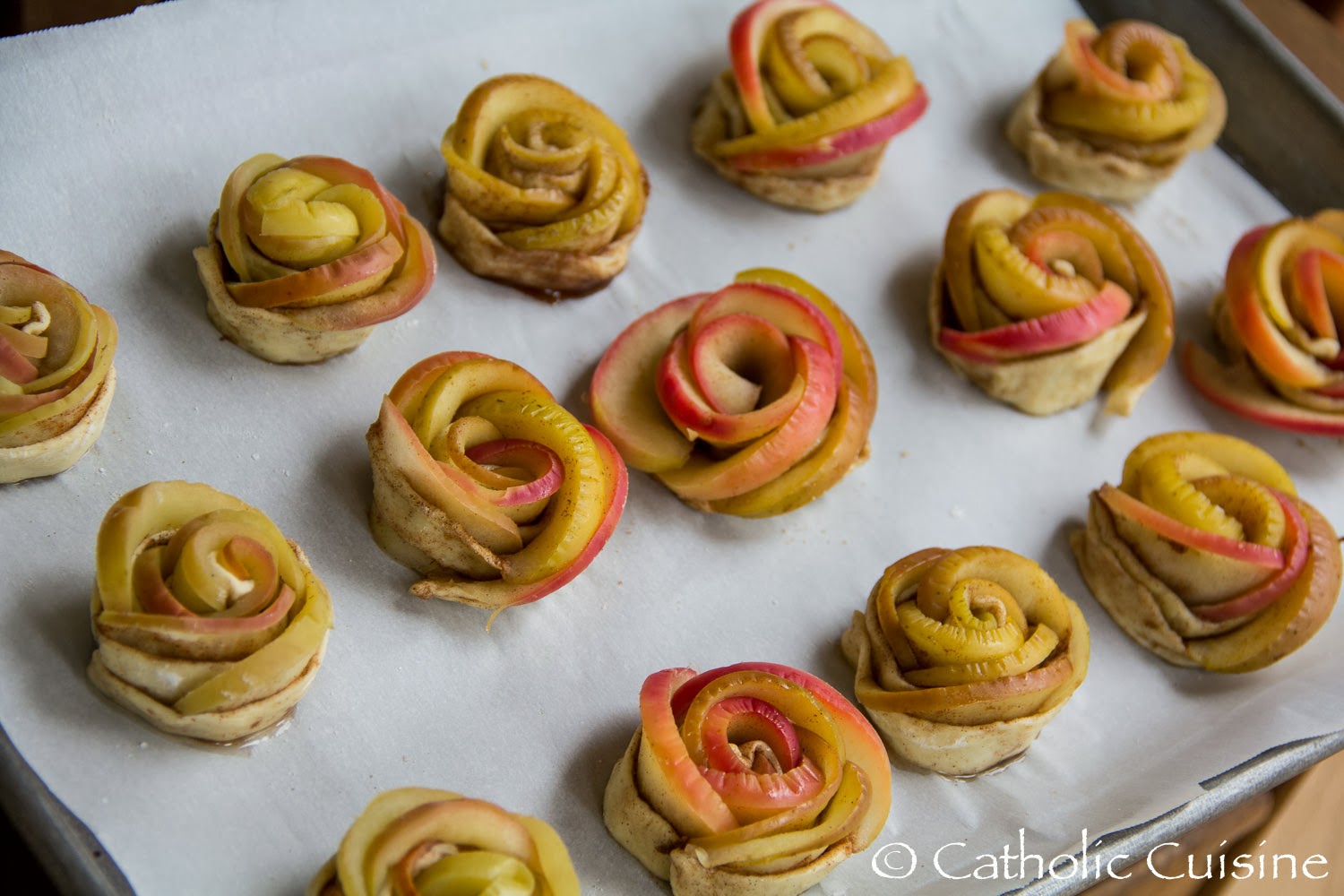
My girls and I enjoyed baking Apple Roses in preparation for the feast of St. Thérèse!  There are many variations of Apple Roses that can be found online, including pies, tarts, cakes and more, but we decided to use the puff pastry sheet we had in the freezer to make the following Apple Rose Pastries.  Happy Feast of St. Thérèse! 


Heavenly Garden Apple Rose Pastries
adapted from here and here

Ingredients:
  • 1 Puff Pastry Sheet 
  • 3 Apples - I used a combination of Fuji and Pink Lady
  • 5 Tablespoons Sugar
  • 2 teaspoons Cinnamon
  • 1 pinch Nutmeg
  • 1 teaspoon Lemon Zest
  • 4 cups Water
  • 3 Tablespoons sugar
  • 2 Tablespoons lemon juice
  • Powdered Sugar for dusting (optional)
  • Parchment Paper

Directions:


Wash and core the apples. Slice in very thin slices, slightly smaller than 1/8 inch.  Place the sliced apples in a saucepan along with the 4 cups water, 3 tablespoons sugar and 2 tablespoons lemon juice. Bring to a boil and let simmer for 2 minutes, or until the apple slices soften and can easily bend. 


Strain the apples and let cool in the colander.  Line a plate with paper towels and nicely arrange the apple slices so that they can dry and cool completely.


While the apples are cooling, mix the 5 tablespoons of sugar with the cinnamon, nutmeg and lemon zest.  Prepare you work surface by lightly sprinkling it with some flour (or just use a silicone mat) and unfold the sheet of puff pastry (it is easiest to work with if it is not completely thawed).  Using a pastry (or pizza) cutter, cut long strips approximately 1/2 inch wide.  Spread the cinnamon mixture over the dough and slightly press it down.


By this time your apples should be cool and almost dry.  Take a few slices and place them on the first strip of pastry dough, overlapping them so they do not fall out and will create a rose-like design (petals) once completed.  Now start rolling, making sure it is fairly tightly rolled.  Place on a baking sheet covered with parchment paper.


Repeat until you have create all of the Apple Roses.


Bake at 425˚F for 25 minutes, or until nicely golden.


Dust with powdered sugar if desired.


St. Thérèse, the little flower, please pick me a rose from the heavenly garden and send it to me with a message of love; ask God to grant me the favor I thee implore and tell Him I will love Him each day more and more. -Rose Novena

Pin It

Wednesday, September 12, 2012

Mystical Rosette Ombré Cake

The following cake recipe and tutorial was submitted by Highlander and Islander, from HI Cookeryin honor of today's feast of the Most Holy Name of the Blessed Virgin Mary.   I love this cake!   I attempted to make a similar cake last December for our youngest daughter, our little "Christmas Rose." It is such a fun cake to make and would also be perfect for the upcoming feast of St. Therese!  


September 12: Feast Day of the Most Holy Name of the Blessed Virgin Mary

Our Lady inspires us to create special cakes in her honor. Last year, we posted our version of a “Stella Maris (Mary, Star of the Sea) Cake.” This year, we made a “Mystical Rosette Ombré Cake,” since one of Mary’s nicknames is the “Mystical Rose.” The name is meaningful to us as we were married at the Mystical Rose Chapel, which overlooks iconic Diamond Head, in Honolulu, Hawaii.

For this particular cake, we used two techniques that are quite trendy today—ombré to create color gradations inside of the cake and rosette piping to decorate and texturize the outside of the cake. The cake has a pretty presentation on its own but when sliced, it reveals the subtle surprise of a blue hue!

Make a “Mystical Rosette Ombré Cake” for the Feast Day of the Most Holy Name of the Blessed Virgin Mary.

Recipe

For the blue ombré cake

  • 2 boxes of white cake mix (for 3 8-inch round cakes) or 3 boxes (for 3 12-inch round cakes)
  • egg whites
  • oil
  • water
  • blue food coloring
  • rose water flavoring (optional to taste; see Notes)
Directions

Grease and flour 3 round cake pans. Prepare the cake mix according to the package instructions, adding a few drops of rose water to flavor the batter (optional). Divide the batter into 3 equal portions. Use the food coloring for each portion, doubling or tripling the amount of the drops to create distinct color gradations.


Pour the batter into the pans (be sure to remember which pan contains light, medium and darker colors). Bake according to the package instructions. Remove from the oven and allow the cakes to cool completely.


For the frosting

(Adapted from Wilton)

  • 1 cup vegetable shortening (we used Crisco brand all-vegetable shortening baking sticks)
  • 1 teaspoon vanilla (we recommend clear vanilla extract)
  • pinch of salt
  • 4-6 cups powdered sugar, sifted
  • 4+ tablespoons of cream, milk or water

Directions

Make 2-3 quantities of the frosting recipe (enough to frost the 3-layered 8- or 12-inch round cakes). In a large mixing bowl, cream the shortening with the vanilla and salt. Gradually add the powdered sugar and beat until smooth. Pour a little bit of liquid to thin it out until the frosting reaches spreadable and piping consistency. Smear a little frosting on the bottom of a cake board and invert the darkest color cake onto it to secure in place. Generously spread frosting on top of this cake.


Layer with the medium color cake on top. Spread frosting on top of this cake. Finally add the lightest color cake on top. Spread frosting on top of this cake and crumbcoat the sides until completely covered.


Outfit a pastry bag with Wilton tip 1M. About an inch from the bottom of the cake, make a rosette by swirling a circle from the center outward. Space an inch apart and repeat until the bottom row of the cake is covered with rosettes. Continue making rosettes on the side of the cake and on top. Refrigerate to set the frosting. Bring the cake to room temperature about half an hour before serving.


Place on a cake pedestal and top with a Mary figurine (optional). Slice to reveal the ombré coloring inside the cake. Use a sharp knife to make the first cut deep into the cake. Wipe the frosting off the knife. Make a second cut into a wedge shape. Serve on plates. Always wipe the frosting off for each cut to make clean slices and showcase the ombré.


Notes

  • Rose water may be found in the specialty baking aisle of grocery stores or at Indian and Middle Eastern food markets. Be careful not to add too much to the cake batter or else the floral flavor will be overpowering.
  • We actually made a “Mystical Rosette Ombré Cake” for a student prayer social to celebrate the Vigil of Mary, Queen of the Apostles (September 5). We made another one for a parish potluck at our church to observe the Nativity of the Blessed Virgin Mary (September 8).
  • Make a Mary cake for her birthday or one of her many feast days. Search our blog for other cake recipes for inspiration and ideas.

Pin It