Showing posts with label St. Francis. Show all posts

Monday, October 2, 2017

Cookies that Remind us of the Stigmata Saints


There are numerous examples of hand shaped sugar cookies decorated with "stigmata" in various places on the internet.  It is hard to track down where the idea originated. It has not been posted on Catholic Cuisine, and I wanted to share the easy version we created. The ones I have seen either used jam/jelly or a frosting to get the effect. I thought an easier alternative would be to just place a red hot in the center of the cut cookie and bake. No need for the more time consuming decorating.


We just passed the feast of one of the most well-known stigmatists, St. Pio of Pietrelcina but are coming up on the feast of St. Francis, the first recorded stigmatist.  St. Francis received his stigmata on the Feast of the Exultation of the Cross in 1224. There is a specific feast to commemorate that event - Septemper 17 though his October feast day is a good time to recall it as well. 

Some of the more well-known stigmata saints:
Gemma Galgani (April 11)
St. Catherine of Siena (April 29)
Veronica Giuliani (July 9)
Feast of the Stigmata of St. Francis (September 17)
St. Pio of Pietrelcina (September 23)
Francis of Assisi (October 4)

There are also many saints who recieved the invisible stigmata or only the crown of thorn head stigmata, including St. Faustina Kowalski, St. Rita of Cascia, St. Mary Margaret Alacoque, St. Rose of Lima.

One could also make these for feast of St. Thomas (who had to touch the wounds to believe) or any days around the Passion of Christ (Good Friday, Holy Saturday). 

The cookies are made using any standard sugar cookie dough recipe or even a prepared refigerator dough from the store. Using a hand (or foot) shaped cookie cutter (or paper pattern for cutting if you don't have a cookie cutter in this shape) cut out the dough. Place a red hot candy in the center of the cookie and bake as directed. And if you prefer there are also the options to decorate with jelly or frosting which give it a more realistic image of bleeding. 

Pin It

Sunday, July 13, 2014

The Lace Cookie - Florentines


With the recent feast of Sts. Zelie and Louis Martin I shared the connection to the lace and lace making. Lace is such a beautiful and delicate textile art and the look can translate to the kitchen to some degree.

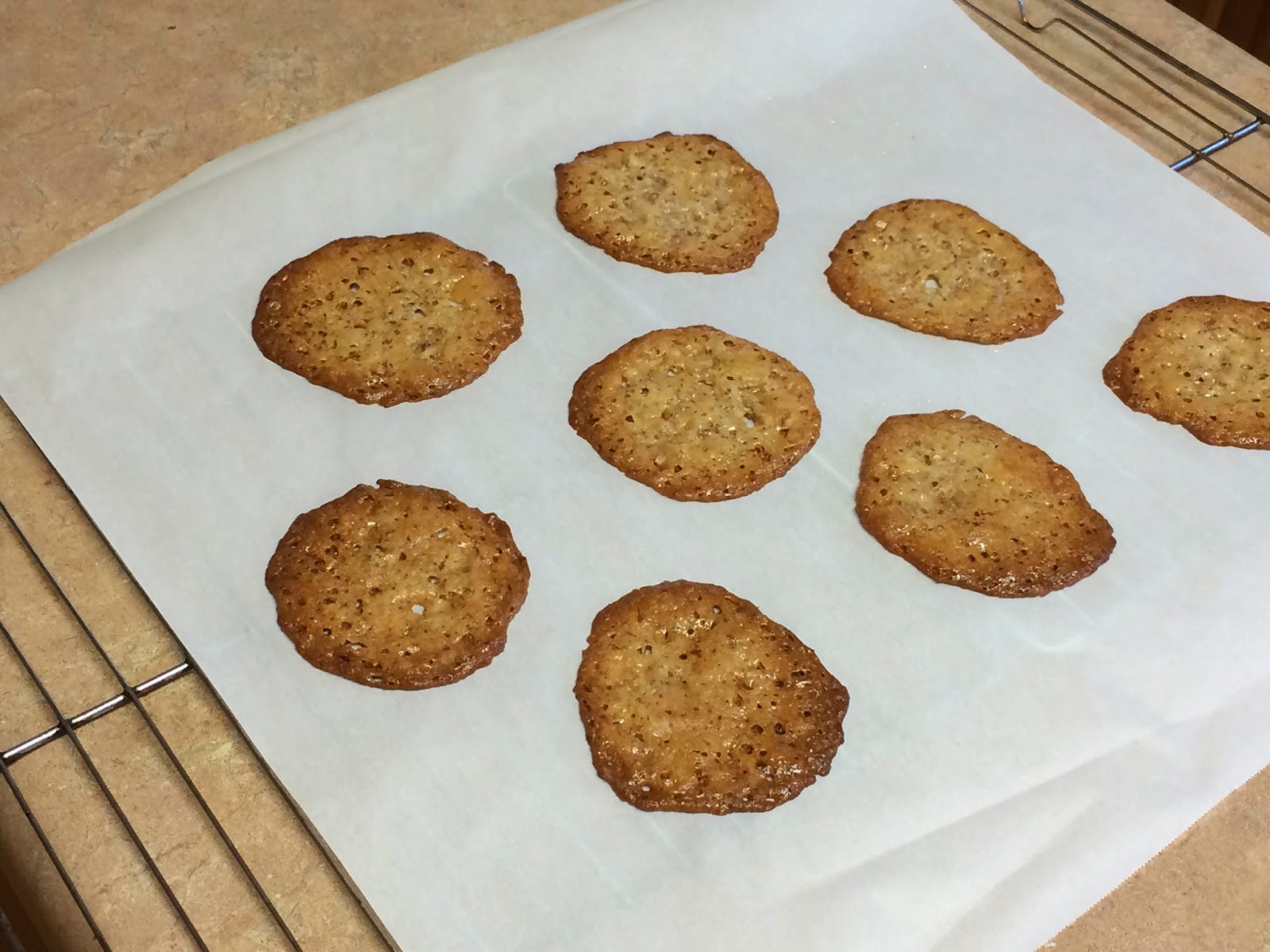
July 13 is the anniversary date of Sts. Zelie and Louis Martin and follows their feast day by one day. So since we are still thinking about the Martins, I am adding an additional lace themed treat idea for today. The florentine is a a cookie commonly called lace cookie because of the natural lacy open hole appearance it gets while baking. There are variations on the cookie but the traditional one is almond or other nut based. Candied fruit, coconut, oats are sometimes used in the variations. Sometimes just a honey/sugar and butter base such as these here.

Florentines

1 3/4 cups sliced, blanched almonds (about 5 ounces)
3 tablespoons flour
finely grated zest of 1 orange
1/4 teaspoon salt
3/4 cup sugar
2 tablespoons cream
2 tablespoons light corn syrup
5 tablespoons butter
1/2 teaspoon vanilla extract


Pulse the almonds in a food processor until finely chopped, but not pasty. Stir together the almonds, flour, zest and salt in a bowl.

Put the sugar, cream, corn syrup and butter in a small saucepan and cook over medium heat, stirring occasionally, until mixture comes to a rolling boil and sugar is completely dissolved. Boil for 1 minute. Remove from heat and stir in the vanilla. Add sugar mixture to almond mixture and stir just to combine. Cool for 30 minutes.

Scoop rounded teaspoons (for 3-inch cookies) or rounded tablespoons (for 6-inch cookies) of batter and roll into balls. Place on baking sheet lined with parchment paper, leaving about 3 to 4 inches between each cookie. They will spread considerably in oven.


Place in preheated oven - 350 degrees. Bake 1 pan at a time, until the cookies are thin and an even golden brown color throughout, rotating pans halfway through baking time, about 10 minutes. Cool on baking sheet for 5 minutes, then transfer to racks to cool.

You can serve plain or drizzle with chocolate. You can also put a filling (jam, cream, chocolate, ice cream) between two cookies for a sandwich style. 
Pin It

Saturday, July 12, 2014

Saint Zélie Martin Lace Effect Sugar Cookies

“The good God gave me a father and mother more worthy of Heaven than of earth.”

Written by St. Thérèse of Lisieux of her parents, Sts. Louis and Zélie Martin, who married on July 13, 1858 and whose feast is celebrated today, July 12.

The couple were married for nineteen years before Zélie’s death from breast cancer in 1877. They created a close, caring, family home, where love of God and neighbor were taught and practiced. It was in and by marriage that Louis and Zelie were to gain their own sanctification and set a heroic example for others. Their example illustrates how marriage can be a starting point of the journey to holiness made in the company of a spouse.  St. Louis Martin and St. Zélie Martin were canonized as a couple in October 2015. First time in history that a married couple has been canonized together.

Marie Azelia (known as Zélie) Guerin was born near Alencon France in 1831. This is an area of France renowned for its beautiful lace making.  Zélie was an accomplished lace maker in the tradition and style of the region.  After she married Louis Martin in 1858, they settled in Alencon and conducted their businesses where Louis took on the business management of Zélie’s lace making enterprise.  An example of her beautiful lace can be seen here. 

This is a simple idea to incorporate a touch of subtle lace effect into a cookie for the feast day. Using any sugar cookie recipe, just roll out the dough and cut out basic shaped cookies. Keep the dough a little thicker than you would normally when you cut the cookie as you will be pressing down lace and it will flatten slightly. Place a lace or crochet doily (or any piece of lace with large, deep design would work) over the cookie dough and roll gently but with enough pressure to press the design into the dough. 


Remove lace, place cookies on baking sheet and bake until golden.


As mentioned any sugar cookie recipe (or even pre-prepared refrigerator brands) could be used. If you are looking for a good sugar cookie recipe, I like this one from a Midwest parish cookbook.

Sugar Cookie Dough Recipe
  • 2 ¾ C. sifted flour
  • 1 t. baking powder
  • ½ t. salt
  • ¾ C. butter or margarine
  • 1 C. white sugar
  • 2 eggs
  • 1 t. vanilla

Put softened margarine in large bowl of mixer. Add sugar, eggs, and vanilla. Beat until mixture is light and fluffy. Mix in flour, baking powder, and salt. Blend until smooth. Chill at least one hour. Roll small amount of dough at a time on floured board. Cut into desired shapes. Put on ungreased cookie sheet. Bake at 375 degrees for 8-10 minutes.

While St. Zélie was specifically a lacemaker by trade, there are numerous saints who are listed as patrons for lacemaking and lacemakers. These cookies would be a fitting addition for a treat on any of their feast days. 

St. Zelie, Pray for Us!


Pin It

Monday, April 28, 2014

Italian Flag-Shaped Caprese Salad

Here's an idea for any Italian Saint's Feast Day or Papal Celebration!  We used this idea to celebrate the Canonization of JPII and John XXIII this past weekend at the same time as we gathered for our Rome Pilgrimage Reunion.
 
Caprese salad is a common salad entrée found in Rome so we thought it quite fitting for an Italian feast! 
 
Don't forget that both St. Catherine of Siena and St. Francis of Assisi are the 2 Patron Saints of Italy...It would be quite fitting for their feast days as well:)
It's very simple to put together and even more festive in the shape of the Italian flag!
Ingredients:
Typically, Caprese consists of  sliced tomatoes, fresh mozzarella and basil leaves, drizzled with extra-virgin olive oil and sprinkled with salt and pepper. It's that easy and it's so fresh and delicious!
*I used a fresh mozzarella log and Roma tomatoes for the flag so the shapes would correspond in size.*
 
Depending on your taste, balsamic vinegar may be added or a different blend of spices.  Dining in Rome, we rarely experienced it being served with vinegar.
Instructions:
Wash and gently dry fresh basil leaves and set aside.  Slice fresh mozzarella log and tomatoes of choice.  (We used Roma) Arrange according to flag colors, drizzle with olive oil, and sprinkle with salt and pepper.
Buon appetite!
 

Pin It