Showing posts with label Cookies. Show all posts

Saturday, May 22, 2021

Snickerdoodles for the Humorous Saint, Philip Neri


St. Philip Neri (feast day May 26), is known by many names including the “laughing saint,” the “humorous saint,” and the “patron saint of joy.” This Italian priest and founder of the Congregation of the Oratory was a practical joker, as exemplified by him showing up to an event with his beard half shaved off. He inserted humor into his homilies, was known to keep a joke book, and also hung a sign on his door that said, “The House of Christian Mirth.” In all things St. Philip maintained a light-hearted view of the world, using humor to keep him from being too prideful or vain. 

For St. Philip's feast day don't take yourself to seriously...and enjoy some snickerdoodles, the cookies with the funny name that sounds like they are laughing. 


Snickerdoodles 
Ingredients: 

1 cup butter or margarine, softened 
1 ½ cups sugar 
2 eggs 
2 ¾ cup flour 
2 t. cream of tarter 
1 t. baking soda 
¼ t. salt 
Cinnamon-Sugar Mixture: 
1/4 cup Sugar 
1 1/2 tbsp. cinnamon 

Instructions: 
Preheat oven to 375 degrees. Thoroughly cream butter and sugar until light and fluffy. Add the eggs and cream together. Stir in flour, cream of tartar, baking soda, and salt, just until combined. In a small bowl, stir together sugar and cinnamon. Roll dough into small balls until round and smooth. Drop into the cinnamon-sugar mixture and roll to coat well. Place on ungreased sheet or parchment lined cookie sheet. Bake 8-10 minutes or until set. 

 “A heart filled with joy is more easily made perfect than one that is sad.” 

 St. Philip Neri, patron of joy, Pray for us 


Additional Note: There are other saints who saw the value and importance of humor - St. Francis of Assisi, St. Teresa, St. Ignatius, and St. John Vianney to name a few. Check out this Catholic Exchange article for some insight into other saints whose feast days would be also be opportunities to partake of some snickerdoodles.


Pin It

Tuesday, January 14, 2020

Hermit Bars to Remember the Hermit Saints


Old-Fashioned Hermit Bars are a classic New England cookie that are spicy and sweet thanks to addition of cinnamon, ginger, nutmeg, and cloves. There are several variations, but the basic cookie/bar is full of spices and dried fruits (usually raisins). Origin of the name for these spicy bars is not known - and several theories exist, including that they look like a rough brown hermit's robe. Regardless of the origin, the name is intriguing as it evokes the idea of the hermit saints - those who isolated themselves from society to live a life of asceticism. There is a tradition of holy hermits (Eremites, "inhabitants of a desert" from the Greek eremos). Several well known hermit saints have January feast days: St. Simon Stylites (January 5) and St. Paul, the first Christian hermit (January 15) and St. Anthony of the Desert (January 17), father of Western monasticism. And while a life of asceticism would not include indulgent sweets, in this week of two great hermit saints, you can still enjoy some hermit bars or cookies. 

Old-Fashioned Hermit Bars  

Ingredients
2 cups flour
2 tsp baking soda
1½ tsp cinnamon
2 tsp ground ginger
½ tsp ground nutmeg
½ tsp ground cloves
½ tsp salt
½ cup butter
1 cup brown sugar 
¼ cup molasses
1 egg
2/3 cup chopped raisins (or other dried fruit, ie cranberries)
1 cup powdered sugar
5 tsp milk

Instructions
In bowl combine together the flour, baking soda, spices, and salt. Set aside.

In a large bowl cream butter and sugar until light and fluffy. Add the molasses and egg and continue to mix. Gradually add the flour and spices mixture until just combined. Stir in the raisins.

Chill the dough for 30 minutes.  While the dough chills, preheat the oven to 375° and grease a large baking sheet or line with parchment paper.

After chilling shape it into a ball and divide in two. Shape each half into a log, 12 inches long and arrange on the prepared baking sheet, leaving at least 3 inches between the logs. Press down lightly on the tops of the logs with your fingertips to give them a slightly squared-off shape.


Bake on the center rack for 15 minutes, or until the edges are just barely crisp.

While bars are cooling, combine the powdered sugar and milk until smooth but not too runny. Drizzle over the baked logs while they are slightly warm.

Allow the icing to firm up then cut into bars.

[Variations on the hermit cookie genre can include drop cookies or flatten the dough in a baking dish for brownie style.]

There are so many hermit saints of the Church, that Hermit Bars can be a feast day item throughout the year. 

St. Paul, the Hermit - Pray for Us!
St. Anthony of the Desert - Pray for Us!
Pin It

Monday, July 1, 2019

St. Junípero Serra's Black Mission Figs

Fig Cookies and The Mission Bell (OOP) - The story of Father Junipero Serra's travels in the California wilderness, of his interest in the Indians and of his building of the missions.


July 1st is the feast day of St. Junípero Serra who was canonized a saint on September 23, 2015. You can find lots of other ideas in the Commemorating the Canonization of Junípero Serra post over at Shower of Roses. 

The Black Mission Fig was named after the mission fathers who planted the fruit as they made their way north along the California coast! Black Mission Figs or fig filled cookies (Trader Joe's Fig Bites, Fig Newtons, etc) would make an easy and simple treat for today.


Black Mission Figs from Trader Joe's


St. Junípero Serra, Ora Pro Nobis!

Pin It

Friday, April 6, 2018

Lady Kisses for Lady Day


The solemnity of the Annunciation is also known in some places as Lady Day. When I first saw these little bite-sized Italian cookies called, baci di dama or "lady’s kisses", I thought of them as an option for this day - Lady Day. I can imagine them being Our Lady's kisses - kisses Our Lady would have bestowed on her sweet son. The name originates from the cookie’s resemblance to two lips holding together like a kiss. These Italian cookies are common for feast days in Italy - especially St. Joseph. Most years St. Joseph's feast day and the Annunciation are a week apart, so making double at that time could cover both feasts. Though this year the feast is abrogated to April 9 because its traditional date fell on Palm Sunday. 
The outer cookies are delicate and usually made of almond or hazelnut flour. The hazelnut version is from the city of Cuneo (where Nutella comes from), and the almond ones are from the town of Tortona.  There are some different variations of the recipe available. This is adapted from the Martha Stewart recipe. 
Our Lady's Kisses
Ingredients:
2/3 cup sugar
1/2 teaspoon vanilla extract
1/4 teaspoon lemon zest, fine
2/3 cup almond (or hazelnut) flour
3/4 cup unbleached wheat flour
pinch of salt
2 ounces semisweet chocolate chips, chopped

Directions:
Preheat oven to 325 degrees. Beat 7 tablespoons butter with sugar on medium-high speed until light and fluffy, about 3 minutes. Add vanilla and lemon zest, then both flours and salt; beat until a dough starts to form. Transfer to a work surface; knead until a firm dough forms, 1 minute.

Scoop 1 level teaspoon of dough; roll into a ball. Place on a rimmed baking sheet lined with parchment. Repeat with remaining dough, spacing balls 1 inch apart. Place in freezer about 15 minutes, until firm.  Melt chocolate and remaining 1 tablespoon butter. Let cool until thick and spreadable.

Bake cookies until domed and light golden, about 16 minutes. Let cool completely. Spread 1/2 teaspoon chocolate mixture on flat side of one cookie; sandwich with flat side of a second. Repeat with remaining cookies. Let chocolate set before serving.

I found this litany poem by G.K. Chesterton which speaks of a kiss and the mystic rose – a reference to Mary (as are all the symbols in this poem). So beautiful and definitely brings to mind the image I was imagining between Mother and the Child Jesus. 

A Little Litany by Gilbert Keith Chesterton
When God turned back eternity and was young,
Ancient of Days, grown little for your mirth
(As under the low arch the land is bright)
Peered through you, gate of heaven—and saw the earth.

Or shutting out his shining skies awhile
Built you about him for a house of gold
To see in pictured walls his storied world
Return upon him as a tale is told.

Or found his mirror there; the only glass
That would not break with that unbearable light
Till in a corner of the high dark house
God looked on God, as ghosts meet in the night.

Star of his morning; that unfallen star
In that strange starry overturn of space
When earth and sky changed places for an hour
And heaven looked upwards in a human face.

Or young on your strong knees and lifted up
Wisdom cried out, whose voice is in the street,
And more than twilight of twiformed cherubim
Made of his throne indeed a mercy-seat.

Or risen from play at your pale raiment's hem
God, grown adventurous from all time's repose,
Or your tall body climbed the ivory tower
And kissed upon your mouth the mystic rose.

Note: I also think these little cookies would be fitting for the feast of St. Mary Magdalene (July 22) as she is believed to be the woman who washed with her tears, anointed with oil and kissed the feet of Christ. She is often depicted kissing Christ's feet. Lady Kisses could represent her as well.


Pin It

Monday, October 2, 2017

Cookies that Remind us of the Stigmata Saints


There are numerous examples of hand shaped sugar cookies decorated with "stigmata" in various places on the internet.  It is hard to track down where the idea originated. It has not been posted on Catholic Cuisine, and I wanted to share the easy version we created. The ones I have seen either used jam/jelly or a frosting to get the effect. I thought an easier alternative would be to just place a red hot in the center of the cut cookie and bake. No need for the more time consuming decorating.


We just passed the feast of one of the most well-known stigmatists, St. Pio of Pietrelcina but are coming up on the feast of St. Francis, the first recorded stigmatist.  St. Francis received his stigmata on the Feast of the Exultation of the Cross in 1224. There is a specific feast to commemorate that event - Septemper 17 though his October feast day is a good time to recall it as well. 

Some of the more well-known stigmata saints:
Gemma Galgani (April 11)
St. Catherine of Siena (April 29)
Veronica Giuliani (July 9)
Feast of the Stigmata of St. Francis (September 17)
St. Pio of Pietrelcina (September 23)
Francis of Assisi (October 4)

There are also many saints who recieved the invisible stigmata or only the crown of thorn head stigmata, including St. Faustina Kowalski, St. Rita of Cascia, St. Mary Margaret Alacoque, St. Rose of Lima.

One could also make these for feast of St. Thomas (who had to touch the wounds to believe) or any days around the Passion of Christ (Good Friday, Holy Saturday). 

The cookies are made using any standard sugar cookie dough recipe or even a prepared refigerator dough from the store. Using a hand (or foot) shaped cookie cutter (or paper pattern for cutting if you don't have a cookie cutter in this shape) cut out the dough. Place a red hot candy in the center of the cookie and bake as directed. And if you prefer there are also the options to decorate with jelly or frosting which give it a more realistic image of bleeding. 

Pin It

Monday, September 25, 2017

Beautiful Cookies for the Feast of St. Thérèse

These cookies, in honor of St. Thérèse, were submitted by LaDawn Wilson. Thank you, LaDawn! 


These cookies work well for St Therese's feast day. She has been by my side, while raising the children and taught me how to use my creativity and work toward being "little." Still working on that part. :)

I painted the roses on the teacup cookies with gel food coloring and lemon extract, to make a watercolor look. Above the cookies are pastel marshmallows I dipped in chocolate and wrapped to look like a rose.


Pin It

Thursday, November 17, 2016

Christ the King Cookie Crowns


The Feast of Christ the King is a moveable feast. It is celebrated on the final Sunday of the liturgical year, which is the last Sunday before Advent begins.

Decorating crown shaped cookies is a fun activity for children to celebrate this feast! You can use store bought cookie dough, or make your own, and if you don't happen to have a crown cookie cutter, just cut out your own crowns freehand or using a printable template. Here is Charlotte's simple recipe from her Cookie Masks for Mardi Gras:

Cut-Out Cookie Dough

Ingredients:
  • 1/2 C. butter
  • 3/4 C. sugar
  • 1 egg
  • 1/4 Tbl. Vanilla or almond
  • 1/4 Tbl. butter extract
  • 1 3/4 C. flour
  • 1/2 tsp. baking powder
  • 1/4 tsp. salt

Directions:

Cream butter and sugar. Add eggs and flavorings and mix well. Stir flour, baking powder and salt together. Add to batter and mix well. CHILL 3-4 hours or overnight before using.

Roll cookies out approximately 1/4 inch thick. Bake cookies at 350 degrees F (175 degrees C) for 8-10 minutes. This dough keeps well in a covered container in the refrigerator for a couple of weeks.

Decorate with Cookie Icing and sprinkles.

Pin It

Sunday, November 13, 2016

St. Rose Philippine Duchesne "Oak" Cookies


St. Rose Philippine Duchesne was born in France in 1769 and entered the Visitandine convent when she was 19 where she lived until it was shut down during the French Revolution's Reign of Terror. Following the revolution, along with foundress St. Madeleine-Sophie Barat, she was a prominent early member of the Religious Sisters of the Sacred Heart of Jesus, and founded the congregation's first communities in the United States. She spent the last half of her life teaching and serving the people of the Midwestern United States, and had a particular dedication to the people of the Potawatomi tribe who named her Woman Who Prays Always.

Because the French word for “oak” is chêne (and du chêne means “of oak”), symbols of oak leaves and acorns are often seen in Sacred Heart schools in America to recall the name of the woman who pioneered Sacred Heart education in the New World. 
Oak shaped sugar cookies make a nice tribute to St. Rose Philippine Duchesne for her feast day, November 18. These were made using this Ann Clark oak leaf cookie cutter, but there are a variety of oak leaf cutters (& acorn ones) available for sale and any could be used as a symbol for this saint.  Any traditional rolled sugar cookie dough would work for this recipe. This is the sugar cookie recipe I use. Make frosting in desired colors. Since she has a fall feast day, I included autumn colors. Make leaf veins in the frosting with a toothpick. 

St. Rose Philippine Duchesne, Pray for us!

--> Pin It

Thursday, October 27, 2016

St. Simon (& Jude) Saw Cookies


St. Simon, the apostle (who shares tomorrow's October 28 feast with St. Jude) is often pictured with a saw in paintings or on statues.  It is one of his chief symbols since he was said to have been martyred by being cut in half with a saw.  As we recall this feast day of St. Simon the Zealot, sugar cookies decorated like saws are a good way to illustrate that symbol. Use the sugar cookie recipe of your choice or this one published in past at Catholic Cuisine which is the standard one I use.


This is the cookie cutter that was used.


I made a decorator frosting and tinted it brown and grey to replicate the colors of a saw.

Cookies are always a fun way to incorporate saint symbols. Enjoy.


St. Simon, Pray for us!

Pin It

Wednesday, October 5, 2016

Beautiful Cookies for Our Lady's Many Feast Days

These cookies were submitted by LaDawn Wilson in honor of Our Lady. Thank you, LaDawn!


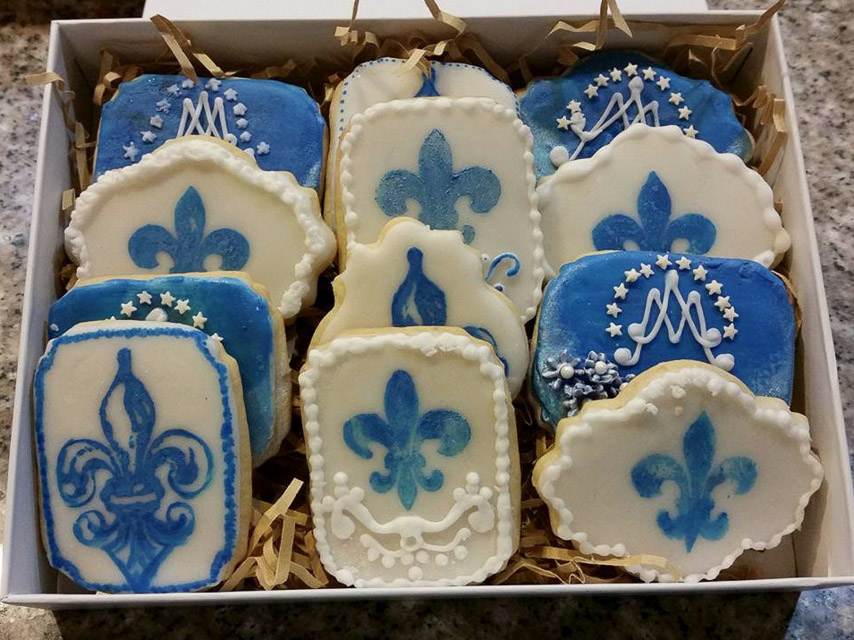
With Mary's birthday, Our Lady of Sorrows, and soon Our Lady of the Rosary feast days in such close proximity, I could not get her out of my mind. (Thank goodness, right?). I have been working with sugar veil and finally figured out how to get it out of its mold without it ripping. It is true what they say about sugar veil, Find a spot in your home where it works. Trial and error, for sure.

The trinkets are just fondant I sprayed with edible gold. The background on the fleur de lis was stenciled with the same spray.


I highly recommend Sweet Ambs site for sugar veil tutorials and buying information. She also mentions Haniela's tutorials, which have been extremely helpful.

You can find additional ideas for the Blessed Virgin Mary and the feast of Our Lady of the Rosary in the archives. 

Pin It

Saturday, August 13, 2016

Assumption Cookies

These beautiful cookies, in honor of the Feast of the Assumption of the Blessed Virgin Mary into Heaven celebrated on August 15th, were submitted by LaDawn Wilson who shares, "I homeschooled six children for over twenty years. I now have three grandchildren I can bake for each week. I enjoy revolving most of my creativity around feast days and the children's birthdays." Thank you, LaDawn! 


Assumption Cookies

"The cookies are a basic sugar cookie recipe but I added lemon emulsion and poppy seeds.
I used two stamps for the fleur de lis. I like to paint directly on the stamp using AmeriColor Gels and then stamp the cookie on completely dried white glaze. Royal icing is used for the white borders and Ave Maria symbol. The tiny flowers are made from fondant."


Pin It

Tuesday, July 12, 2016

A Simple Treat for the Feast of Sts. Louis & Zélie Martin


Happy feast of Sts. Louis & Zélie Martin!  Today is the first time we celebrate their feast as canonized saints! I had hoped to have time to bake another French Vanilla Cake and Cupcakes in Honor of the Watchmaker and Lace Maker but our schedule was too full and I had to simplify. After searching through the pantry I decided to simply twist open some Oreo cookies, decorate each as a "watch face" using some melted chocolate, and then serve them on top of small rose covered lace paper doilies.


Tip: After twisting open the cookies, scrape off any cookie crumbs with the smooth side of a knife.


I just cut off the corner of a snack baggie and squeezed the melted chocolate through the small hole to decorate each cookie. Not perfect by any means, but my little ones loved them!  You can see the rest of our celebration over at Shower of Roses


Sts. Louis & Zélie Martin, pray for us! 

Pin It

Tuesday, March 15, 2016

Celtic Knot Graham Cookies


This graham flour cookie is a festive treat for St. Patrick's Day or any other Irish saint feast day tea party. 

Celtic Knot Graham Cookies


Ingredients:

2 cups all-purpose flour
1 1/2 cups graham flour
3 tablespoons graham cracker crumbs
1 teaspoon baking soda
1/2 teaspoon salt
2 sticks unsalted butter, at room temperature
1 cup brown sugar
1/2 cup molasses
1 large egg
1/2 teaspoon vanilla extract

Directions:

Sift flours, baking soda and salt into large bowl.  Beat butter in another large bowl at medium speed until smooth and creamy, about 2 minutes.  Add brown sugar and beat together. Add molasses and beat until fluffy.  Add egg and beat until well blended.  Reduce speed to low and add vanilla.  Add flour mixture and graham cracker crumbs and beat on low speed just to blend.

Wrap ball of dough in plastic wrap.  Chill until firm, at least 4 hours and preferably overnight.
Sprinkle work surface with flour and roll out 1/2 of dough. Refrigerate unused portion.

Roll lengths of dough into ropes and, working on a parchment-lined baking sheet, twist them into knots as shown.  I printed out a 3 inch celtic knot clipart to use as a template and place under the parchment paper. 


Bake in pre-heated oven (350° F) for 8-12 minutes.  Let cool on pan until firm enough to transfer to wire racks. Sprinkle with powdered sugar. Cool completely.  Makes about 2 dozen, 3-inch knot cookies.


Pin It

Monday, January 4, 2016

Italian Epiphany - Befanini


It is interesting to discover the various traditions of the Christmas season from around the world. My interest in Italian culture increased this year since my daughter spent a semester abroad in Florence. The Italians have the tradition of La Befana, the old woman. In folklore, Befana visits all the children of Italy on the eve of Epiphany (Jan. 6th) to fill their socks with candy and presents if they are good or a lump of coal or dark candy if they are bad. The name Befana is derived from the word epifania, the Italian name for Epiphany (Greek). One traditional treat made for Epiphany in Italy, particularly Tuscany region, is a sugar cookie called Befanini.

Befanini - Italian Epiphany Sugar Cookie

Ingredients:
  • 3 cups flour
  • 1 ½  cups sugar
  • 6 ounces butter (softened)
  • ½ cup of milk
  • 3 eggs plus 1 for the egg wash
  • Zest of half lemon
  • 1 tablespoon baking powder
  • pinch salt
  • 2 tablespoon of Sambuca or Rum
  • multicolored sprinkles

Directions:
In mixing bowl, combine the flour and the sugar.  Add the softened butter and mix.  Add the eggs and continue mixing.  Now add the lemon zest, the baking powder, the salt and the liqueur.  Mix on medium speed adding the milk as necessary to make a smooth dough.  

Transfer the dough to floured pastry board and knead to form a ball.  Wrap the dough and refrigerator for 30 minutes.

Preheat oven at 350 degree.  Add flour to working surface and around your rolling pin. Roll out the dough to 1/4 inch thick.  Use cookie cutters in different shapes to cut your cookies.  Stars are especially appropriate for Epiphany.

Place on the cookie sheet lined with parchment paper. Make an egg wash with one egg and a bit of milk. Brush the cookies with the egg wash mixture and add sprinkles.


Bake for 10-12 minutes at 350 until nice gold color.  Remove from oven and transfer to a cooling rack.  Makes about 5 dozen.
Pin It

Thursday, April 16, 2015

Viking Shield Cookies for the Feast of St. Magnus


The feast of St. Magnus, Earl of Orkney, is celebrated on April 16th. To celebrate his feast this year I made some quick and easy Viking Shield Cookies with a few ingredients I happened to have in my cupboard. You can find additional photos, prayers, and book suggestions over at Shower of Roses


Ingredients:
  • Fudge Stripes, Dark Chocolate 
  • White Candy Melts, melted
  • Hershey Kisses

Directions:


Unwrap the Hershey Kisses and place one over the center of each Fudge Stripes cookie. 


Place the melted candy (or melted white chocolate chips) into a baggie and clip off the corner with a pair of scissors leaving a small hole. Squeeze some melted candy onto the bottom of each Hershey kiss to attach them to the cookie.


Add additional dots of melted candy around the outside of the shield. Let dry. 


Happy Feast of St. Magnus! 

Pin It

Monday, January 19, 2015

Altagracia Cookies

This post was written by Catholic Cuisine contributor, Charlotte from Waltzing Matilda

Legend says that the pious daughter of a rich merchant asked him to bring her a portrait of Our Lady of Altagracia from Santo Domingo, but no one had heard of that title. The merchant, staying overnight at a friend's house in Higuey, described his problem as they sat outdoors after dinner. An old man with a long beard, who just happened to be passing by, pulled a rolled up painting from his bindle, gave it to the merchant, and said, "This is what you are looking for." It was the Virgin of Altagracia. They gave the old man a place to stay for the night, but by dawn he was gone, not to be seen again. The merchant placed the image on their mantle, but it repeatedly disappeared only to be found outside. They finally returned it to the church. 

In the picture book, A Gift of Gracias, by Julie Lavarez, a connection is made between this special feast day and oranges. These Orange Carrot Cookies would be a delightful treat for the Feast of Our Lady of Altagracia, coming up on January 21st, especially paired with a reading of the book. You can find the original recipe over at Dawn's blog, By Sun and Candlelight. I made a few changes that I will post here. Just FYI, these are soft, almost muffin-top like cookies, not crispy or crunchy cookies.

Altagracia Cookies

1 egg, room temperature
1/2 C. unsalted butter, softened
1/2 - 3/4 C. sugar (I used less.)
1 tsp. vanilla extract
the zest of 1/2 an orange (about 1 Tbl.)
1 C. mashed, cooked carrots
2 C. all purpose flour
1 1/2 tsp. baking powder
(sugar sprinkles, optional)


Preheat oven to 350 degrees. Combine baking powder and flour and set aside. Cream the egg, butter, sugar and vanilla. Add carrots and zest and mix well. Slowly incorporate flour mixture being careful not to over mix. Drop by tablespoons onto parchment covered cookie sheets. Add sugar sprinkles if desired. Bake 10-12 minutes. Remove from oven and let cookies cool on a wire rack. 
Pin It

Tuesday, December 2, 2014

St. Francis Xavier Fortune Cookies


As most of you know, fortune cookies are thin, folded cookies with a paper saying inside. They are associated with Asian restaurants and recipes. I thought it would be fun to make fortune cookies for a saint feast day who has a connection to Asia. In place of fortunes inside the cookies, it would be a good opportunity to put quotes or saying associated with the saint. St. Francis Xavier is an excellent choice as he was a missionary to Japan and China. His feast day is this week, December 3.  St. Francis spent time in the Philippines, India, and Japan, baptizing tens of thousands. He set sail for China but died on the island of Sancian within sight of China. For his travels and zealous missionary efforts in the far east he is associated with that area and is a patron of several of those countries. Other saints that could be included if you were to do this at a different time are St. Paul Miki and the Japanese Matryrs, the Chinese Martyrs, etc.  Now, the actual truth of fortune cookies as being from these Asian cultures is not accurate. It seems that they were first made in the United States for Chinese restaurants. But they are significantly associated with the food of the culture to most of us now, so fit this activity, I believe.

For some saints or martyrs from China and other southeast Asian countries there is little available of their teaching or writing to use as quotes, but St. Francis has some and that is why it made sense to target his feast day initially. Here is a link to a document of quotes that you can download and print off to use for making your fortune cookies. Just print and cut them into strips.

I had previously tried making fortune cookies many years ago and knew that they are a bit tricky. It takes a quick hand to maneuver the cookies before they set and can no longer be shaped. The batter and baked cookie have to be just right, so it won't crack or harden to quickly.  This time, with a couple of early ones for practice, I got the hang of it and they turned out okay.  Don't let this intimidate you. It really was easier than my previous experience.  You can check out some YouTube videos which walk you through the process.  There are slight variations on the ingredients, but this is what I used.

How to make home-made fortune cookies:

Ingredients:
  • 3 tablespoons butter, softened
  • 3 tablespoons sugar
  • 1 egg white
  • 1/2 teaspoon vanilla extract
  • 1/3 cup all-purpose flour

Directions:
  • Print and cut out quotes so they are on small strips of paper. 
  • Line a baking sheet with parchment paper. Draw two 3-1/2-in. circles on parchment paper.
  • In a small bowl, beat the butter, sugar, egg white and vanilla until frothy. Add flour and mix until just blended in. 
  • Spread 1 T. batter over each circle. 
  • Bake at 400° for 4-5 minutes or until lightly browned.
  • Cover one cookie with a kitchen towel (to help keep it soft while working with other). 
  • Loosen other cookie from parchment paper with a thin spatula and flip over onto work surface. 
  • Place a fortune in the center of that cookie.
  • Fold cookie in half over paper so the edges meet and hold edges together for few seconds.
  • Place center of cookie over the rim of a mug.
  • Gently press ends down to bend cookie in middle.  Hold and let set a few seconds. 
  • Set inside muffin tin cup to cool and retain shape. 
  • Repeat with second cookie. 
  • Repeat with remaining batter and paper quotes. 
Yield: 10-12 cookies.

St. Francis Xavier, Pray for us!

Ad Majorem Dei Gloriam


Pin It

Friday, October 17, 2014

St. Luke's Artist Palette Cookies


There is a great article, which was shared over at Catholic Culture today, about St. Luke, Evangelist and Artist written by Jennifer Gregory Miller. She begins by saying that "the month of October is filled with many memorials and optional memorials of saints, but the only two feasts during the month are for St. Luke, Evangelist on October 18, and ten days later Saints Simon and Jude, apostles." She goes on to say that in her family she likes to "emphasize the various "levels" of feast days, and since feasts are higher than memorials and optional memorials, St. Luke will be honored in a special way."

Jenn's article inspired me to plan something extra for the feast of St. Luke this year. I was just telling a friend yesterday that I really need to get started on Tract B of our Art Program for this school year. What better day to kickoff art than on the feast of the patron saint of artists?!  So we are going to get started with "A Little Art Study" as suggested by Jenn, after reading about St. Luke in Lives and Legends of the Saints from our October Book Basket.

I'm especially looking forward to learning a little more about Our Lady of Czestochowa, the "Black Madonna,"which my girls and I were blessed to see and venerate (the pilgrim icon) at my brother-in-law's parish during our recent road trip.

To go along with our art study I looked through my cupboards to see if I could come up with a special treat with the supplies I had on hand. In less than ten minutes I had a little platter of "St. Luke's Artist Palette" cookies all ready for the feast. They are far from perfect, but they were quick, easy, and still turned out cute. My children are going to love them!


St. Luke's Artist Palette Cookies

Supplies:

  • Sandwich Cookies (I used Trader Joe's Joe-Joe's, Oreos would work great too.)
  • M&M's in Red, Orange, Yellow, Green, and Blue (I used what I had in my cupboard: a mix of regular red, orange, blue M&M's, yellow Reese's Pieces, and green Pumpkin Spice M&M's…) 
  • Pretzel Sticks
  • White Heart Shaped Sprinkles (like these)
  • White Icing 

Directions: 

Twist open cookie. Place an M&M of each color on the white filling. Break a Pretzel Stick in half and attach the Heart Sprinkle to the broken end with a dab of white icing. (Note: If you don't have icing you can use a little of the cookie filling.) Place the pretzel "paintbrush" on the cookie. All done!


St. Luke, Patron of Artists, Pray for Us! 

Pin It