Showing posts with label written by Jennifer. Show all posts

Monday, March 25, 2013

Pascha: Easter Sweet Cheese Spread, Updated

In 2009 I posted about Festive Easter Breads and Cheese. My cookbooks are full of margin notes, so I thought I would update my notes on the recipes. This is crossposted with my food blog, Family Food in Feast and Feria.


We enjoy spreading Pascha, the Easter Sweet Cheese Mold on the Paska, just like in one of our favorite children's books, Rechenka's Eggs by Patricia Polacco. At first I was a bit confused, as the name for the dessert cheese is Pascha (or Pashka), very close to the Ukrainian name for the bread. And “Pascha” is the Orthodox name for Easter. Once I got the names sorted out, I was convinced I had to try the cheese. I didn’t have an “official” mold, so used the clean clay unglazed flowerpot. Be sure to make ahead (the recipe says 2-3 days. Wednesday or Holy Thursday is probably the latest). I omit the candied fruit and the almonds, as I want a smoother, creamier texture. My husband always requests this so I have been working on improving this every year.

The recipe I use is from A Continual Feast: A Cookbook to Celebrate the Joys of Family and Faith Throughout the Christian Year by Evelyn Vitz. I’ve had the pleasure to meet her and some of her daughters (and even go on retreat with her and her daughter in law this month!). But I digress…

This is an absolutely beautiful and delicious dish; versions are prepared in Poland, Russia, the Ukraine, and Latvia. It is made in a tall mold (or flower pot), then turned out onto a large platter and decorated. Cool and rich, it tastes like a cross between ice cream and cheesecake. It goes wonderfully with other the sweet Easter breads, such as Kulich, or Paska Or Easter Sweet Bread or with various Easter cakes.

There was some discussion of the "farmer cheese" from the previous post. This is a more difficult ingredient to find. My grocery store carries this, the brand is "Friendship", but you can try ethnic grocery stores. Some people have had success with Mexican queso fresco. It is NOT an aged hard cheese, but a soft and crumbly, almost like ricotta, or a softer version of feta. It is usually found near the yogurt, cottage cheese and/or sour cream, but not in the cheese section

If you cannot find farmer's cheese and need to use large curd cottage cheese or ricotta, rinse the cheese with cold water and drain well in a fine colander. Ricotta might need to just be drained. Then take a fine mesh strainer and press the cheese through to make it finely sieved and ready to mix. 

I’ve had trouble over the years having the mixture drain well so it becomes firm. Last year was my most successful year. The flowerpot that works well for me is an 8″ clay flowerpot. But I have found the shorter and wide flowerpot drained better than the tall pot. The picture below shows the two 8″ pots, but the one on the left is the one I use for both the bread Paska and the cheese spread. These are just clay pots made in Italy that I found in my local gardening store. I cleaned well before using.


After covering with cheesecloth, I place a small plate on top, then used a weight (literally, one or two of my husband’s free weights) and then put the pot in a large bowl. Last year the bowl was shaped that the pot was suspended above a few inches, instead of flat on the bottom. This allows more draining.
For decorating I just keep it simple. And face it — no matter how beautiful the presentation, after one small serving it never looks "pretty" again. But that doesn't matter, because it is super delicious and everyone will keep coming back for more.

Pascha
1 whole egg
4 egg yolks
2 1/3 cups sugar
1 cup heavy cream
2 pounds farmer cheese (see comments)
1/2 pound sweet butter, at room temperature
1 tablespoon vanilla extract
1 1/2 cups fruit: raisins and/ or dried currants, mixed candied fruit peel (I omit)
1 cup blanched almonds, chopped (I omit)
2 tablespoons freshly grated orange or lemon rind (I use both, enough zest from one orange and 1 lemon)
For decorating:
Candied fruit peel, maraschino cherries, or nuts
Fresh strawberries to place around the base and on top
Beat the egg and the yolks until thick and lemon-colored. (NOTE: Using a stand mixer, this is about 5 minutes.) Gradually add the sugar, and beat until the mixture is thick and creamy. Pour into a saucepan and add 1/2 cup of the cream. Heat over medium-low heat, beating constantly, until the mixture begins to thicken. Do not boil. Remove the pan from the heat and continue beating until the mixture has cooled to lukewarm.
(NOTE: I use a wire whisk to beat while heating. I have a gas stove, and using fresh cream from the farmer the mixture is already very thick. On the heat this takes about 10-15 minutes. You will know it's getting thicker when you see the sugar dissolving. At the beginning it's very grainy. After removing from the heat I either put back in the stand mixer and just beat until cooled to lukewarm, or keep in saucepan and stir with the whisk. I don't do it constantly, but very regularly, while I'm beating the other ingredients.)
In a mixing bowl, combine the cheese, butter, the other 1/2 cup of cream and the vanilla. Cream until the mixture is smooth. Add the egg mixture, then the fruits, almonds, and orange or lemon rind. Blend thoroughly. (NOTE: At this point the mixture is very soupy.)
Line a flower pot or Pascha mold with 2 thicknesses of cheesecloth. Place the pot over a bowl (to catch liquid), and pour the Pascha mixture into the pot. Put a layer or two of cheesecloth over the top, set a plate on it and something heavy on the plate. (The purpose is to press the extra liquid out of the Pascha and into the bowl below.) (NOTE: After pouring into the mold, I put a plate and then weigh it down. I gradually add more weights, my husband's free weights, after the mixture has chilled longer. Try to place a plate that covers the whole top. There will be oozing over. Do not panic.) Chill overnight or for a day or two.
Remove the top cheesecloth. Unmold the Pascha onto a large platter, and remove the rest of the cheesecloth.
Decorate the Pascha with the candied fruit peel or maraschino cherries or nuts to form the letters XB or CR (Christ is risen) on one side, and on the other side a cross. You may use the Western cross form or the Orthodox cross, or any other cross design that you prefer. In Russia, Pascha is often decorated with an angel and a lily, as well as the cross.
Around the base and on top of the Pascha, place fresh strawberries. Serve chilled.
Yield: 14 to 16 servings

The best part after making these goodies, was arranging the Easter basket for a blessing at our parish by the pastor. I included our Easter eggs, pysanky, ham, wine, butter lamb, paska and pashka. This year I bought a simple Easter basket cloth made by some Catholic ladies in Johnstown, PA, which I can't wait to use.

Update 2016: After struggling for many years on my molds not draining, a friend suggested I use true
Pascha molds. I got two red plastic ones. The symbols did not leave an imprint on the molds, but they did drain well! I highly recommend going this route.


A blessing on the Paschal feast, and your celebration!


Pin It

Paska: Ukrainian Easter Bread, Updated


In 2009 I posted about Festive Easter Breads and Cheese. My cookbooks are full of margin notes regarding these recipes, so I thought I would update and share my notes. Crossposted with my food blog, Family Food in Feast and Feria.


For the Ukrainian Easter Bread, Paska, I now adapt a recipe from Celebration Breads: Recipes, Tales, and Traditions by Betsy Oppenneer. I highly recommend this cookbook– it is very detailed instructions and diagrams.

I find one of the most difficult aspects of baking ethnic recipes is finding the right tools. This is an example — “Paska molds are somewhere between the height of a souffle dish and a 3-pound coffee can.” So this recipe uses either two 3-pound coffee cans or two 8-inch souffle dishes. I have neither on hand, and always forget this until it’s too late. So I’ve made due either with a Pyrex or Corning Ware casserole dish that is 8 inches across, or a wider mouthed (clean) flower pot that is also 8 inches across. (More on the flowerpot in my Pascha update post.)

The details on the recipes are two pages long, but basically you can compare the previous recipe for Paska.

Here’s my adapted ingredient list:
Paska, Ukrainian Easter Bread

Ingredients
For the Dough:
1 scant Tablespoon or 1 (1/4 ounce) package of active dry yeast
1/4 cup warm water (about 110 degrees F)
1/2 cup warm milk (about 100 degrees F)
8 large egg yolks, beaten
1/4 cup (1/2 stick) unsalted butter, melted
1/2-3/4 cup granulated sugar
1 Tablespoon finely grated lemon zest
1 teaspoon orange peel, zested
1 teaspoon vanilla extract
1 teaspoon salt
1 Tablespoon brandy or rum
4 to 5 cups unbleached all-purpose flour
1/2 to 1 cup golden raisins (soaked in brandy or rum)

For the Molds:
Butter
1 cup dried bread crumbs (I use flour)

For the Topping:
1 large egg
1 Tablespoon cold water

Using a mixer: Sprinkle the yeast in the water to soften in the mixer bowl. Add the milk, yolks, butter, sugar, zest, vanilla, salt, brandy and 2 cups of the flour. Beat on medium-low for 2 minutes, adding the flour 1/4 cup at a time until the dough pulls away from the sides. Add raisins and mix. Change to the dough hook and and continue kneading on medium low, adding a tablespoon at a time.

Put the dough in an oiled bowl and coat the ball of dough with oil. Cover with a towel and let rise until doubled, about 1 to 1 1/2 hours. (This is one of my frustrations with my kitchen. This always takes longer for me, almost double the amount of time. I’m hoping my “proof” setting in my new oven will change this.)

Meanwhile, heavily grease the pans, and if desired sprinkle the sides and bottoms with bread crumbs. (If skipping the bread crumbs, do flour the pan.)

On an oiled surface, turn out the dough and set aside about one-fourth (1/4) of the dough and cover it. Divide the remaining dough and shape each piece into a smooth ball. Place the dough in the prepared molds. Divide the remaining piece of dough into 4 equal pieces and roll each one into a short dough equal to the diameter of the molds. Snip the ends of each rope about 1 inch. Lay 2 ropes at right angles to each other (the shape of a cross) on each loaf and curl the ends outward.


The decorations on top of the loaf are very individual, and can be ornate. These hints from Ukrainian Easter by Mary Ann Woloch Vaughn are extremely helpful. One year I made a simple cross and made an Alpha and Omega on either side of the cross, reminiscent of the Paschal Candle decorations. (Graphics from Ukrainian Classic Kitchen: )

Cover allow a second rise for about 45 minutes. Preheat oven to 375 degrees F. with 10 minutes remaining. Right before baking beat the egg with the cold water and brush over the top of each loaf.

Bake for 25 minutes until the internal temperate of the bread is 190 degrees F. Remove the bread from the pans  immediately let cool on a rack.


Pin It

Friday, March 22, 2013

Easter Sweet Bread

While preparing my plans for Holy Week, I realized I had taken multiple pictures last year of my Easter Bread and then didn't post anything! This is cross-posted with my blog, Family in Feast and Feria.

My husband requests annually a Paska Cheese Mold. To accompany the sweet cheese spread I made Easter Sweet Bread from Cooking for Christ by Florence Berger. Although published originally in 1949, this recipe is foolproof and delicious!

Easter Sweet Bread

2 cakes yeast
1 tablespoon sugar
1 cup lukewarm water
6 tablespoons butter
1/2 cup sugar
3 egg yolks
1/2 teaspoon salt
1 cup scalded and cooled milk
7 cups sifted flour
Melted butter
Sugar
Raisins
Cinnamon
Nuts
1 beaten egg
Milk
Confectioners' sugar icing

Dissolve yeast and one tablespoon sugar in water.

Cream butter, one-half cup sugar. Add eggs. Stir in yeast mixture and salt. Alternate milk and flour until the dough is moderately soft.Knead until smooth. Cover and let rise until double in bulk.

Roll out in oblong strip one-fourth inch thick. Brush with melted butter. Sprinkle with sugar, raisins, cinnamon and nuts. Roll up length-wise.

Place in circle on greased cookie sheet. Cut three-fourths inch slices almost through roll with scissors. Turn each slice partly on its side — pointing away from the center. Cover and let the bread rise again until double in bulk.

Brush on beaten egg diluted with milk. Bake in moderate oven (350º) for 30 minutes. While still hot, frost with confectioners' sugar icing and sprinkle with nuts.


This makes a large amount of dough. Kneading is very therapeutic.


Letting the dough rise has been my difficulty over the years. My kitchen is drafty. But I have a new oven with a "proof" setting. We'll see if that improves the rise. Usually I have to allow double the usual rising time.

 
I get sad when I bake breads or other wheat containing foods, because my oldest can't help without having an allergic reaction. I usually have to mix when he's in bed, because the airborne flour makes him miserable.

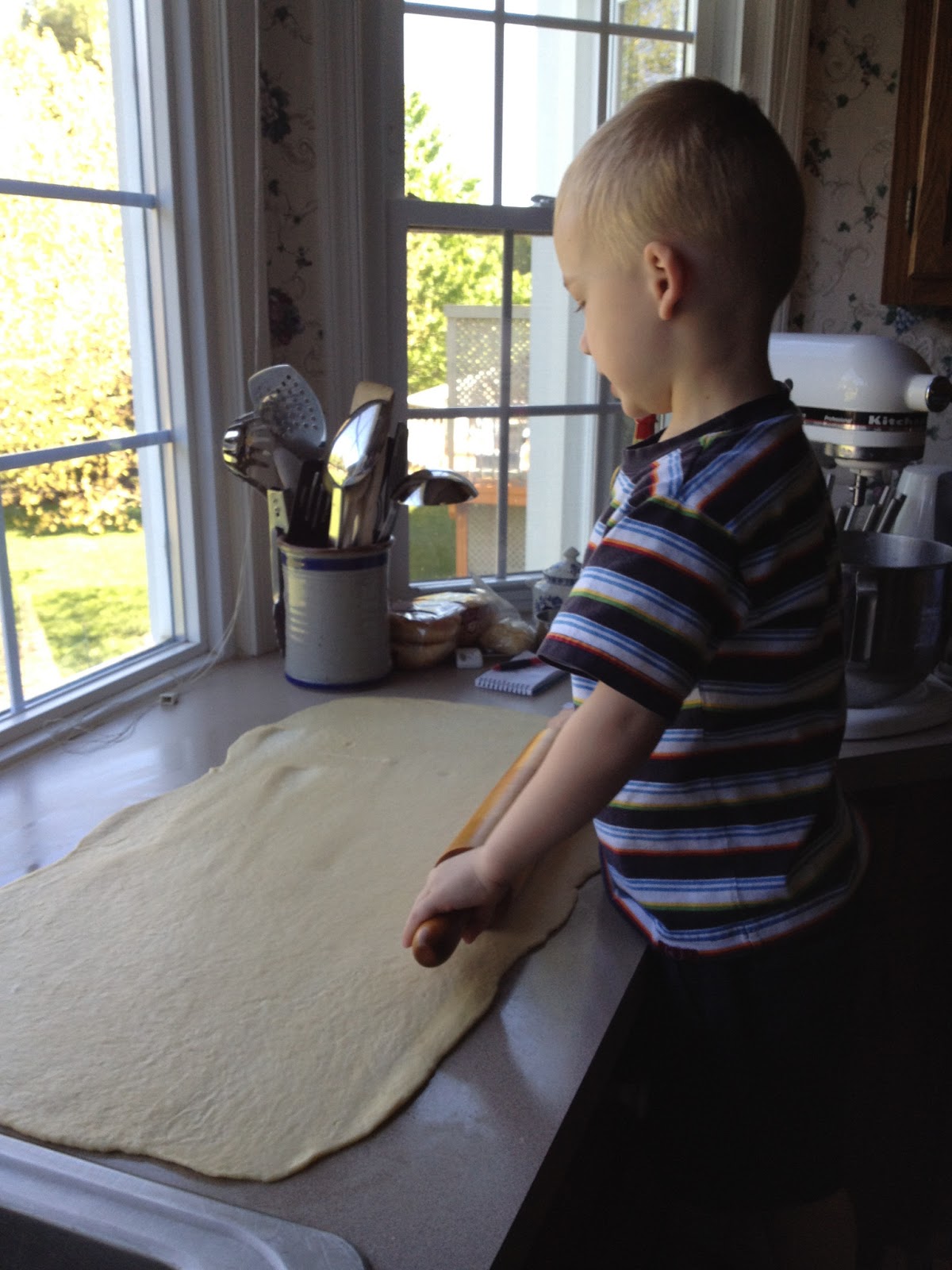
But my youngest son has no allergies, so he's excited and willing to help. As long as it's not too messy for him. He doesn't like sticky hands.

Rolling out the dough. I should have measured, but I think this is around 22" x 36".


Brush with melted butter. Sprinkle with sugar, cinnamon, raisins and chopped nuts. Roll and pinch closed. Then join in a ring.


Place the ring on greased cookie sheet. Cut three-fourths inch slices almost through roll with scissors. Turn each slice partly on its side — pointing away from the center. Cover and let the bread rise again until double in bulk.

This sounds complicated, but really not that difficult, and it looks beautiful!

Brush on beaten egg diluted with milk. Bake in moderate oven (350º) for 30 minutes.


While still hot, frost with confectioners' sugar icing and sprinkle with nuts. Delicious! the photos don't do it justice.


Serve warmed or room temperature for Easter breakfast slathered with Paska or sweet butter and Easter hardboiled eggs.

Pin It

Tuesday, November 2, 2010

St. Hubert, Patron of Hunters, November 3rd


This Halloween/All Saints Day I made costumes that would do double duty. Peter Pan became St. Eustace and Robin Hood became St. Hubert. Both saints and have similar legends of converting after seeing a stag with a cross in its antlers while hunting. They are also patrons of hunters and forest rangers. Then a friend of mine from the Netherlands mentioned St. Hubert's feast is November 3rd, and there is a special bread attached to this day. I hadn't heard of this before, so I did a little sleuthing.

St. Hubert of Liege was born in seventh century in Maastricht, Netherlands, grandson of Charibert, King of Toulouse and Eldest son of Bertrand, Duke of Aquitaine. He was a worldly young man, especially loved to hunt. While hunting on Good Friday, he saw the stag with the cross which called him by name to turn to the Lord. He immediately converted to Christianity. After his wife died, he gave up his nobility and became a priest. He was first elected bishop of Maastricht, and later moved to become the first Bishop of Liege, Belgium.

In addition to being the patron of hunters (especially using hounds), he also is invoked against rabies. His feast day marks the formal opening of the hunting season in Europe.

There is a special Mass for St. Hubert, during which in some places the organ music is replaced with hunting horns, and the hounds, horses, and hunters participate, receiving a blessing. In Belgium there is a blessing of a special bread, St. Hubert's Bread, mastellen. Then it's off to a hunt; in France and Belgium, it's usually a stag hunt.
In parts of France and Belgium there has long been a custom of holding stag hunts on Saint Hubert's Day, and the hunters gather before the chase for Mass and the blessing of men and horses and dogs. After the hunt is over, those taking part gather for a bountiful breakfast consisting of fish, meat, salad, cheese, and dessert. Naturally the meat is venison of some sort, and the salad may well be one of dandelion greens (Feast Day Cookbook by Katherine Burton and Helmut Ripperger).
It seems both the Netherlands and Belgium lay claim to this saint, and both countries have a special ring-shaped bread, shaped similarly like a bagel or donut, with the flavor of cinnamon. This is the bread brought to the Mass for a blessing.

There is an old folk rhyme for the blessed bread:
"I came all the way from Saint Hubert's grave,
Without stick, without staff.
Mad dogs, stand still!
This is Saint Hubert's will."

Sadly, I couldn't find a good recipe that I could translate to American standards. I've had bad luck getting reliable conversions, and the translators aren't ideal. I did find one recipe here, but in Euro measurements.
To one kilogram of flour, add half a litre of milk, 75 g of yeast, 5 grams of cinnamon, 300 g of butter, 20 g of salt and 50 g of sugar. Add the butter, the sugar and the cinnamon at the end of mixing when the dough is nearly fully developed. Leave the dough 30 minutes to prove and then divide in pieces of 55 g. Shape the pieces into round balls and leave to rest for about 15 minutes. Make a ring out of the dough pieces similar to bagels or donuts (in some villages the baker really makes a ring or a hole in the middle of the dough piece while in other villages he will rather make a kind of dimple in the middle of the product). So all those who thought that a ring shaped product was typical American, can forget about it. That kind of shape exists in Belgium since the Middle Ages. People used to take the mastellen to the church so the priest bless could them and they were supposed to be a good remedy against rabies. After proofing they are brushed with egg and baked for about 10 to 12 minutes in a rather hot oven (200°C).

I'd love to track down a usable recipe, so if any reader can share, I'd appreciate it!

While I'm not a hunter, nor do I have much game on my table, there are quite a few people who regularly hunt and incorporate game meats for their families. The options for recipes honoring St. Hubert are quite vast and varied:


Cooking With the Saints by Ernst Schuegraf has several game recipes for this saint:
  • Salpicon Saint-Hubert (Ragout à la St. Hubert). Good for leftover game meat of any kind

  • Côtes de Chevreuil Saint-Hubert (Venison Cutlets in the Style of St. Hubert)

  • Potage Saint-Hubert (Soup St. Hubert)

  • Hasenrücken St. Hubertus (Saddle of Hare St. Hubert)

  • Petites Terrines de Lièvre Saint-Hubert (Terrine of Hare St. Hubert)

  • Wildschweingulasch Sankt Hubertus (Goulash of Wild Boar St. Hubert)

  • Frischlingskeulen St. Hubertus (Legs of Young Boar St. Hubert)

  • Rehkeule St. Hubertus Mit Ingwer (Leg of Venison with Ginger a la St. Hubert)

  • Lepre Alla Sant'Uberto (Hare Casserole with Red Wine)

  • Jägerbraten Hubertus (Hunter's Roast St. Hubertus)

There is also an Omelette à la Saint-Hubert that includes game meat.

Or you can give up game and meat for this feast and have the St. Hubert Fish Stew from From a Monastery Kitchen by Brother Victor-Antoine d'Avila-Latourrette.

Since I don't have game, I think I will make the roast in the style of game:
Jägerbraten Hubertus
Marinade
1 onion, chopped coarsely
1 carrot, sliced finely
8 juniper berries, crushed
4 cups dry red wine
5 peppercorns, crushed
1 bay leaf

Meat
1 1/2 pound beef (topside) or similar game meat
salt and pepper
2 Tablespoons butter
3 strips bacon, lean, well-smoked
1/2 cups sour cream
1 Tablespoon red currant jelly
Mix all the ingredients for the marinade together in a large bowl. Put the meat into it and let it marinate for 24 hours in the refrigerator. Turn meat over a few times while marinating.

Remove meat and dry with a paper towel. Save marinade. Season meat with salt and pepper.

In a heavy casserole with a lid melt the butter and brown the meat thoroughly on all sides. Add 1 cup of the marinade, cover the meat with the bacon and braise in the covered casserole in a hot oven 375 degrees F. for 1 1/2 hours to 1 hour, 40 minutes. During this time turn the meat over a few times and pour extra marinade over it.

When the meat is cooked, put the cooking juices through a sieve or puree them and put in a saucepan over low heat. Season sauce with salt and pepper, add the sour cream and currant jelly.

This is best served with braised red cabbage, steamed apples, and dumplings, spatzle or mashed potatoes.

Think of St. Hubert the next time you have anything to do with hunting! Pin It

Friday, January 1, 2010

King Cake for Epiphany

After seeing Jessica's compilation of Epiphany recipes, I was distressed to realize there was no New Orleans style King Cake included on Catholic Cuisine for Epiphany. Having roots from southern Louisiana, King Cake is a necessity not an option for Epiphany.

"King Cake" is the Louisiana term for the sweet bread served on Epiphany. This is the day that opens up Carnival or Mardi Gras. Most people think that Mardi Gras is only around the beginning of Lent, but it actually begins on 12th Night and ENDS on Tuesday at midnight before Ash Wednesday. Here's an interesting explanation of the King Cake origins.

This excerpt from The Original Picayune Creole Cook Book, fifth edition from 1922:
This is a Creole cake whose history is the history of the famous New Orleans Carnivals celebrated in song and stories. The "King's Cake," or Gateau de Roi, is inseparably connected with the origin of our now world-famed Carnival balls. In fact, they owe their origin to the old Creole custom of choosing a king and queen on King's Day, or Twelfth Night. In old Creole New Orleans, after the inauguration of the Spanish domination and the amalgamation of the French settlers and the Spanish into that peculiarly chivalrous and romantic race, the Louisiana Creole, the French prettily adopted many of the customs of their Spanish relatives, and vice versa. Among these was the traditional Spanish celebration of King's Day, Le Jour des Rois, as the Creoles always term the day. King's Day falls on January 6, or the twelfth day after Christmas, and commemorates the visit of the three Wise Men of the East to the lowly Bethlehem manger. This day Is still even in our time still the Spanish Christmas, when gifts are presented in commemoration of the Kings’ gifts. With the Creoles it became Le Petit Noël, or Little Christmas, and adopting the Spanish custom, there were always grand balls on Twelfth Night; a king and a queen were chosen, and there were constant rounds of festivities, night after night, till the dawn of Ash Wednesday. From January 6, or King's Day, and Mardi Gras Day became the accepted Carnival season. Each week a new king and queen were chosen and no royal rulers ever reigned more happily than did these kings and queens of a week.
It seems almost every country has their own version of an Epiphany cake or bread. I couldn't find all the names or types for all the countries, but here are some highlights, keeping in mind that different regions and families do things a bit differently, so it's hard to make sweeping summaries.

Hispanic Countries: Rosca de los Reyes (Cake of the Kings). This is a fruit and nut filled ring or crown topped with icing and decorations, and bean or tiny doll inserted.

Spain: Roscón de Reyes is a roll that is ring shaped and sometimes filled with chocolate or jelly.

Germany and Switzerland: In both countries the Three Kings Cake is called Dreikönigskuchen and usually a gold crown is placed on top of the cake.

France: Galette (or Gateau) des Roi (or Rois) (Cake of the Kings). Usually this is a round and flat cake, honey-spice or sponge inside. It is decorated with pastry, fruits, or sugared frills. Each cake has a bean, small token or miniature doll inside. A nice tradition: there should be one more piece than the number of guests. The extra portion, la part a Dieu--God's share--is for the first poor person who knocks at the door. The day of the Kings means sharing as well as receiving. Nobody who asks for food or alms will leave empty-handed that day.

England: Twelfth Cake is eaten with Lamb's Wool (mulled ale with roasted apple pulp). Inside the cake are a bean and a pea. The man to find the bean was the King of the part, and the woman with the pea is the Queen.

The Festive Bread Book by Kathy Cutler contains 7 different types of bread or cakes for Epiphany, including ones from Spain, Brazil, Holland and a Twelfth Night Bread of Lady Carcas. This book is OOP. Another book I highly recommend, Celebrations of Bread by Betsy Oppenneer, only has one recipe for Epiphany, Rosca de Reyes.

We usually serve this King Cake as part of our Epiphany family celebration. This recipe is from from La Cucina Egeriana. by Eleanor Bernstein, Ferraro, CSJ and Maria Bettina, from Notre Dame Centre for Pastoral Liturgy, a cookbook that is out-of-print. There is another similar recipe in Bad Catholics Guide to Good Living by John Zmirak and Denise Matychowiak. I know Denise is a chef from New Orleans, so this recipe is definitely authentic. Compared to this one, the main difference is that there is no nut filling in her version.


Cake:

2 packages dry yeast
1/3 cup warm water
1/2 cup sugar (divided, 1/3 cup plus remaining amount, 2 Tbsp.)
1 stick butter
2/3 cup evaporated milk
2 teaspoons salt
4 eggs
1 tablespoon finely grated lemon rind
2 tablespoons finely grated orange rind
5 cups flour plus 1 cup for kneading surface

Melt 1 stick butter, milk, 1/3 cup sugar and salt in a saucepan. Cool to lukewarm. Combine 2 tablespoons sugar, yeast and water in a large mixing bowl. Let stand until it foams (5-10 minutes). Beat eggs into yeast mixture, then add milk mixture and lemon and orange rinds. Stir in flour, 1/2 cup at a time, reserving 1 cup for the kneading surface. Knead dough until smooth (about 5-10 minutes). Place in large mixing bowl that has been greased. Turn dough once to grease top; cover and let rise in a warm place until doubled, about 1 1/2 to 2 hours.

Filling:
1/2 cup chopped pecans
1/2 cup brown sugar, packed
3/4 cup granulated sugar
1 Tablespoon cinnamon
1 stick butter, melted

Topping:
Either 1 egg beaten or Confectioner's Sugar Icing (see below)
Then 1/3 cup each colored sugar of purple, yellow and green
2 plastic babies (3/4 inch) or 2 red beans

For filling, mix pecans, brown sugar, granulated sugar and cinnamon. Set aside. For topping, tint sugar by mixing in food coloring until desired shade is reached. For purple, use equal amounts of blue and red. (Use just a drop or two at a time).

When dough has doubled, punch down and divide in half. On a floured surface, roll half into a rectangle 30 x 15 inches (this takes a long time for me, and the dough gets to be very thin). Brush with half of the melted butter and cut into 3 lengthwise strips. Sprinkle half of sugar mixture and pecans on strips, leaving a 1-inch lengthwise strip free for sealing. Fold each strip lengthwise toward the center, sealing the seam. You will now have three 30-inch strips with sugar and nut mixture enclosed in each. Braid the 3 strips and make a circle by joining the ends. Repeat with the other half of the dough.

Place each cake on a 10"x15" baking sheet, cover with a damp cloth, and let rise until doubled, about 1 hour. Brush each egg and (optional) sprinkle top with colored sugars, in sequence.

Preheat oven to 350 degrees. Bake 20 minutes or until cake tests done. Remove from baking sheet immediately so that sugar will not harden. While still warm, place 1 plastic baby or bean in each from underneath the cake.

At this point I add Confectioner's Sugar Icing and then sprinkle colored sugar in different sections of the cakes.

To freeze, wrap cooled cake tightly in plastic wrap. Before serving, remove plastic and thaw. The cake is best if heated slightly before serving.
Pin It

Monday, December 14, 2009

Last Minute Gift Ideas: Catholic Cookbooks

I'm often asked for recommendations for books on living the Liturgical Year in the home, in particular those wonderful Catholic feastday cookbooks. I discovered two new ones this Advent, and will also mention a few tried and true titles. There's still time to request or order these books for Christmas!

'Tis the Season to be Baking by Father Dominic Garramone, O.S.B.


'Tis the Season to be Baking: Christmas Reflections and Bread Baking by Father Dominic Garramone, O.S.B. is a small but packed little volume on Advent and Christmas baking.

Father Dominic had a PBS series, Breaking Bread With Father Dominic, and this is his fifth book on baking bread, see Monastery Greetings for his other titles. You can also read a bit more about Father in this magazine article.

I was hooked right from the preface -- Father captured exactly what I feel during the holiday seasons of the year:
One of the most common comments I hear about baking is something like this: "I don’t have time to bake bread much anymore–well, except during the holidays, of course." What an amazing paradox: many people only have time to bake during what is often viewed as the busiest time of the year! But we make time for what is most important to us. What these people are really saying is: "My family’s Christmas baking traditions are so important that I always make time for them."
I don't bake bread as often as I would like, but I agree with Father, I want to do those special breads for Christmas and Easter. I love how making bread in my home reminds me of the Holy Mass in a small way. And so for feast days, bread is the extra component I like to share.

Father explains his book:
The breads I have selected for this book are a mixture of traditional recipes and original creations. Some have been made for centureis, some I inherited from my mother or my grandmothers, others are "new traditions" of Saint Bede Abbey that have only been around since I started baking for the community. But each bread has a connection to the characters we find in the Christmas story as it is presented in the gospels of Matthew and Luke. Each bread directs us to reflect on how we can better prepare to celebrate the holy days of the Advent and Christmas seasons. I hope the recipes and reflections included here will help you reclaim some of your own heritage or create a new tradition for your family, and make your holiday baking a means of deepening your own spirituality.
The recipes are wonderful, easy to follow, and most have black and white illustrations and diagrams. Included in the collection are recipes for St. Nicholas, St. Lucia, St. Joseph, the shepherds, angels, the Wise Men, swaddling clothes, and much more. There is also a wonderful menu and recipes for a Family Christmas Brunch based on Father's own family's traditions.

And since Christmas is a whole season, giving this book for Christmas Day there is still much time to try out many of the recipes!

Sacred Feasts: From a Monastery Kitchen
by Victor-Antione D'Avila-Latourette


A few weeks ago I popped into a Catholic bookstore and saw Sacred Feasts: From a Monastery Kitchen by Victor-Antoine D'Avila-Latourrette. Brother Victor is a Benedictine Monk and has written many different cookbooks. His religious order abstains from meat, so all his cookbooks are vegetarian, but include fish, eggs, and dairy. Brother has written many other cookbooks, such as Twelve Months of Monastery Soups and Twelve Months of Monastery Salads. All of his recipes are simple but flavorful, with a nod toward the French tradition of cooking.

This newest cookbook is one I've been hoping Brother Victor would write. All his other cookbooks would be around the seasons and months of the year, sometimes with different recipes named for feast days, and a few dishes to celebrate the feasts, but this cookbook is written around the liturgical seasons and feast days! Take a peek inside the Table of Contents to see the great variety.

When I got home from my little bookstore outing, I requested this book for a Christmas gift from my husband. I cannot wait to really read through the book and try the recipes.

A Continual Feast by Evelyn Vitz

For the newly married, those beginning a family, or families just taking an interest in a Catholic perspective on liturgical year and cooking, A Continual Feast by Evelyn Vitz is the perfect gift.

In my opinion, this is the best overall Catholic cookbook in print today. Mrs. Vitz covers all areas -- seasonal, liturgical seasons, feast days, saints, traditional and cultural recipes, and also family and sacramental feasting. Each recipe has a wonderful background and are easy-to-follow. A must for every Catholic family.


Cooking With the Saints by Ernst Schuegraf

I think Cooking With the Saints by Ernst Schuegraf is the next level of liturgical cooking. This is a beautiful book, hardcover, with full color photos of the dishes and beautiful art of the saints -- nice enough to be a coffee table book. The recipes are wide and varied, from main meals, desserts, breads, and appetizers, most traditional recipes from various countries. Included is a biography and a classic artistic rendition of each saint before the recipes are given, and usually there are several for each saint. Not all saints in the calendar are included, but there is a wide variety. If you enjoy reading Catholic Cuisine, this book would be a wonderful addition to your cookbook library.

Book of Feasts and Seasons by Joanna Bogle

I have to include Book of Feasts and Seasons by Joanna Bogle and her companion book, A Yearbook of Seasons and Celebrations. Mrs. Bogle is a British author, and she shares many Catholic traditions around the liturgical year, particularly from her country. They aren't only recipes, but provide various Catholic customs and traditions. Perhaps you have seen her on EWTN, her show Feasts and Seasons, which brings the books alive to the American Catholic audience? Check out the website for a few of her recipes. Her books are very enjoyable to read and quite informative.

Happy reading and baking! Pin It

Sunday, November 29, 2009

Stir-Up Sunday: Jamaican Fruit Cake

Happy New Year!

Today is the first Sunday of Advent, and we begin a new Church Year, another Year of Grace, or Year of Our Lord. This time of Advent we focus on two comings: we remember the longing, the anticipation, the hope, the long patient wait for the Messiah. We also are remembering that Christ will come again at the end of time, and we prepare for that Final Judgment. Our time here is precious! The Catechism of the Catholic Church says this much more eloquently:
When the Church celebrates the liturgy of Advent each year, she makes present this ancient expectancy of the Messiah, for by sharing in the long preparation for the Savior's first coming, the faithful renew their ardent desire for his second coming. By celebrating the precursor's birth and martyrdom, the Church unites herself to his desire: "He must increase, but I must decrease." (CCC, 524)
And so, we need to stir up our hearts, renew ourselves to prepare for His coming. In the Extraordinary Form of the Mass, the translation of the Collect (or Opening Prayer) of the Mass for the First Sunday of Advent invited that stirring:
O Lord, stir up Thy might, we beg Thee, and come that by Thy protection we may deserve to be rescued from the threatening dangers of our sins and saved by Thy deliverance. Through Christ our Lord. Amen.
A traditional English custom on this day was to make a Plum pudding, with every family member giving a good stir representing their hearts being stirred on that day. Plum pudding and fruit cake have taken a hard rap over the years. There are those who hate them and those who love them, and few fall in between. I know this is a bit late for actually stirring up on Sunday, but all week is a good time to do this. I'm offering this recipe as an alternative to standard fruitcake -- because it contains rum AND no candied fruit. Perhaps this will suit someone's fancy?

Jamaican Fruit Cake

Cut with scissors into small pieces:
1 lb. each of currants, seedless raisins, prunes, and dates.

Mix and stir in, soaking for 3 days:
1 pt. light rum
1 pt. white tablewine

After soaking fruits, sift together:
6 cups flour
4 tsp. baking powder
1 tsp. each nutmeg, cinnamon

Cream:
1 lb. butter
2 cups sugar

Add:
8 beaten eggs
1 tsp. vanilla

Mix well, then add flour mixture gradually. Lastly, fold in fruit and liquor, and 1 cup English walnuts, if desired (chopped to desired size).

Grease and line with wax paper 4 bread pans or 2 tube pans. Place cakes on rack in middle of oven. Place shallow pan of water (hot) on bottom or slower oven (300 F.) Bake 3 hours, removing water last 30 minutes of baking.

When cakes are cold, wrap in aluminum foil. Store in air-tight container in a cool place. Allow at least 2 weeks, preferably longer for aging.

(If this is baked in a tube pan, it can be used as the Christ Child's birthday cake, with as many candles on it as there are children in the family.)

Recipe adapted from Family Liturgical Customs, No. 1: Advent by Ethel Marbach, 1964, Abbey Press. Pin It

Saturday, August 8, 2009

Raise a Glass to St. Dominic!

Last year when I shared Chicken with Sauteed Tomatoes for St. Dominic's day, Mary Liz left a comment explaining the connection of St. Dominic with oranges. As today is his feast day I'm not suggesting anything elaborate for his feast, except to eat an orange or raise a glass of orange juice, or a delightful Mimosa (1 part champagne or white sparkling wine to 1 part orange juice) to toast the founder of the Order of Preachers, known as the Dominicans (although there is a wonderful Orange Roll recipe for January 20.)

Why is the orange associated with St. Dominic? From this site we read:

The Orange Tree
The orange tree pictured is at Santa Sabina and is said to be a direct descendant of the one planted in Rome by Our holy Father Dominic in 1220. Apparently this was the first of its type to be planted in Italy. The Villa Sciarra in Rome has an orange grove grown in commemoration of the bringing of the plant to Italy by St. Dominic.
From the original posting of Sacred Destinations Rome: Santa Sabina:
The Legend of the Orange Tree
In the quadrangular enclosure at Santa Sabina on the Aventine Hill in Rome, there is an orange tree. According to a legend, St. Dominic planted the seed from which it grows. In the nineteenth century, when the tree sent off a new and healthy shoot, having many oranges, someone noted that it was when Pere Lacordaire was a novice. Some took that as a symbol of the new vigor of the Order which was soon restored in France and of its increase in other provinces. And so the legend grew that when the orange tree produced well, there would be a flowering of the Order.

More information and photos of the actual tree can be found on St. Dominic's Orange Tree.

So you'll understand now that images of St. Dominic he is pictured with an orange tree. So raise your orange juice glass to St. Dominic today!

Image of Orange Tree from opeast.org.au and Image of Mimosa from Williams-Sonoma.com
Pin It

Wednesday, April 22, 2009

Cry 'God for Harry, England and St. George!'

St. George's feast day is April 23rd. St. George is the patron saint of England (and tomorrow marks its National Day) but also of other regions and countries such as Aragon, Catalonia and Valencia; Portugal, Cyprus, Georgia, Serbia, Bulgaria, Bosnia and Herzegovina, the Republic of Macedonia. Wikipedia shares the vast popularity of this saint.

There are already some great ideas for St. George from last year, one post marking my one year anniversary writing for Catholic Cuisine (thank you, Jessica).

William Shakespeare's birthday is also celebrated on this day, April 23. His famous and often quoted 'Battle of Agincourt' speech includes the rally call by Henry V: Follow your spirit; and, upon this charge, Cry 'God for Harry, England and St George!'" (Henry V, Act Three, Scene 1).

I thought I'd share these fun links for more English observation of St George's Day:

BBC Good Food: St. George's Day Recipes

How To...Celebrate St George's Day. This is a wonderful .pdf file with information, recipes, and crafts.

Although in the back of my mind I knew St. George's feast day was tomorrow, I hadn't really put together some firm ideas for my son and I to celebrate. We have lots of other busy plans, but we definitely need to fit in one of his favorite soldier saints. I know once we start talking and reading about St. George, some Playmobil knights are going to action!

Enjoy remembering the Bard and St. George! Pin It

Thursday, April 9, 2009

Festive Easter Breads and Cheese: Paska and Pascha

ETA 2013: See my updates for Paska and Pascha.

Since my family has no dominant ethnic heritage, I love to dig up cookbooks and be inspired by different cultural traditions for feast days. Florence Berger echoes my thoughts:
Being American Catholic, we can choose the best of the cultures of all the nations of the world and make them ours in Christ. We can call the songs, the stories, the dances and the foods of all peoples our own because in our American heritage there is blood and bone and spirit of these different men and women. If America is a melting pot, it can also be a cooking pot from which we women can serve up a Christian culture. (Cooking for Christ, NCRLC, 1949)
My favorite area is through festive breads (although I confess I haven't been as adventurous since my son was diagnosed with food allergies). My interest in Ukrainian psyanky (and Polish pisanki) made me interested also in the Ukrainian and Polish foods used to celebrate Easter.

One year I made this very simple Paska, Ukrainian Easter Bread from The Festive Bread Book by Kathy Cutler (1982). It's festive, but not heavy, and a perfect accompaniment to the sweet Easter cheese mold. This is usually included in the Easter Baskets brought to church for a blessing (also the Roman Ritual). I simply used a Corning Ware 1-1/2 quart round covered French White Casserole without the lid and it worked out fine (use what you have!).

Paska (Ukrainian Easter Bread)

1 egg
1 egg yolk
2 1/2 - 3 1/2 cups flour
1/4 cup sugar
1/2 teaspoon salt
1 Tablespoon active dry yeast
1 teaspoon grated lemon peel
1 teaspoon grated orange peel
1/2 teaspoon vanilla extract
1/4 cup golden raisins (I used more, up to one cup)
1/2 cup milk
4 Tablespoons unsalted butter
melted butter, if desired

Beat egg and egg yolk until fluffy and light. Add 2 cups flour, sugar, salt yeast, lemon peel, orange peel, vanilla and raisins. Mix thoroughly.

Heat milk and butter to hot (120 to 130 degrees F). Add to flour mixture. Mix thoroughly.

Add enough remaining flour to form a soft dough. Knead on lightly floured surface until smooth -- about 10 minutes.

Place in greased bowl, turning to coat top. Cover; let rise in warm place until double -- about 1 hour.

Punch down dough. Set aside a little of the dough to be used as decoration on top for the loaf. Shape the rest into a ball.

Place in greased cake pan 3 inches deep and 6 inches across or 1 quart souffle dish. Make cross of remaining piece of dough; place on top of loaf.

Cover; let rise in warm place until double -- about 30 minutes.

Bake in a preheated 350 degree oven 45-60 minutes or until done. Cool on wire rack. While still warm, brush with melted butter if desired.

The decorations on top of the loaf are very individual, and can be ornate. These hints from Ukrainian Easter by Mary Ann Woloch Vaughn are extremely helpful. I did a simple cross and made an Alpha and Omega on either side of the cross, reminiscent of the Paschal Candle decorations.

We enjoyed spreading the Easter Cheese Mold on the bread. At first I was a bit confused, as the name for the dessert cheese is Pascha (or Pashka), very close to the Ukrainian name for the bread. And "Pascha" is the Orthodox name for Easter. Once I got the names sorted out, I was convinced I had to try the cheese. I didn't have an "official" mold, so used the clean clay unglazed flowerpot as per A Continual Feast's directions. Be sure to make ahead (today or tomorrow). I omitted the candied fruit. My cheese did not mold (it didn't drain), so I ended up serving from the flowerpot. It was still delicious.

Pascha

This is an absolutely beautiful and delicious dish; versions are prepared in Poland, Russia, the Ukraine, and Latvia. It is made in a tall mold (or flower pot), then turned out onto a large platter and decorated. Cool and rich, it tastes like a cross between ice cream and cheesecake. It goes wonderfully with the sweet Easter breads, such as Kulich, or with the various Easter cakes.

1 whole egg
4 egg yolks
2 1/3 cups sugar
1 cup heavy cream
2 pounds farmer cheese (see comments)
1/2 pound sweet butter, at room temperature
1 tablespoon vanilla extract
1 1/2 cups fruit: raisins and/ or dried currants, mixed candied fruit peel
1 cup blanched almonds, chopped
2 tablespoons freshly grated orange or lemon rind
For decorating:
Candied fruit peel, maraschino cherries, or nuts
Fresh strawberries to place around the base and on top

Beat the egg and the yolks until thick and lemon-colored. Gradually add the sugar, and beat until the mixture is thick and creamy. Pour into a saucepan and add 1/2 cup of the cream.

Heat over medium-low heat, beating constantly, until the mixture begins to thicken. Do not boil. Remove the pan from the heat and continue beating until the mixture has cooled to lukewarm.

In a mixing bowl, combine the cheese, butter, the other 1/2 cup of cream and the vanilla. Cream until the mixture is smooth. Add the egg mixture, then the fruits, almonds, and orange or lemon rind. Blend thoroughly.

Line a flower pot or Pascha mold with 2 thicknesses of cheesecloth. Place the pot over a bowl (to catch liquid), and pour the Pascha mixture into the pot. Put a layer or two of cheesecloth over the top, set a plate on it and something heavy on the plate. (The purpose is to press the extra liquid out of the Pascha and into the bowl below.) Chill overnight or for a day or two.

Remove the top cheesecloth. Unmold the Pascha onto a large platter, and remove the rest of the cheesecloth.

Decorate the Pascha with the candied fruit peel or maraschino cherries or nuts to form the letters XB or CR (Christ is risen) on one side, and on the other side a cross. You may use the Western cross form or the Orthodox cross, or any other cross design that you prefer. In Russia, Pascha is often decorated with an angel and a lily, as well as the cross.

Around the base and on top of the Pascha, place fresh strawberries. Serve chilled.

Yield: 14 to 16 servings
From A Continual Feast by Evelyn Vitz

The best part after making these goodies, was arranging the Easter basket for a blessing at our parish by the pastor. I included our Easter eggs, pysanky, ham, wine, butter lamb, paska and pashka. I loved seeing all elaborate cloths and baskets and beautiful breads and goodies, and it inspired me to do more the next year.

Pictures from easteuropeanfood.about.com and FoodNetwork.com . Pin It

Wednesday, April 8, 2009

Judases

In my previous post, Holy Thursday in the Home, I mentioned the Czechoslovakian tradition of serving Judases on Holy Thursday:

On Green Thursday (Holy Thursday) the Czechoslovakians eat "Judases" and greens--a soup of green herbs followed by a green salad. Housewives busy themselves with the preparation of the Easter foods that will be consumed on the holy weekend. They say:
Soon will come Green Thursday
When we shall bake the Lamb;
We shall eat Judases farina
And three spoonfuls of honey.
"Judasas" are served with honey at breakfast in Czechoslovakia. These are breakfast cakes of twisted dough, made to look like rope, suggesting the fate of Judas the Betrayer, who "went and hanged himself" in remorse after he had identified Jesus to His enemies. Honey is considered a preventive against disaster (Easter the World Over by Priscilla Sawyer Lord and Daniel J. Foley, 1971, p. 58).
I had mentioned that I couldn't find a recipe, nor did I know the Czechoslovakian name. A reader, Michelle, was up for a challenge and found a recipe (and also thanks to P.J. for sending another one). After I found that they are called "Jidáše" (pronounced yi-dah-shay), I was able to find one other one. I've adapted the recipes below, fleshing out instructions and posting it here. I have to give warning that the recipe is "untested" and the conversions into American measurements in parentheses are my suggestions and not exact. I've shared a few photos to illustrate there are various interpretations on how to shape the "rope", so there's not one "correct" way to form the bread, so have fun!

And although the Czechoslovakian tradition is to serve them on Holy Thursday, in remembrance of Judas hanging himself, I think I would serve them the day before, today, on Spy Wednesday. It is known as Spy Wednesday because this is the day in the liturgy that Judas met with the high priests and made the bargain for his betrayal for 30 pieces of silver (Matt 26:14-16; Mark 14:10-11; Luke 22:1-6).

Recipe for Jidáše or Judases (Easter sweet rolls):

500 g of regular flour (4 cups)
250 ml of milk (1 cup)
30 g of yeast (1 oz)
1 tablespoon sugar
2 egg yolks
120 g of butter (8 Tbsp or 1/2 cup)
80 g of honey (1/4 cup)
1 teaspoon lemon zest
1/4 teaspoon salt
1 egg yolk for egg wash, beaten with small amount of water
honey thinned with water for glaze

Prepare the leavening mixture using the milk, yeast and sugar. In a separate bowl, blend the butter, egg yolks and 80 grams of honey. Mix in the flour with the leavening mixture, then add the butter and egg mixture. Add grated lemon zest and salt. Leave the dough to rise for one hour. Then, cut strips and shape them into spirals (this shape is to remind us of the rope with which Judas hung himself). Arrange the rolls on a baking sheet covered with parchment paper and let rise. Preheat oven to 375°F, brush the jidáše with the egg wash. Bake for about 15-20 minutes at 375°F or until golden brown. While still hot, glaze with honey.

See also this recipe for Judas Rope. (Images from radio.cz and babinet.cz ) Pin It

Tuesday, April 7, 2009

Holy Thursday in the Home

In a few days we begin the holiest days of the year, the Sacred Triduum. In planning for Holy Week, my first thoughts go to menu planning. Is it good that I'll be doing extra things in the kitchen to prepare for Holy Week? Am I being more of a Martha than Mary and detracting from the feast? I watched Joanna Bogle's Feasts and Seasons on EWTN and she also mentioned something about being in the kitchen more during holydays such as Holy Week than the rest of the year. She had an opposite opinion and allayed my fears — spending the extra time making these treats for the holy days marks the time and food as special, unique. She said it more eloquently, but it made me feel more confident to continue.

Holy Thursday is marked with many food traditions. I'm sharing my Holy Thursday meal traditions, but also wanted to mention a few cultural ones from around the world.

Traditions of Holy Thursday

Father Francis X. Weiser, S.J., The Easter Book (1954) explains the popular names of Holy Thursday:
The second day of the celebration of Tenebrae bears the liturgical name "Thursday of the Lord's Supper" (Feria Quinta in Coena Domini). Of its many popular names the more generally known are:
  • Maundy Thursday (le mande; Thursday of the Mandatum) — The word Mandatum means "commandment." This name is taken from the first words sung at the ceremony of the washing of the feet, "A new commandment I give you" (John 13, 34); also from the commandment of Christ that we should imitate His loving humility in the washing of the feet (John 13, 14-17). Thus the term Mandatum (maundy) was applied to the rite of the feet-washing on this day.

  • Green Thursday — In all German-speaking countries people call Maundy Thursday by this name (Gründonnerstag). From Germany the term was adopted by the Slavic nations (zeleny ctvrtek) and in Hungary (zold csutortok). Scholars explain its origin from the old German word grunen (to mourn) which was later corrupted into grün (green). Another explanation is that in many places, before the thirteenth century, green vestments were used for the Mass that day.

  • Pure or Clean Thursday — This name emphasizes the ancient tradition that on Holy Thursday not only the souls were cleansed through the absolution of public sinners but the faithful in all countries also made it a great cleansing day of the body (washing, bathing, shaving, etc.) in preparation for Easter. Saint Augustine (430) mentioned this custom. The Old English name was "Shere Thursday" (meaning sheer, clean), and the Scandinavian, Skaer torsdag. (Because of the exertions and thoroughness of this cleansing in an age when bathing was not an everyday affair, the faithful were exempted from fasting on Maundy Thursday.)

  • Holy or Great Thursday — The meaning of this title is obvious since it is the one Thursday of the year on which the sacred events of Christ's Passion are celebrated. The English-speaking nations and the people of the Latin countries use the term "Holy," while the Slavic populations generally apply the title "Great." The Ukrainians call it also the "Thursday of the Passion." In the Greek Church it is called "The Holy and Great Thursday of the Mystic Supper."
In some Latin countries sugared almonds are eaten by everybody on Maundy Thursday. From this custom it bears the name "Almond Day" in the Azores. In central Europe the name "Green Thursday" inspired a tradition of eating green things. The main meal starts with a soup of green herbs, followed by a bowl of spinach with boiled or fried eggs, and meat with dishes of various green salads.

Easter the World Over by Priscilla Sawyer Lord and Daniel J. Foley (1971) mentions the Czechoslovakian traditions for Holy Thursday. I'm not sure if this is a Czech or a Slovak tradition:
On Green Thursday (Holy Thursday) the Czechoslovakians eat "Judases" and greens--a soup of green herbs followed by a green salad. Housewives busy themselves with the preparation of the Easter foods that will be consumed on the holy weekend. They say:
Soon will come Green Thursday
When we shall bake the Lamb;
We shall eat Judases farina
And three spoonfuls of honey.
"Judasas" are served with honey at breakfast in Czechoslovakia. These are breakfast cakes of twisted dough, made to look like rope, suggesting the fate of Judas the Betrayer, who "went and hanged himself" in remorse after he had identified Jesus to His enemies. Honey is considered a preventive against disaster (p. 58).
I have searched through all my books and on the Internet, and I cannot find any recipes for Judases in the English language and measurements. If I had the Czechoslovakian word perhaps I would have better luck. It has been mentioned as a bread, sometimes cake, but no recipe. Update 2015: I did find a few recipes, one which I posted here: Judases. Anna also shared a link to a recipe in the comments, Judas Rope.

Jennifer Mackintosh already mentioned the tradition of eating green for Green Thursday, including a wonderful recipe for Spinach Pie. Evelyn Vitz in A Continual Feast suggests a Seven-Herb Vichyssoise, and fish with a green herb butter, spinach, a mixed green salad, and green desserts such as Mint or Pistachio Ice Cream or Lime Sherbet. The custom of the green foods can be traced to the Jewish Passover meal with the bitter herbs, but also a health focus, as spring is arriving, and the green herbs provide a healthy spring cleansing. Since some people serve all green meals on St. Patrick's Day, that would be another place for inspiration for serving green foods.

Passover Meal

Since I was a young girl my family has gathered to celebrate a Holy Thursday meal. We never called it a Seder, although we have called it a Passover meal. The purpose was to remember Jesus' Last Supper, and to prepare the family for participation at the evening Mass of the Lord's Supper. I did try to learn more about the Jewish Seder meal, and over the years we would try to be more "authentic". But I have to say the men in my family were always a good barometer -- "Why are we doing this? We're not Jewish." They pointed out that we are Catholics trying to recall Jesus' last days, not trying to practice the Jewish faith. I found in my reading that the current Seder meal wasn't established until after 70 A.D., and many sources say not until 500 years after Christ's death. After prayerful consideration, why would we implement a ritual that was written after Christ that emphasizes awaiting the Messiah when He has already come? Wouldn't it make more sense to look back at the Old and New Testaments and imitate what Jesus the Messiah did at His Last Supper?

It was interesting to study, butI realized I wasn't sharing the night with Christ. I respect the Jewish religious ritual of a Seder meal, but not as something to implement in my home. I used the Old Testament and New Testaments as inspiration. Francis Fernandez (In Conversation With God, Volume 2) mentions that the Last Supper is "to be the last Jewish Passover and the first Passover in which her Son is both Priest and Victim" (p. 252). (See also The Hunt for the Fourth Cup by Dr. Scott Hahn.) I want to look forward to the Paschal Feast, which is the Mass, and particularly the Easter Vigil liturgy.

I found it so interesting that in Celebrating the Faith in the Home: Lent and Easter in the Christian Kitchen by Laurie Navar Gill and Terea Cepeda (printed by Emmanuel Books) that Mrs. Gill came to a similar conclusion:
The "Christian Seder" or Passover meal on Holy Thursday has become popular in some circles in the past few decades. I have attended such dinners and have even tried to put one on myself. I enjoyed learning more about the Jewish Passover traditions as Our Lord observed them -- the symbolic foods, the toasts, the questions and the beautiful Jewish blessing prayers.

Yet my own sense is that too closely to imitate a Jewish Passover rings falsely at my table. Our Holy Thursday menu does include some symbolic foods from the Passover meal. We read about both the Exodus of Jews and the story of the Last Supper, but we do not imitate the narrative and blessings from the Jewish observance.

Instead, we try to concentrate on the fulfillment of the Passover in Jesus. Through His blood, He has saved us from death. And in the Holy Eucharist, He feeds us with His own flesh and blood. The high point of our Holy Thursday observance is our participation in the true carrying on of that last Passover meal. No re-enactment around our table, no matter how authentic, can compare with the Truth that we encounter in the Holy Sacrifice of the Mass.
While reading Rumer Godden's In This House of Brede, I was struck by the description of Holy Week in the Benedictine Monastery. While this is a fictitious work, the author based the writings on actual convent life. I have the whole quote here but I loved this description of the table for Holy Thursday dinner, and have used it as inspiration for my own table:
On that same day, the Abbess, following her Master’s example, became the servant of the whole community, serving them at midday dinner. The sight of the refectory was inviting: each place was laid with a snow-white napkin, a glass of wine, a bunch of grapes, a small wheaten loaf, and a brown earthenware bowl of vegetable soup. Apricot puffs and cheese were laid along the side tables. When the nuns were seated, the Abbess came in, wearing a white apron and white sleeves, and with her came the kitchener, Sister Priscilla, bearing a great silver salver of fish. The Abbess went to every nun, serving her and laying beside her plate a nose-gay of small flowers: violets, wood anemones, primulas, grape hyacinths, tiny ferns, pink heaths.
Father Francis Weiser from his Religious Customs in the Family gives some wise instructions on a family celebrating a Passover-type meal on Holy Thursday:
In many homes the memory of the Last Supper is brought out by the arrangement of the main meal in the evening. Of late the custom has been suggested in various books and pamphlets, of imitating the ancient Passover meal even in its details. A yearling lamb is to be roasted and served with bitter herbs and a brown sauce. Jewish matzos, together with wine, are to be distributed by the father in silence to all members of the family, thus commemorating the institution of the Blessed Sacrament.

The use of some pious "ritual" at the supper on Holy Thursday is surely to be recommended, although a complete I imitation of the Last Supper of our Lord in its details does not seem to be advisable. Children, with their gift of keen and faithful observation, might easily conceive the ritual at the family table as a "photographic" reproduction of the Last Supper and thus acquire inaccurate and unhistorical notions about it. To mention only one example, are we sure that Christ used massah (unleavened bread) of the shape and size of modern Jewish "matzos".
Our Holy Thursday Meal

I love how Florence Berger in Cooking for Christ answers the apostles' question:
Whenever I hear Peter and John asking the Lord, "Where wilt Thou that we prepare the Pasch?" I want to interrupt and say, "Come to our house, please do." But even today we, as Catholics, can bring Christ and His friends home with us. When we receive the Holy Eucharist on Maundy Thursday, He lives within us. When we gather guests at our tables to re-enact the last supper, Christ is in our midst. For, as the antiphon of Holy Thursday sings, "where charity and love are, there is God." There is a divine bond between our altar and our home.
Holy Thursday celebrates the institution of the Sacrament of the Eucharist and the Sacrament of Holy Orders. The Eucharist was established within the Passover meal by Jesus with His Apostles. A wonderful way to bring home the richness of this feast is to imitate the Last Supper by recalling some aspects of the Passover meal, and a foot washing ceremony with the family in imitation of Jesus. This a wonderful tradition to start in the family. If things are rushed on Holy Thursday, move the meal sometime before Holy Thursday (Wednesday night, for example) so that the whole family can participate in imitating Christ at the Last Supper.

The idea is serving foods reminiscent of the Passover meal as the Jews did in Egypt and Christ did in imitation of the Exodus, not in imitation of Judaic religion. Elements of the Mass of the Lord's Supper are included to prepare us for participation at the Mass of the Lord's Supper. Incorporating the various senses in this meal really helps active participation, particularly for children.

Holy Thursday is one of the biggest feasts in the Church year, since it commemorates the institution of Holy Orders and of the Holy Eucharist. Sunday-best should be worn by participants and the table should be beautifully decorated, with a white tablecloth (in imitation of the white vestments used at Mass) and even the good china and silver. For dessert (since this is a special feast day, no Lenten abstaining here), at times I have baked a cake in the shape of a lamb (there are numerous types of lamb molds available at craft stores or baking supply stores). Before or during the dinner, we read from Exodus 12:1-20 —- the story of the first Passover. Then someone reads from the New Testament reading about the Last Supper and the institution of the Eucharist rom either Matt 26:17:30; Mark 14:12-26 or Luke 22:7-20.

Simple Menu Suggestions:

These ideas loosely follow the instructions in Exodus, "A lamb...a year-old male lamb without blemish...That same night they shall eat its roasted flesh with unleavened bread and bitter herbs...."
  • Bitter Herbs: Cooked spinach and raw celery sticks dipped in salt water, mixed green salad (the greens also incorporate the "Green Thursday" tradition)
  • Unleavened bread: Crackers or store-bought matzohs, pita bread or homemade unleavened bread
  • Wine: red wine and/or grape juice
  • Lamb: Leg of lamb, or roast lamb, lamb chops, or meatloaf baked in shape of lamb (use a lamb cake mold)
  • Haroset: Applesauce with raisins, reminding of the bricks and mortar the Jews laid in Egypt. (This is an additional element we have added.)
Our Holy Thursday Dinner Menu:
  • Roast Beef (Reminder of the Passover Lamb, and Christ the Paschal Lamb)
  • Mashed Potatoes (allergy free, made with safe margarine and chicken broth and seasonings)
  • Cooked Spinach (reminder of the bitter herbs)
  • Applesauce (reminder of the Charoses, the bricks and mortar in Egypt)
  • Bread (reminder of the Unleavened Bread and the Eucharist)
  • Grapes (reminder of the wine of the Last Supper which becomes the Blood of Christ)
  • Dessert (Because it is a festive day in the eyes of the Church)
  • Wine and/or Grape Juice
Our family doesn't like the taste of lamb, so I'm actually serving roast beef. It looks similar to lamb. It seems Holy Week has extra constraints, so while I want to make a festive meal, sometimes time, energy, (and nowadays) and budget is lacking. One year my mother actually made a meatloaf in the lamb cake mold pan. It was definitely memorable.

We usually save making the lamb cake for Easter. I usually choose a dessert that won't have leftovers to taunt us during Good Friday. Depending on my time, I might make unleavened bread, following Maria von Trapp's recipe. If I use regular bread it will be small individual loaves at each place setting. For my son with food allergies, I will serve gluten free bread sticks. Another alternative is serving Hot Cross Buns, again, following Maria Von Trapp's recipe.

Before eating, the family gathers for the "Washing of the Feet", which I've described on my blog.

The children are reminded that this meal is different than what the Jews celebrate because Christ already died and saved us, so we are not still awaiting a Messiah. We are not obliged to follow the directives for the Passover meal, we are merely doing it in imitation of Christ, so we can use all of our senses to know, love and serve Christ. While eating the reading from Exodus 12: 1-20, the story of the First Passover, is read out loud. This is the same first reading at the Mass of the Lord's Supper.

The meal is simple, joyful, and family-friendly, and wonderful preparation to enter more deeply into the liturgy of the Sacred Triduum. Pin It