Showing posts with label St. John the Apostle. Show all posts

Monday, April 25, 2016

Penne Pasta "Quills" for the Evangelists


There are hundreds of kinds of Italian pastas, and each one has its own special name.  Each pasta name actually means something which can be really fun and symbolic for making a connection for a creative dish or celebration.

Penne pasta is a tubular shaped pasta with slanted ends. The name means “quills” or “feathers” and is so named because of this shape. We associate quills with feather pens and writing. Many saints who were writers, doctors, evangelists are depicted holding a quill.

Because of its shape, penne complement virtually every sauce and are exceptional when paired with a chunky sauce. Penne pairs nicely with chunky meat, chunky vegetable, cream, or oil based sauces. It is also a good shape to use for baked dishes.

Red is the vestment color used liturgically for the feast of martyrs and also for the evangelists. St. Mark, whose feast is today was both. Making a dish using the "quill" shaped pasta in a creamy sauce with sun-dried tomatoes will include the symbols both of him as a writer of the Gospel represented by the quill shape and as a martyr/evangelist with the red.   While I chose a sun-dried tomato and cream basse option, any of the marinara sauces would be equally fitting for an evangelist. 
Evangelist Feast Days
St. Mark - April 25
St. Luke - October 18
St. Matthew - September 21
St. John - December 27

Creamy Sun-dried Tomato Penne

2 C. dried penne or mini penne pasta
1 T. olive oil
1/2 C. sun-dried tomatoes (chopped)
1/2 C. cream
1/4 C. freshly grated parmesan
1/2 t. garlic powder

Boil pasta. While waiting for pasta to cook, saute sun-dried tomatoes in olive oil for a few minutes. Add cream and mix. Add parmesan and garlic powder. Mix. Drain pasta and pour sauce over warm pasta. Serves 4.


Pin It

Sunday, September 20, 2015

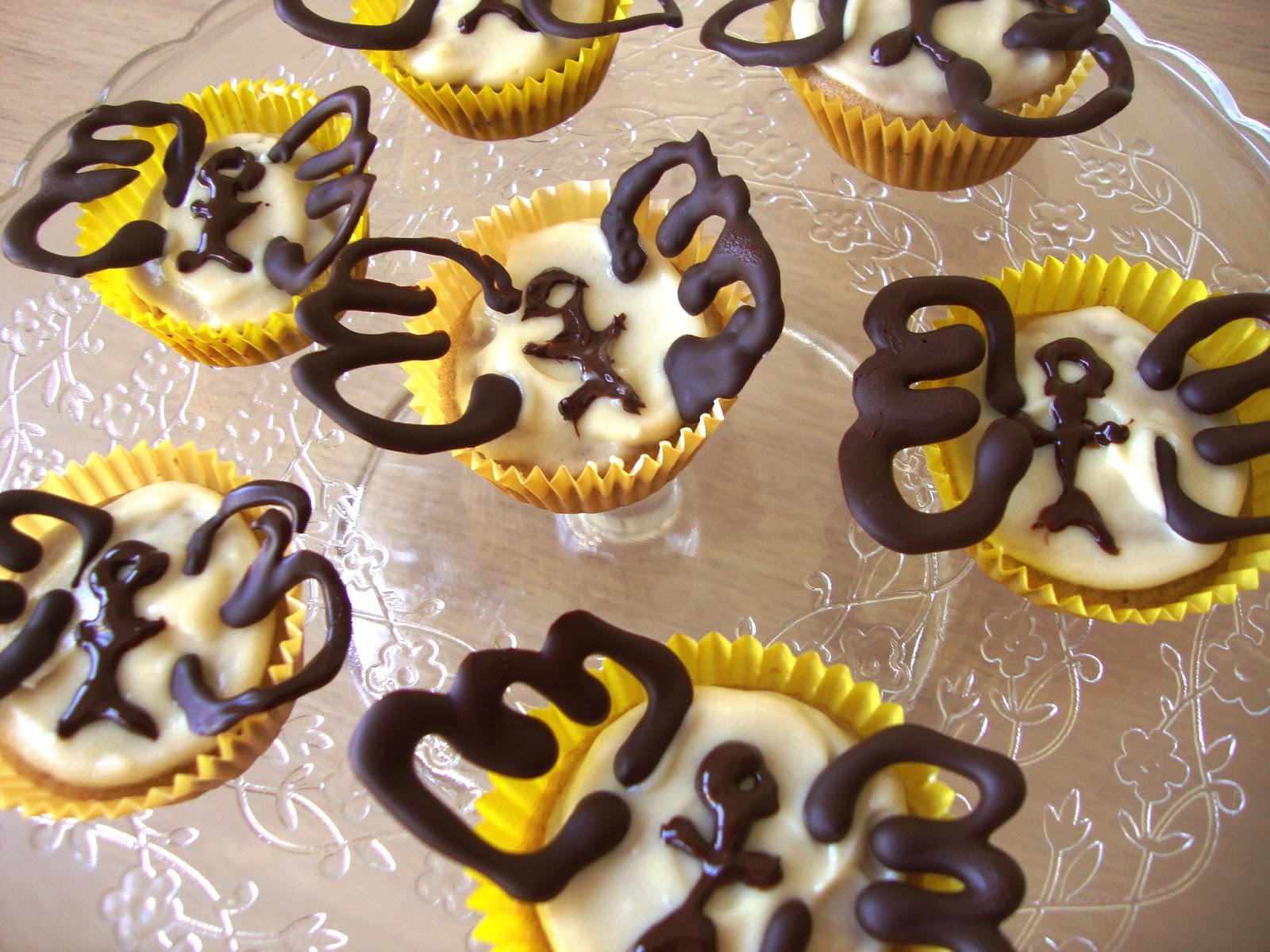
St. Matthew Winged Cupcakes

The following recipe was submitted by Julie Machado, from Marta, Julie e Maria, for the feast of St. Matthew. Thank you, Julie!


A symbol for St. Matthew is a winged man or angel. Some link it to the geneology at the beginning of his Gospel while others to the angel that appeared to Joseph. I had the idea to make winged cupcakes, with the figure of a man, but you could also draw a lion for St. Mark, an ox for St. Luke or an eagle for St. John and put on the wings. (View the various symbols here.)

First, melt some chocolate, put it in a frosting dispenser or plastic bag with the tip cut off and draw angel wings on wax paper. Let them set in the refrigerator.


Make cupcakes and frost them according to whatever recipe you like best. I used a sugar and spice recipe from a cupcake book. Draw a man stick figure on the cupcakes using the melted chocolate. Stick the wings on.

It is hot here so my wings started melting pretty fast out of the refrigerator.


"Such was his intention when, behold, the angel of the Lord appeared to him in a dream and said, “Joseph, son of David, do not be afraid to take Mary your wife into your home. For it is through the holy Spirit that this child has been conceived in her."  Matthew 1:20


Pin It

Monday, February 9, 2015

"Thunder & Lightning" for St. Scholastica


There is a rustic Italian peasant dish called tuoni e lampo or "thunder and lightning" which is made with pasta and chick peas (garbanzo beans) - where “thunder” refers to the profusion of fried chickpeas, and “lightning” to the excessive amount of coarsely cracked black pepper.

One of the most dramatic stories told about St. Scholastic and her brother, St. Benedict, is one associated with thunder and lightning and found in the Dialogues of St. Gregory the Great. St. Scholasica very rarely got to see her beloved twin brother, St. Benedict. On one of their annual visits, he indicated that he had to leave and not be outside the monastery overnight.  His sister implored him to stay just for the night, but he would not. She started to weep and prayed to God. At that time violent thunder and lightning erupted, the skies opened and a mighty storm commenced. St. Scholastica said basically, "You would not listen to me but God did."  St. Benedict was forced to stay the night.  They spent the night in spiritual and heavenly talk. Benedict returned to his monastery the next morning.  St. Scholastica died a few days later and yet St. Benedict was able to have spent the extra time with her.  A lovely version of the story is told in Tomie de Poala's picture book, Holy Twins: Benedict and Scholastica


How excited I was to find the Italian dished called "thunder and lightning." Though not associated with the feast day as far as I could find, to me it seemed so perfect for St. Scholastica's feast day, February 10. Tuoni e lampo is often made with a mixture of pasta types - what is left at the bottom of the bags, then adding the beans. So really any type of pasta could be used. This particular version of the recipe I found, used a pasta called orecchiette, or "little ears" for its shape. I thought that could be a clever connection to God hearing St. Scholastica's pleas. It also seems fitting as it can refer to the St. Benedict in his rule as he begins the Prologue with these words: "Listen carefully, my son, to the master's instructions, and attend to them with the ear of your heart." 

Tuoni e Lampo

Ingredients:
6 ounces dried orecchiette pasta (“little ears”)
2 T. olive oil
1 large clove garlic, minced
1 cup cooked garbanzo beans
1 ½ t. finely slivered sage, plus sprigs for garnishing
½ cup chicken broth
½ t. coarsely cracked black pepper, “mignonette or butcher-grind”
1 T butter
1/2 cup freshly grated Parmigiano-Reggiano

Directions:
Add orecchiette to pot of boiling, salted water and cook until al dente (about 12 minutes.) While that is boiling, cook garlic and chickpeas in olive oil over high heat. Stir until the chickpeas begin to pop.  Add sage, broth and pepper.  Continue to cook over high heat until the broth reduces a bit and becomes syrupy (about 5 minutes.)   Drain pasta well.  Put butter in a large warm bowl and add pasta.  Toss.  Add chickpeas and broth to bowl and stir well. Add 1/2 cup cheese and salt to taste.Mix gently.  Drizzle with extra-virgin olive oil, if desired, and dust with extra cheese. Garnish with small sage leaves.  Serve immediately.  Serves 4 though easily doubled to serve a large crowd. 

St. Benedict and St. Scholastica, Pray for us!


[Author note: Since St. James and St. John are known as the "Sons of Thunder" tuoni e lampo would be a dish appropriate in name for either of their feast days as well.] Pin It

Friday, December 27, 2013

"Drink you the love of St. John."


The following text was submitted by the editor of Advent and Christmas in a Catholic Home, Katherine Zehnder.  It is from the 1950's "Advent and Christmas in a Catholic Home" by Helen McLoughlin and includes a variation of the recipe that can be found in the archives Thank you Katherine! 

There is a beautiful Catholic custom for St. John's feast day - the blessing of wine. It is in honor of him remaining unharmed after drinking a poisoned cup of wine over which he made the Sign of the Cross. The father of the family can read Psalm 22 and then recite this prayer: " Lord Jesus Christ, Thou didst call Thyself the vine and Thy holy apostles the branches; and out of all those who love Thee, Thou didst desire to make a good vineyard. Bless this wine and pour into it the might of Thy benediction so that everyone who drinks or takes of it, may through the intercession of Thy beloved disciple the holy apostle and evangelist John, be freed from every disease or attack of illness and obtain health of body and soul. Who livest and reignest forever. Amen."

A toast to the love of St. John is then pledged by all the family. The father touches his glass of wine to his wife and says: "I drink to you the love of St. John" and she in turn touches the children's (watered down wine) goblets and says "drink you the love of St. John."

St. John's Wine

2 cups wine
2 whole cloves
2 pinches cinnamon
1 cardamon seed
1/4 tsp nutmeg

Boil the spices in the wine for about five minutes. Strain the wine. Serve hot.

Happy Feast of St. John!

Pin It

Monday, October 28, 2013

All-Saints Themed Cookies

The following post was submitted by Lynne from Adoro Te Catholic Home Educators. The All-Saints Themed Cookies were made for a parish bakesale to fund their home school groups March for Life bus and are simply beautiful! Thank you Lynne! 


All Saints Day should be a joyful feast in its own right, but its timing leaves much to be desired. For moms who’d like to combat the blur after a night of shepherding and last-minute costume changes, resist the urge to crunch on that rapidly-hardening candy corn and pull out a cookie sheet. The folks at Adoro Te Home Educators recently held a March for Life fundraising bake sale featuring some sweet, saint-themed cookies that are easy to recreate at home. All it takes is sugar cookie dough, a cookie cutter, pre-made fondant and a cookie mold.

All of the cookie molds were ordered online. St. Nicholas, Madonna of the Portal and St. Cecilia are springerle cookie molds purchased from House on the Hill . The St. John the Evangelist and Salve Regina springerle molds were purchased from Springerle Joy.  St. Gabriel and St. Michael are bread stamps from Prosphora Stamp Central.


*Cookie mold tip: The St. Nicholas mold can be used for several saints. Color the fondant red and the image is St. Nicholas; color the fondant green and the image is St. Patrick.

Roll out your cookie dough to a 3/8 inch thickness and cut out the shape of the mold. This can be done in a few ways: purchase the custom cookie cutter available with some molds; use the cookie mold as a template by laying it on the dough and cutting around the edge of the mold with a ravioli cutter; or find the right sized cookie cutter from Cheap Cookie Cutters.  If possible go a slight bit smaller with the cookie cutter because the dough will spread when baking. Bake the cookies, in the center rack, at a 325 degree oven for 15-20 minutes (oven times vary).


* Rolling tip: We used dostix to roll out the dough evenly. Dostix make the rolling process fast and easy. They are the best baking purchase I have ever made. 

* Baking tip: Because these cookies are rather thick they have to be baked at a low oven for a longer period of time to ensure they are cooked through.


After the cookies are baked and cooled it is time to work on the fondant tops. Using pre-made fondant, we used Wilton brand fondant and gel food coloring, knead and roll out the fondant to a ¼ inch thickness. Lightly dust your mold with powdered sugar. Press the rolled out fondant into the mold starting from the center of the mold and working your way to the edges. Be sure to press the fondant into all of the deep areas of the design, you can feel the indentations as you press down on the fondant. Starting from the edge carefully peal the fondant from the mold. Trim the edges of the design then ‘glue’ the fondant to the cookie by brushing the top of the cookie with light corn syrup.


* Fondant tip: When coloring your fondant use plastic food grade gloves.


Pin It

Thursday, December 27, 2012

Eagle Brownies


One of our sons celebrates a name-day on December 27th, the feast of St. John the Evangelist!  I've posted the directions in the past for the Eagle Cake we often make to celebrate this feast day, but this year I thought I'd share a few pictures of this year's version, made with brownies.  


It was a little harder to get out of the 9" square pan (next time I need to remember to line the pan with parchment paper) but the chocolate frosting disguised all the imperfections.  ;)  We used a black M&M for the eagle's eye, some yellow frosting for the beak, and 1 orange spice drop (cut in half) for the feet.


"The Eagle when accompanying St. John the Evangelist is an emblem of the spiritual character of his Gospel, but when the King of Birds accompanies St. Prisca it refers to the legend that an eagle held watch over her body until it was buried after her martyrdom. When a figure bearing an eagle's head, or a four-winged eagle, or a male saint with an eagle is depicted, it always represents St. John, not in the character of a simple Apostle, but as the Evangelist."  ~ How to Distinguish the Saints in Art by Their Costumes, Symbols and Attributes

St. John the Evangelist, Pray for Us! 

Pin It

Tuesday, October 16, 2012

Bible Cookies for the Year of Faith


A couple years ago, when trying to come up with a snack for our Little Flowers Girls' Club meeting on the virtue of Wisdom, I came up with these cute little Bible Cookies to place on top of our cupcakes.  Lacy expanded on this idea by cleverly adding a little bookmarks made from fruit roll ups!   We just made them again, since one of our Kindergarten Themes this past week was "B is for Bible" inspired by A is for Altar, B is for Bible, and I thought I'd share the directions with you all, as we begin The Year of Faith.   

Bible Cookies 

Ingredients:
  • Fig Newtons (we made these with "Gold" Peach & Apricot Newtons)
  • White Icing (I used Wilton's Icing Writer, but any white icing/frosting would work)
  • Red Fruit Roll-ups


Directions:

Begin by trimming off one long side of each fig newton with a sharp knife.   This creates the book, with three sides of "pages" showing with the binding on the remaining side.  


I have found that standing them on their end and cutting straight down leaves a nice clean edge, versus cutting through the cookie/cake:  


Using a sharp knife, cut "bookmarks" from the red fruit roll ups. Stick them into the end of the "book" (newton) using a toothpick (or the end of the knife, like I did).       


Decorate the cover and binding with icing to complete the "Bibles."


This idea can also be modified, using different flavored/colored cookies and decorations, like we did for our "Story of a Soul" cookies last year.  

These cookies would make a great snack anytime during this "Year of Faith."  They are also perfect for the feasts of the Evangelists, Sts. Matthew, Mark, Luke, and John, or for the feast of St. Paul and any other of the many saints that are symbolized with a "Book."   

Pin It

Saturday, October 23, 2010

Edible Eagles


"E is for Eagles

Here where clear waters reflect the clean air, 
look to the deep sky,
up where big birds fly.
See! Against white clouds...a bald eagle pair!"


As an extra project to go along with our Geography Study of New Hampshire this past week, my boys made Edible Eagles!

Since the Eagle also symbolizes some of the saints, I thought this would be a fun addition to our collection of ideas and recipes here at Catholic Cuisine.  These Edible Eagles would be a great little treat to make for the feast of St. John in December, a fun snack for the first Blue Knights meeting for Year Two (featuring St. John), or even for the upcoming feast of All Saints!  

"The Eagle when accompanying St. John the Evangelist is an emblem of the spiritual character of his Gospel, but when the King of Birds accompanies St. Prisca it refers to the legend that an eagle held watch over her body until it was buried after her martyrdom.  When a figure bearing an eagle's head, or a four-winged eagle, or a male saint with an eagle is depicted, it always represents St. John, ot in the character of a simple Apostle, but as the Evangelist." ~   How to Distinguish the Saints in Art by Their Costumes, Symbols and Attributes

Acording to Saints.SQPN.com, the Eagle also symbolizes the following:
  • Our Lord, who could gaze undazzled upon the glory of God, the Father, as an eagle at the sun
  • Baptism by early Christians
  • Saint Augustine of Hippo as a symbol of inspiration
  • Saint Cuthbert of Lindisfarne, who was fed by an eagle
  • Saint Florian of Lorch, whose corpse was protected from abuse by an eagle
  • Saint John of the Cross as a symbol of inspiration
  • Saint John the Evangelist as a symbol of inspiration and the Holy Ghost
  • Saint Juan Diego, whose birth name means “the eagle who speaks”
  • Saint Medard of Noyon, who was sheltered from the weather by a hovering eagle
  • Saint Ruggero of Canne, who was sheltered in his travels by an eagle
  • Saint Servatus, who was sheltered from the sun by an eagle while he travelled as a pilgrim
  • Saint Wenceslaus, due to his association with Bohemia

Edible Eagles

Ingredients:
  • 1/4 cup of white chocolate chips (we used candy melts)
  • 6 large marshmallows
  • Finely shredded coconut
  • Chocolate sandwich cookie
  • 6 Cashews (we used peanuts) 
  • Black decorators' gel

Instructions:

Melt 1/4 cup of white chocolate chips (or candy melts) according to the package directions. 

For each bird, drop a large marshmallow into the melted chocolate, using a spatula to coat it well. 

Remove the marshmallow from the chocolate and roll it in finely shredded coconut, leaving one end uncovered. 

Immediately set the marshmallow, coconut free end down, atop a chocolate sandwich cookie. 

Let the chocolate set a bit, then use a toothpick to make a hole in the side of the marshmallow and insert a cashew for a beak. (We attached our peanuts with a bit more white chocolate.) 

Finally, add black decorators' gel eyes. 


You can find a few other great ideas in the archives including the Eagle Marshmallow Pops & Eagle Head Quesadillas and the Eagle Cake.

Pin It

Saturday, December 26, 2009

Fun Food for the Feast of St. John the Apostle

The following guest post was submitted by Lacy from Catholic Icing.  Thank you Lacy!

Hi! This is Lacy from Catholic Icing, and I'm posting today to share some ideas for the Feast of St. John with you. His symbol is the eagle, so here are some eagle foods I have made:

Eagle Marshmallow Pop


If you want to make your own eagle marshmallow pop, here's what you'll need:

Lollipop Sticks
Large Marshmallows
Dark Chocolate Chips
White Gumdrops
Shredded Coconut
Almond Bark
Black Food Color Paste
Flower Shaped Sprinkles

Here's what you do:

For the Body~
Put your large marshmallow on the stick and cover in melted dark chocolate. Stick on 2 yellow flower-shaped sprinkles for his feet, and chocolate chips for the wings. Allow to cool. Use a blob of melted almond bark to stick on shredded coconut for the eagle's tail.

For the Head~
Melt your dark chocolate and almond bark until smooth. Dip the bottom of your white gumdrop into the melted almond bark, then dip into your shredded coconut to make the "feathers" on his neck. Cut a slit where his beak goes, and insert a sideways yellow flower-shaped sprinkle.  For the eyes, make 2 dots with black food color paste using a dull toothpick (as a substitute for one of those awesome food markers).


Eagle Head Quesadillla


This eagle head quesadilla is really easy to make. Just fold a tortilla in half, and then cut out a "ghost" shape with some scissors.  It cuts very nicely with scissors. Then, put some cheese in the middle and microwave (or fry it if you're a little more ambitious than me, or if you're preparing it for adults). Finish off by cutting the beak shape out of a slice of cheddar cheese, and stick a raisin on there for an eye :-D


Other ideas for celebrating the feast of St. John can be found in the archives! Pin It

Saturday, December 27, 2008

Eagle Cake

As I mentioned earlier, today was the feast of St. John the Apostle. One of the symbols for St. John is the eagle. Since we celebrate one of my sons namedays today, I decided to make an Eagle cake using the directions for an Eaglet Cut-Up-Cake in My Nameday Come for Dessert by Helen McLoughlin as a guide. It was really easy and quite fun to put together!

It turned out very homemade looking -- but that never does matter to children, does it?!


EAGLET CAKE

1) You will need a 9-inch square cake. Bake it from a cake mix or
from your best-liked recipe. When cool, cut a strip diagonally
across the center of the cake, 3 inches wide to use for the body.
Cut the corner off one end to make a beak.

(In case some of you need visuals like I do, I drew a picture for you.)

2) Place the cake strip so that the pointed end is the head; use
the cut-off piece for the beak. Use remaining cake pieces as
spread-out wings. Frost with white seven-minute frosting.

(I used canned frosting in chocolate and lemon.)

3) When the fluffy frosting is swirled on the eaglet, add coconut
for feathers. Make a red gumdrop eye and a glistening beak of
tiny yellow candies. For the feet and wing tips use split pieces
of licorice "shoelaces."

(I skipped this step since my goal was to use what I had on hand. I frosted the body with chocolate frosting, the beak with lemon, and used powdered sugar for the head. I then added a couple candy corns for his talons. To finish him off I just added a brown M&M for his eye.)


This cake can also be used for the feasts of Sts. "John of the Cross; Augustine of Hippo; Priscilla, an early Christian martyr; the Benedictines Cuthbert, Bertolph, and Thierry (or Theodoric); Leopold; and Wenceslaus, who is shown in art with an eagle on a shield." ~ Helen McLoughlin
Pin It

Friday, December 26, 2008

St. John's Love

On December 27th we celebrate the feast of St. John the Apostle. St. John was one of the sons of Zebedee, or "sons of thunder," and the apostle "whom Jesus loved." We have a extra special devotion to St. John in our home since we celebrate one of our sons "namedays" on this feast!

According to legend, Emperor Domitian served St. John poisoned wine in an attempt to murder him. However, since St. John blessed the wine before drinking it, the poison rose from the glass and slithered away in the shape of a serpent.

In remembrance and honor of St. John, Catholics can bring wine to church to be blessed at the end of Mass. The wine is then turned into a sacramental called the "Love of St. John." This sacramental wine can be used for special occasions throughout the year, or be given to the sick.


Blessing of Wine for the Feast of St. John the Apostle
(Source: Feast Day Cookbook)

Leader: Our help is in the name of the Lord.
All: Who has made heaven and earth.
Leader: The Lord be with you.
All: And also with you.
Leader: Let us pray. Be so kind as to bless and consecrate with Your right hand, Lord, this cup of wine, and every drink. Grant that by the merits of Saint John the Apostle and Evangelist, all who believe in You and drink of this cup may be blessed and protected. Blessed John drank poison from the cup, and was in no way harmed. So, too, may all who this day drink from this cup in honor of Blessed John, by his merits, be freed from every sickness by poisoning and from any harms whatever. And, when they have offered themselves in both soul and body, may they be freed, too, from every fault, through Christ our Lord.
All: Amen.
Leader: Bless, Lord, this beverage which You have made. May it be a healthful refreshment to all who drink of it. And grant by the invocation of Your holy name that whoever tastes of it may, by Your generosity receive health of both soul and body, through Christ our Lord.
All: Amen

Often times a special hot mulled wine is made to be served with the main meal. We have made this wine the past couple years and have really enjoyed it:

St. John's Love

1 quart red wine
3 whole cloves
1/16 teaspoon ground cardamom
2 two-inch cinnamon sticks
1/2 teaspoon ground nutmeg
1/2 cup sugar

Pour the wine into a large saucepan. Add the remaining ingredients. Boil for 5 minutes (at this point the alcohol will be pretty much evaporated). Serve hot.

If you were unable to have wine blessed at Mass, the father of the family will bless the cup and then sprinkle the wine with holy water.


To begin the toasting, the Father of the house lifts his glass toward the Mother and says, "I drink you the love of St. John." The Mother then replies, "I thank you for the love of St. John." She then turns to the oldest child, lifts her glass and says, "I drink you the love of St. John..." and so on, until everyone has been toasted. Even the children can have a small sip, though I am not going to promise that they will like it!!

*This year I picked up Martenelli's Sparkling Apple-Pomegranate for my kids. I'll still serve it in our wine glasses.


May you all have a very blessed feast of St. John!
Pin It