Showing posts with label 01 January. Show all posts

Thursday, January 30, 2020

St. John Bosco's Candy Juggling Balls


St. John Bosco, patron of educators and a spiritual father to boys in need, has his feast day today, January 31. He is known for having used magic tricks and juggling to entertain the youth he wanted to draw closer to God. St. John Bosco was a skilled showman and crowds would be drawn to him. During his performance, he would stop to teach and people would stay to listen to his message.

It is also said that he kept candy in his pockets as treats for the boys, and even “turned" pebbles into candy with illusion. For those reasons, I am sharing this idea of a simple treat to celebrate his feast day - M&M’s are candy, that resemble juggling balls.

Let us enjoy a sweet reminder today this caring and entertaining priest.

St. John Bosco, Pray for us!

Pin It

Monday, January 20, 2020

St. Agnes Little Lamb Popcorn Snacks


I have seen this idea for sheep-themed birthday parties and thought it would make a nice and simple (and healthy) feast day snack idea of those saints associated with sheep or who have a sheep/lamb as a symbol. This week is the feast of St. Agnes (January 21), who is usually depicted holding a lamb to represent her virginity.

Fill small baggies with popcorn (not ziploc), tie the baggie closed, and tape on paper lamb head using this template or have your children draw their own.  I taped the corners to the back to make sure it retained the rounded shape. Could also just wrap in plastic wrap to make a round shape.

Other saints with lambs/sheep symbol including those who were shepherds:
St. Genevieve (January 3)
Sts. Jacinta and Francisco (February 20)
St. Bernadette (April 16)
St. Drogo (April 16)
Good Shepherd Sunday (4th Sunday Easter Season)
St. Germaine (June 15)
St. John the Baptist (June 24)
St. Joan of Arc (October 21)

*Looks like April 16 is a great day for sheep themed ideas with two different saints associated with sheep. 


St. Agnes, Pray for Us!

Pin It

Sunday, January 19, 2020

St. Sebastian Fruit Skewer Arrows


On January 20 we remember St. Sebastian, early Roman martyr. He was sentenced to be shot to death by archers. His body was riddled with arrows and he was left to for dead, but survived and was later clubbed to death. He is the patron of soldiers, athletes and archers. The arrow symbol is associated with him for this persecution that he suffered.

Other saints who have arrows for a symbol are:
  • St. Frances of Rome (March 9) - art depictions of her holding arrows
  • St. Thomas the Apostle (July 3) - was martyred by spear, though arrows and stones are also often pictured with the spear as his symbols
  • St. Philomena (August 11) - the two anchors, three arrows, palm and ivy leaf found on the tiles of her tomb were interpreted to represent method of martyrdom
  • St. Ursula (October 21) - an arrow is the symbol of her method of martyrdom and pictured either holding an arrow or with an arrow in her chest
  • St. Edmund (November 20) - symbol is crown this two arrows, symbol of his martyrdom
Readers often ask for healthy feast day options and also ones that are simple. Hopefully this is an idea that fits both those request criteria. Fruit skewers can be made in just a few minutes. A variety of fruit can be used - blackberries, blue berries, raspberries, melon balls or cubes, grapes. And strawberries with their "tipped" ends make a nice pointed end of the arrow, so place it as the final fruit. You can also leave the pointy skewer end free.  We cut feather end (fletching) out of construction paper and taped on the skewer.


St. Sebastian, Pray for Us!


Pin It

Friday, January 17, 2020

St. Anthony of Egypt Bacon Strips


Today is the feast day of St. Anthony of Egypt (also know as St. Anthony the Great, St. Anthony of the Desert, St. Anthony the Abbot). He is considered the father of western monasticism. He is also the patron saint of domesticated animals, and Saint Anthony is often depicted standing next to a pig, which he is said to have healed. That is one of numerous explanations as to how St. Anthony has become associated with pigs. The feast has traditionally been associated with farmers bringing their animals to the church to be blessed, for good health and fertility.

His feast day is a very good excuse to eat bacon, which is always a treat at our house and always welcome for any occasion. It is simple and always enjoyable. While today's feast is a Friday this year and many families would be going meatless - think about him this weekend and enjoy a treat then. Any excuse to "pass the pig."


St. Anthony, Pray for Us!

Pin It

Tuesday, January 14, 2020

Hermit Bars to Remember the Hermit Saints


Old-Fashioned Hermit Bars are a classic New England cookie that are spicy and sweet thanks to addition of cinnamon, ginger, nutmeg, and cloves. There are several variations, but the basic cookie/bar is full of spices and dried fruits (usually raisins). Origin of the name for these spicy bars is not known - and several theories exist, including that they look like a rough brown hermit's robe. Regardless of the origin, the name is intriguing as it evokes the idea of the hermit saints - those who isolated themselves from society to live a life of asceticism. There is a tradition of holy hermits (Eremites, "inhabitants of a desert" from the Greek eremos). Several well known hermit saints have January feast days: St. Simon Stylites (January 5) and St. Paul, the first Christian hermit (January 15) and St. Anthony of the Desert (January 17), father of Western monasticism. And while a life of asceticism would not include indulgent sweets, in this week of two great hermit saints, you can still enjoy some hermit bars or cookies. 

Old-Fashioned Hermit Bars  

Ingredients
2 cups flour
2 tsp baking soda
1½ tsp cinnamon
2 tsp ground ginger
½ tsp ground nutmeg
½ tsp ground cloves
½ tsp salt
½ cup butter
1 cup brown sugar 
¼ cup molasses
1 egg
2/3 cup chopped raisins (or other dried fruit, ie cranberries)
1 cup powdered sugar
5 tsp milk

Instructions
In bowl combine together the flour, baking soda, spices, and salt. Set aside.

In a large bowl cream butter and sugar until light and fluffy. Add the molasses and egg and continue to mix. Gradually add the flour and spices mixture until just combined. Stir in the raisins.

Chill the dough for 30 minutes.  While the dough chills, preheat the oven to 375° and grease a large baking sheet or line with parchment paper.

After chilling shape it into a ball and divide in two. Shape each half into a log, 12 inches long and arrange on the prepared baking sheet, leaving at least 3 inches between the logs. Press down lightly on the tops of the logs with your fingertips to give them a slightly squared-off shape.


Bake on the center rack for 15 minutes, or until the edges are just barely crisp.

While bars are cooling, combine the powdered sugar and milk until smooth but not too runny. Drizzle over the baked logs while they are slightly warm.

Allow the icing to firm up then cut into bars.

[Variations on the hermit cookie genre can include drop cookies or flatten the dough in a baking dish for brownie style.]

There are so many hermit saints of the Church, that Hermit Bars can be a feast day item throughout the year. 

St. Paul, the Hermit - Pray for Us!
St. Anthony of the Desert - Pray for Us!
Pin It

Friday, January 5, 2018

Epiphany Breakfast Cinnamon Toaster Pastry Stars


On Epiphany we recall the wise men that traveled from the East to seek the baby Jesus, following the star. It is a feast of manifestation, and the light of Christ shining forth. Star shaped foods can be a fun way to commemorate the feast of the Epiphany. These homemade toaster pastries are a breakfast option that incorporates both the star shape and some spices that represent the lands from which they journeyed.

Cinnamon Toaster Pastry Stars
Ingredients
1 cup cold, unsalted butter
2 1/4 cups flour
2 teaspoons apple cider vinegar
1/2 teaspoon salt

1 egg, beaten with 1 tablespoon water
6 tablespoons filling (jam, cinnamon sugar mixture, etc.)

Directions
Cut butter into 1/2 inch squares and combine with flour.  Coat the butter in flour. Combine 1/3 cup water, vinegar, and salt. Dissolve salt. Put both in freezer for 10 minutes. Blend the butter and flour mixture in mixing bowl on low speed until it is a crumbly texture. While still on low, slowly pour the liquid mixture into the bowl. When it comes together into a ball, stop mixer. Turn dough out onto the counter. Cut into two parts, wrap in wax paper, form a disk. Refrigerate for at least 2 hours (up to 3 days).

Preheat oven to 375 degrees. Line baking sheet with parchment paper.

Roll one disk of pie pastry on a lightly floured surface. Use a large star cookie cutter to cut out multiple star shapes. Lay each star on the prepared baking sheet. With a pastry brush, paint each star with the beaten egg.  Scoop a spoonful of filling onto center of each star.  To represent the spices associated with the East - where the wise men came from - I made a cinnamon, clove, and ginger sugar mixture with 2 T. melted butter (1/2 cup sugar, 2 T. cinnamon and a pinch of both cloves and ginger).


Roll out the second disk of pie pastry and repeat steps to cut out additional stars. Lay these stars over the ones already on baking sheet. Seal edges by pressing a fork around the perimeter of each star.

Use pastry brush to paint the tops of each pastry with egg wash and poke top layer through with fork.

Bake for 20 minutes, or until golden brown.  [Optional: frost or dust with powdered sugar after cooling.]

We have made these before as traditional rectangular toaster pastries. The recipe makes 6 traditional pastries or 12 stars. [Adapted from The Homemade Pantry cookbook by Alana Chernila]


St. Thomas Aquinas feast day is later this month, and he is often pictured with a star as well. Something to keep in mind for another cold January toasty breakfast idea. Pin It

Thursday, January 5, 2017

Epiphany of the Lord

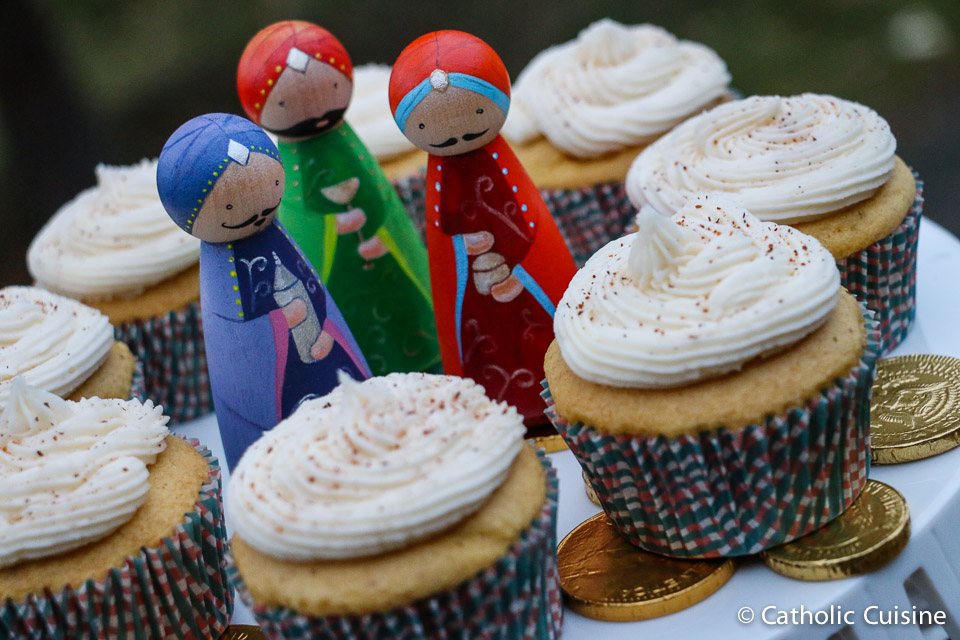
Epiphany Cupcakes from last year's celebration!

The Solemnity of the Epiphany is celebrated either on January 6 or, according to the decision of the episcopal conference, on the Sunday between January 2 and January 8. (source)

The word Epiphany means “manifestation.” As such, the object of the Church on this feast is not only to commemorate the historical arrival of the Magi with their gifts for the new-born King, but moreover to adore the same Christ Who continues to reveal Himself to us today.

It is an ancient custom to bless the home on Epiphany followed by a festive meal. The current year and the legendary initials of the three Magi (Caspar, Melchior, Balthasar) are marked above the outside doorway with blessed chalk; crosses are placed between the initials and year: 20+C+M+B+17. The initials C-M-B are also interpreted as the Latin phrase “Christus Mansionem Benedicat” which means “Christ bless this home!”


Pin It

Thursday, January 21, 2016

Lamb Ragout over Potatoes for St. Agnes


Ragout is a thick, rich stew. Serving this lamb ragout over mashed potatoes creates a hearty meal for a cold January day, such as the feast of St. Agnes, January 21.  I was particularly attracted to this version of a ragout recipe, as it is served over the mashed potatoes and the fluffy mashed potatoes remind me of lamb's wool - a fitting St. Agnes association to go along with the actual lamb roast.  St. Agnes is typically pictured holding a lamb, and her name means lamb. 

Lamb Ragout

Ingredients

1 tablespoon olive oil
1 1/2 pounds lamb stew meat, cut in cubes
1 cup chopped onion
2 medium carrots, sliced 
2 medium sweet potatoes, cubed
1 can (28 ounces) crushed tomatoes
2 cans (14 ounces each) beef broth
3/4 cup dry red wine
2 teaspoons dried rosemary
1 teaspoon salt
Mashed potatoes

Directions

Heat oil in Dutch oven over medium-high heat. Add stew meat and onion. Cook and stir occasionally until meat is browned. Add remaining ingredients (except mashed potatoes). Bring to a boil. Reduce heat to low; cover. Continue cooking about 2 hours until meat and vegetables are tender.
Serve ragout over mashed potatoes in bowls.

St. Agnes, Pray for us. 

Pin It

Thursday, January 7, 2016

Baptism of the Lord River Jordan Dessert

The following recipe for the Feast of the Baptism of the Lord was submitted by Tamalyn Lawrence. She shares that "It's very simple - blue water, sandy beaches, shells in the sand and blueberries for the river Jordan on top. Super easy and my kids really enjoyed it!" Thank you, Tamalyn!


Baptism of the Lord River Jordan Dessert

Ingredients:
  • 1 quart pineapple sherbet or vanilla ice cream
  • 8 oz whipped topping like Cool Whip
  • 2 tablespoons graham cracker crumbs
  • 1 pint fresh blueberries
  • 1 teaspoon white sugar
  • 2-3 individual madeleine cookies (flavored or plain)
  • blue food coloring


Directions:

1. Soften frozen ice cream or sherbet and spread in an 8x8 glass pan. Stir in blue food coloring and refreeze. "water"

2. Once ice cream has frozen, spread whipped topping across the top. Return to freezer or go ahead and decorate now.

3. Sprinkle graham cracker crumbs on the corners to create the "sand", leaving a space in the middle.

4. Dot blueberries through the middle path to create the "River Jordan". Sprinkle white sugar on top of the blueberries.

5. Break madeleine cookies in half to push in the "sand" to make the "shells".

Serve immediately (can be frozen, but blueberries will freeze).


Note: Traditionally, the Feast of the Baptism of the Lord is celebrated on January 13, the octave day of Epiphany. In the current liturgical calendar, the Baptism of the Lord is celebrated on the Sunday after January 6, which will fall on January 10, 2016.

Pin It

Tuesday, January 5, 2016

Bohemian Kolaches for St. John Neumann


John Nepomucene Neumann was born on March 28, 1811, in the village of Prachatitz in Bohemia  which is now the Czech Republic. John, who had always been interested in being a missionary to America and came to the United States at age 25 and was ordained a priest in 1836.  He served the Niagara frontier for several years. He joined the Redemptorists and professed vows in 1842 and was the first Redemptorist to be professed in the United States.

Fr. John Neumann became a naturalized citizen of the United States in 1848.  His ability to speak seven languages, German, Czech, English, French, Italian, Spanish and Gaelic helped him to serve his people. In 1852, he was appointed the 4th Bishop of Philadelphia. His first concern was always the immigrant children. He gave first priority to establishing schools and is credited with setting up the first system of diocesan parochial schools in the United States.  Also during Neumann's administration, new parish churches were completed at the rate of approximately one per month.

Bishop Neumann collapsed and died January 5, 1860.   On June 19, 1977, John Nepomucene Neumann became America's third Roman Catholic saint, and the first American male saint.

His feast day is January 5 and he is the patron of sick children and immigrants.  [Biography]

To remember St. John Neumann on his feast day, a beloved Bohemian pastry, kolaches, make a great treat. A kolache is a sweetened yeast pastry filled with a fruit, cream cheese, or a poppy seed filling. There are probably about as many variations as there are Czech grandmas.  There are many different shapes, sizes and fillings.  From rounds to folded pockets, hand sized to pie-sized, sweet to savory. Some raised, some not. Most seem to agree that the name “kolache” (or kolach, kolace, kolacky) comes from the Czech word for “cookie”.  So I tried my hand at one variation in honor of the Bohemian to American saint, St. John Neumann. 

Kolaches

Ingredients:
2 packages active dry yeast
½ cup sugar, divided
2 cups warm milk (110° to 115°)
5 ½ to 6 ½ cups flour
2 eggs
1 teaspoon salt
¼ cup butter, softened
2 cups canned prune, poppy seed, cherry or lemon filling
1 egg white, beaten

Directions:
In a small bowl, dissolve yeast and 1 tablespoon sugar in warm milk; let stand 10 minutes. In large bowl, combine 2 cups flour, remaining sugar, eggs beaten, salt, butter and yeast/milk mixture. Mix until smooth. Add enough remaining flour to make a stiff dough.

Turn out onto a floured surface and knead until smooth and elastic, about 6-8 minutes. Add additional flour, if necessary. Place dough in greased bowl, turning once to grease top. Cover; let rise in a warm place until doubled in bulk, about 1 hour.

Roll the dough into balls.  Place balls on pan lined with parchment paper and brush balls with melted oil. Let rise until dough is light (double height).  


Firmly press indentation in center and fill each roll with a heaping tablespoon of filling. Here is a link to recipes for several different fillings.


Brush dough with egg white. Bake at 350° for 10-15 minutes or until rolls are light golden brown. Yield: about 28 rolls.


PRAYER FOR INTERCESSION OF ST. JOHN NEUMANN

O Saint John Neumann, your ardent desire of bringing all souls to Christ impelled you to leave home and country; teach us to live worthily in the spirit of our Baptism which makes us all children of the one Heavenly Father and brothers and sisters of Jesus Christ, the first-born of the family of God.

Obtain for us that complete dedication in the service of the needy, the weak, the afflicted and the abandoned which so characterized your life. Help us to walk perseveringly in the difficult and, at times, painful paths of duty, strengthened by the Body and Blood of our Redeemer and under the watchful protection of Mary our Mother.

May death still find us on the sure road to our Father's House with the light of living Faith in our hearts. Amen.

[Edited to add: This is also an idea for celebration of Servant of God Fr. Emil Kapaun, whose remains have been identified and returned to Kansas 70 years after his death as a POW in Korea. Fr. Kapaun was a son of Czech/Bohemian immigrants as well. Sept. 27, 2021]
Pin It

Monday, January 4, 2016

Italian Epiphany - Befanini


It is interesting to discover the various traditions of the Christmas season from around the world. My interest in Italian culture increased this year since my daughter spent a semester abroad in Florence. The Italians have the tradition of La Befana, the old woman. In folklore, Befana visits all the children of Italy on the eve of Epiphany (Jan. 6th) to fill their socks with candy and presents if they are good or a lump of coal or dark candy if they are bad. The name Befana is derived from the word epifania, the Italian name for Epiphany (Greek). One traditional treat made for Epiphany in Italy, particularly Tuscany region, is a sugar cookie called Befanini.

Befanini - Italian Epiphany Sugar Cookie

Ingredients:
  • 3 cups flour
  • 1 ½  cups sugar
  • 6 ounces butter (softened)
  • ½ cup of milk
  • 3 eggs plus 1 for the egg wash
  • Zest of half lemon
  • 1 tablespoon baking powder
  • pinch salt
  • 2 tablespoon of Sambuca or Rum
  • multicolored sprinkles

Directions:
In mixing bowl, combine the flour and the sugar.  Add the softened butter and mix.  Add the eggs and continue mixing.  Now add the lemon zest, the baking powder, the salt and the liqueur.  Mix on medium speed adding the milk as necessary to make a smooth dough.  

Transfer the dough to floured pastry board and knead to form a ball.  Wrap the dough and refrigerator for 30 minutes.

Preheat oven at 350 degree.  Add flour to working surface and around your rolling pin. Roll out the dough to 1/4 inch thick.  Use cookie cutters in different shapes to cut your cookies.  Stars are especially appropriate for Epiphany.

Place on the cookie sheet lined with parchment paper. Make an egg wash with one egg and a bit of milk. Brush the cookies with the egg wash mixture and add sprinkles.


Bake for 10-12 minutes at 350 until nice gold color.  Remove from oven and transfer to a cooling rack.  Makes about 5 dozen.
Pin It

Wednesday, January 21, 2015

Mini Ground Lamb Pot Pie Cupcakes for St. Agnes Day


I was looking for a lamb dish to make on the feast of St. Agnes and came across this cute idea for mini pot pies. Combining tender lamb with sun-dried tomatoes in a mini pastry crust and topping with mashed potato icing makes pretty “cupcake” looking pot pies.  


Lamb Pot Pie Cupcakes


Ingredients:

  • 3/4 lb. ground lamb
  • 8 oz sun-dried tomatoes, chopped
  • ¼ cup onions, chopped
  • 1 T. Olive oil 
  • Salt, pepper to taste
  • Mashed potato – for 'Icing' topping
  • Mini crusts, pre-made


Directions:

In skillet, saute onions in olive oil until tender. Add ground lamb and cook until browned.  Add sun dried tomatoes, cook for about 5 minutes. Salt and pepper to taste. Fill 12 mini pastry crusts with the ground lamb mixture.  Fill a piping bag with mashed potatoes. Pipe a swirl on top of the meat mixture to cover.  Place under a hot preheated broiler for 2-3 minutes to brown the mashed potatoes. Serve hot or cold. Good for a buffet, snack, lunch or dinner.   Makes: 12 mini pies

St. Agnes, Pray for us!


Pin It

Tuesday, January 20, 2015

St. Agnes Lamb's Wool Drinks

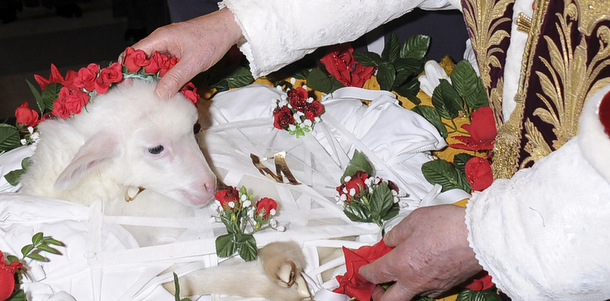
On January 21 we celebrate the feast of St. Agnes, 4th century martyr, known for her consecrated virginity. She is often depicted holding a lamb as her name, Agnes, means lamb or victim in Latin, and pure in Greek. In Rome on this feast day, two lambs are placed on the altar of the Basilica where her relics lie and are then blessed. The wool from these lambs is used in making the pallium, the symbols archbishops wear as sign of their authority. These are given to the new archbishops on the Feast of Sts. Peter and Paul, June 29.


There are so many beautiful details associated with this tradition, as specified in this article from the Vatican News Network:

The small lambs, traditionally less than a year old, are carried to the Pope in baskets, as per tradition, by the Canons Regular of the Cathedral of St John Lateran. To symbolize St. Agnes’ purity, one of the lambs wears a crown of white flowers, while the other wears a red floral wreath to recall her faithful witness even unto death.

Reared by religious sisters in the Saint Lawrence convent in Panisperna, Rome, come Summer these same lambs will be brought to the Saint Cecilia convent in Trastevere.  There, in a custom that has remained in tact down through the centuries, they will be shorn to supply the wool from which the religious sisters will weave the Pallium.

The Pallium are white woolen stoles, decorated with six black crosses worn by metropolitan archbishops around their necks as a symbol of their authority and unity with the Pope. Once woven they are custodied in an urn at the tomb of St Peter until the Holy Father presents them to newly-appointed metropolitan archbishops on June 29, the feast of Sts. Peter and Paul.


St. Agnes Lamb's Wool Drink Ideas

With the connection of lamb's wool, St. Agnes feast day lends itself to anything fluffy and white. Whipped cream seemed a fun way to try to replicate the look of wool and with this mid-winter feast, a perfect topping for a warm drink.  It's easy too!  Whether it be hot chocolate, chia latte, or a cappuccino, make it St. Agnes festive with a "woolly" topping. 


And if you are looking for some specific drink recipes with woolly names here are a few that would be fitting as well. 

Lamb's Wool - a type of Wassail ale dating from medieval times, traditionally served on Twelfth Night celebrating the end of the Christmas season. It is so named as the frothy apple mixture resembles wool. It would make a fun drink for St. Agnes feast celebrating as well. Florence Berger has a recipe for Lamb's Wool in her Cooking for Christ cookbook.  There are other versions of this wool-named ale including this one from Miss Foodwise blog.  Can be made as either an alcoholic or non-alcoholic drink.

Warm Wooly Sheep - a sweet, creamy, warm drink for the grown ups. It is made from Scotch, Drambuie, and warm milk. Recipes abound on various mixed drink websites.

St. Agnes, Pray for us!

Pin It

Monday, January 19, 2015

Altagracia Cookies

This post was written by Catholic Cuisine contributor, Charlotte from Waltzing Matilda

Legend says that the pious daughter of a rich merchant asked him to bring her a portrait of Our Lady of Altagracia from Santo Domingo, but no one had heard of that title. The merchant, staying overnight at a friend's house in Higuey, described his problem as they sat outdoors after dinner. An old man with a long beard, who just happened to be passing by, pulled a rolled up painting from his bindle, gave it to the merchant, and said, "This is what you are looking for." It was the Virgin of Altagracia. They gave the old man a place to stay for the night, but by dawn he was gone, not to be seen again. The merchant placed the image on their mantle, but it repeatedly disappeared only to be found outside. They finally returned it to the church. 

In the picture book, A Gift of Gracias, by Julie Lavarez, a connection is made between this special feast day and oranges. These Orange Carrot Cookies would be a delightful treat for the Feast of Our Lady of Altagracia, coming up on January 21st, especially paired with a reading of the book. You can find the original recipe over at Dawn's blog, By Sun and Candlelight. I made a few changes that I will post here. Just FYI, these are soft, almost muffin-top like cookies, not crispy or crunchy cookies.

Altagracia Cookies

1 egg, room temperature
1/2 C. unsalted butter, softened
1/2 - 3/4 C. sugar (I used less.)
1 tsp. vanilla extract
the zest of 1/2 an orange (about 1 Tbl.)
1 C. mashed, cooked carrots
2 C. all purpose flour
1 1/2 tsp. baking powder
(sugar sprinkles, optional)


Preheat oven to 350 degrees. Combine baking powder and flour and set aside. Cream the egg, butter, sugar and vanilla. Add carrots and zest and mix well. Slowly incorporate flour mixture being careful not to over mix. Drop by tablespoons onto parchment covered cookie sheets. Add sugar sprinkles if desired. Bake 10-12 minutes. Remove from oven and let cookies cool on a wire rack. 
Pin It

Tuesday, January 6, 2015

Chicken Tikka Masala for Epiphany


Behold, wise men from the East came to Jerusalem, saying, "Where is he who has been born king of the Jews? For we have seen his star in the East, and have come to worship him."  
Matthew 2:1-2

January 6th is the traditional feast of Epiphany! To celebrate I decide to serve an Eastern dinner of Chicken Tikka Masala, Basmati Rice with Fresh Cilantro, and Naan recalling the "wise men from the East!" This was the first time I've made Chicken Tikka Masala and I most definitely will not be waiting another year to make it again. It turned out amazing!
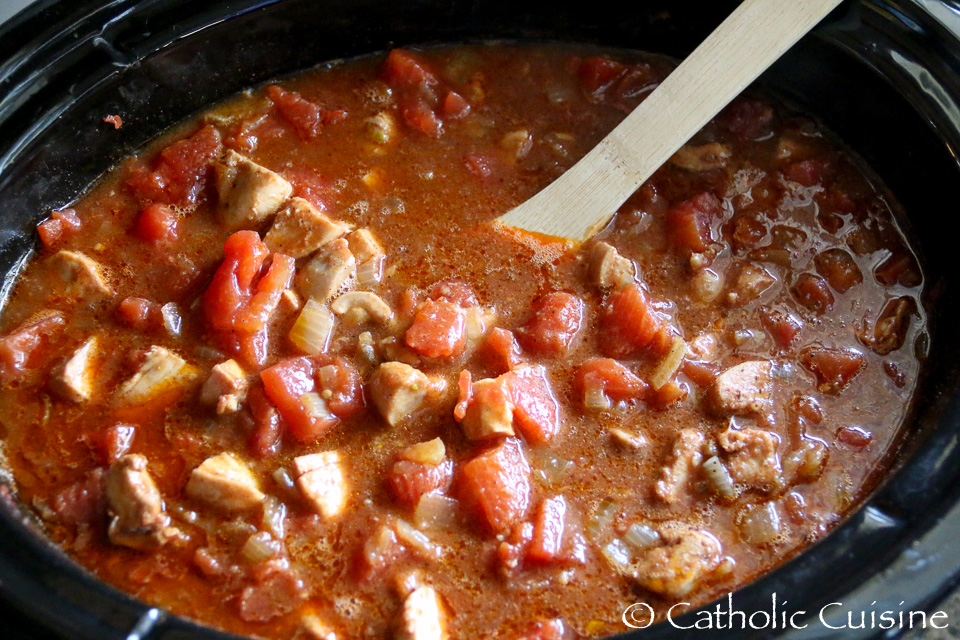

Slow Cooker Chicken Tikka Masala
adapted from thekitchn

Ingredients: 
  • 3 pounds boneless, skinless chicken thighs
  • 2 onions, diced
  • 6 cloves garlic, minced 
  • 2-inch piece whole ginger, peeled and grated
  • 4 tablespoons tomato paste
  • 2 to 3 tablespoons garam masala
  • 4 teaspoons paprika
  • 4 teaspoons kosher salt
  • 4 (14.5-ounce) cans diced tomatoes
  • 1 can coconut cream
  • Fresh cilantro, chopped
  • Basmati rice, cooked 


Directions: 

Cut the chicken thighs into bite-sized pieces and transfer them to a 6-quart slow cooker.

Sauté the onions and garlic in a skillet with a little coconut oil over medium-high until softened, then stir in the tomato paste, grated ginger, paprika, salt, and 2 tablespoons of garam masala until fragrant. 


Transfer to the slow cooker. Stir in the diced tomatoes (with their juices) and mix until the chicken is evenly covered with spices.


Cover the slow cooker and cook for 4 hours on high or 8 hours on low. 


Fifteen minutes before the end of cooking, stir in the coconut milk. If you prefer a thicker sauce, leave the slow cooker uncovered for the last 15 minutes. 


Taste and add more garam masala or salt if needed. Serve over rice with fresh cilantro sprinkled over the top of each serving. 

Serves 8 to 12

Note: The Chicken Tikka Masala can be refrigerated for 3 to 4 days or frozen for 3 to 4 months.

The beautiful Silent Night Table Runner can be found here. 


Happy Epiphany! 

Pin It

Saturday, January 3, 2015

Epiphany Star Appetizers


The wise men were guided to the baby Jesus by following the star they saw in the East, so the five-pointed or Epiphany star is a common symbol of the feast.  Let these fun, and simple to prepare, sausage and puff pastry appetizers guide the way for a fun Epiphany treat to celebrate the day. 

Epiphany Star Appetizers
Ingredients:
  • 1 lb. mild/sweet Italian sausage links
  • 1/2 sheet Puff Pastry (thawed)
  • 1 egg
Directions:
Cut the sausage links into 36 slices, approx. 3/8 inch. Brown the meat on both sides in a frying pan over medium heat. No need to fully cook as it will cook in oven. Set aside on a plate to cool while you get the pastry ready.

Lay the pastry out on work surface. Whisk egg in small dish and brush the surface of the pastry with mixed egg. Using a mini star cookie cutter, cut out 36 star shapes from the pastry. 

Place the meat onto a baking sheet and cover each one with a star of pastry and secure with a toothpick. Bake in a 400 degree oven for 15 minutes. 
Pin It

Saturday, January 25, 2014

St. Paul Lunch

The following post was submitted by Lisa, from Catholic Missionary Family, in honor of today's feast of the Conversion of St. Paul. It would also be perfect for the feasts of Sts. Peter and Paul on June 29th. Thank you Lisa!

For the Feast of the Conversion of St. Paul today I put together a special lunch for the kids using St. Paul symbols. It was easy, quick, and very kid friendly. Maybe this is what I had for lunch as well, so maybe it's also adult friendly.


Here is what you'll need to put on your shopping list.


"Wait, what is the ice cream for?" you ask. It's for the stormy sea dessert! Let's start there.


St. Paul made many voyages to spread the gospel. On one such trip there was a massive storm that left him shipwrecked. To remind us of this Pauline adventure we mixed Sprite, blue food coloring, and vanilla ice cream to create a stormy sea.


Because St. Paul was a Roman citizen he was not crucified, but rather beheaded with a sword. For this reason the sword is St. Paul's symbol. To incorporate this symbol into our lunch we made hotdog swords with pretzel stick blades. The kids loved being able to dip these into ketchup and eat them in one bite.


As I already mentioned, St. Paul made many voyages, so we made apple and cheese ships for the many boats he traveled on.


Finally, St. Paul is the author of many of the books of the New Testament. In the past the Scriptures were written on and read from scrolls. To remind us of St. Paul's writings we had Fruit by the Foot scrolls.

St. Paul, pray for us!

Pin It

Tuesday, January 21, 2014

Marshmallow Lamb Cookies


The lamb, as a symbol of purity, is one of the symbols of St. Agnes. Every year on January 21st, the memorial of St. Agnes, the pope blesses two lambs that have been raised by Trappists of the Tre Fontane Monastery outside of Rome. After the lambs have been blessed they are taken to Benedictine nuns at the Monastery of St. Cecilia in Rome. Here the nuns care for them and use their wool to weave the palliums worn by the Pope and his Archbishops. The palliums are conferred on new archbishops (those appointed as archbishops during the preceding year) on the Feast of Sts. Peter and Paul on June 29th.

"The palliums are about 3 inches wide and have a 14-inch strip hanging down the front and the back. The strips are finished with black silk, almost like the hooves of the sheep the archbishop is symbolically carrying over his shoulders." (CNS)

According to The Church's Year of Grace, "Our saint's name should be traced to the Greek hagne - the pure, rather than to the Latin agna - lamb. But the Latin derivation prevailed in the early Church. The reason may have been that eight days after her death Agnes appeared to her parents with a train of virgins, and a lamb at her side. St. Augustine knew both derivations. "Agnes", he writes, "means 'lamb' in Latin, but in Greek it denotes 'the pure one'."  (Catholic Culture)

Because of St. Agnes's association with lamb,  I made some quick and easy Marshmallow Lamb Cookies for the children to enjoy while coloring pictures and listening to a story about the life of St. Agnes in honor of her memorial.  These Marshmallow Lamb Cookies would also be perfect to make during the Easter season!


Marshmallow Lamb Cookies 
Adapted from Last Minute Mel

Ingredients:
  • Graham Crackers
  • Mini Marshmallows
  • 1 T Confectioners Sugar (and a drop of milk to make icing)
  • Raisins
  • Food Marker

Directions: 

Using a serrated knife and a gentle sawing motion, cut the graham crackers to a somewhat oval shape.

Spread a thin layer of the powdered sugar icing over the top of the graham cracker and cover with marshmallows. 


Microwave on high for approximately 10 seconds.  Remove from microwave and gently push the marshmallows together and flatten slightly.


Add the raisin for the ear and draw in an eye.  Enjoy! 


Pin It