Showing posts with label New Years. Show all posts

Friday, January 5, 2018

Star of the East - Spiced Wine for Twelfth Night

Warm spiced wine, like the Austrian Gluhwein, along with Wassail or Lambs Wool are common traditional drinks served at Twelfth Night celebrations.  Anise is both a spice that can be used for seasoning a mulled wine (or other drink), as well as a symbolic star garnish to add visual appeal.

Gluhwein

Ingredients:
1 (750 milliliter) bottle red wine
3/4 cup water
3/4 cup white sugar
1 cinnamon stick
1 orange
10 whole cloves
2 anise stars
Optional – 1/2 cup rum

Combine the water, sugar, cinnamon, star anise, and cloves in sauce pan. Bring to a boil while stirring constantly, then reduce heat to simmer.

Cut the orange in half and squeeze the juice into pan. Add orange rind. Cook until the mixture starts to thicken like syrup.

Pour in the wine and rum (if using) and stir, heating gradually until steaming. DO NOT BOIL. Remove oranges and serve in prewarmed mugs. Garnish with star anise. 

Your Light is Come: Closely linked to both these themes of divine manifestation and world kingship is a third idea running through the Epiphany feast: that of light. During Advent, the world was in darkness, and we prayed and waited in the spirit of the Jewish nation which lived in expectation of the Coming Light during thousands of years. At Christmas the Light shone forth, but dimly, seen only by a few around the crib: Mary and Joseph and the shepherds. But at Epiphany the Light bursts forth to all nations and the prophecy is fulfilled: "The Gentiles shall walk in Thy light, and kings in the brightness of Thy rising." The mysterious star of Epiphany, "flashing like a flame," is still another facet of the light-motif, a symbol capable of being interpreted in a dozen different ways. Catholic Culture article: "Meaning of Epiphany"

There are many lovely star anise garnished drinks and cocktails that would be fun to make for a Twelfth Night celebration.
Pin It

Saturday, November 29, 2014

Liturgical New Year's Eve Celebration

Happy New Year's Eve! No, not that one - - the eve of the new liturgical year. Several years ago it was suggested to us by a friend that we should celebrate this new year as well. As we begin a new liturgical year on Sunday, the first day of Advent, it is a fun time to recognize the changing of the liturgical year in your homes. Sometimes we have had a party and celebrated with friends, but generally we are more low key but always trying to ring in the new year with something festive like sparkling cider to toast the new year. You don't have to stay up late. Anytime during the day is fine as the new year ushers in with the anticipatory Mass times on Saturday  night.  And you can even celebrate on the first day of the liturgical year (Sunday) instead of the eve. We usually do our toasting the old year and ringing in the new at dinner one of those days.


So here is to a new liturgical year. 

May God bless you abundantly. 
Pin It

Tuesday, October 1, 2013

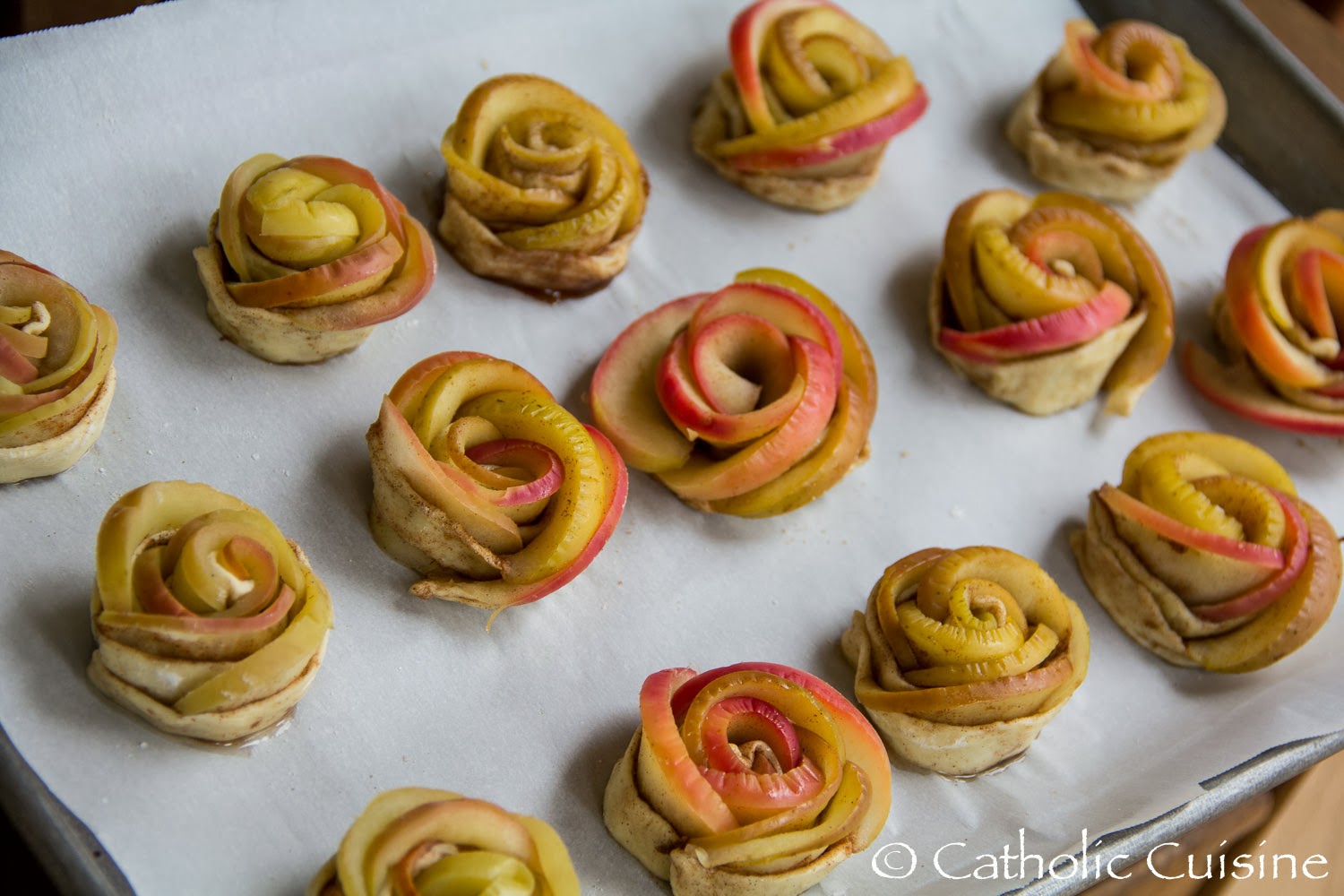
Heavenly Garden Apple Rose Pastries


My girls and I enjoyed baking Apple Roses in preparation for the feast of St. Thérèse!  There are many variations of Apple Roses that can be found online, including pies, tarts, cakes and more, but we decided to use the puff pastry sheet we had in the freezer to make the following Apple Rose Pastries.  Happy Feast of St. Thérèse! 


Heavenly Garden Apple Rose Pastries
adapted from here and here

Ingredients:
  • 1 Puff Pastry Sheet 
  • 3 Apples - I used a combination of Fuji and Pink Lady
  • 5 Tablespoons Sugar
  • 2 teaspoons Cinnamon
  • 1 pinch Nutmeg
  • 1 teaspoon Lemon Zest
  • 4 cups Water
  • 3 Tablespoons sugar
  • 2 Tablespoons lemon juice
  • Powdered Sugar for dusting (optional)
  • Parchment Paper

Directions:


Wash and core the apples. Slice in very thin slices, slightly smaller than 1/8 inch.  Place the sliced apples in a saucepan along with the 4 cups water, 3 tablespoons sugar and 2 tablespoons lemon juice. Bring to a boil and let simmer for 2 minutes, or until the apple slices soften and can easily bend. 


Strain the apples and let cool in the colander.  Line a plate with paper towels and nicely arrange the apple slices so that they can dry and cool completely.


While the apples are cooling, mix the 5 tablespoons of sugar with the cinnamon, nutmeg and lemon zest.  Prepare you work surface by lightly sprinkling it with some flour (or just use a silicone mat) and unfold the sheet of puff pastry (it is easiest to work with if it is not completely thawed).  Using a pastry (or pizza) cutter, cut long strips approximately 1/2 inch wide.  Spread the cinnamon mixture over the dough and slightly press it down.


By this time your apples should be cool and almost dry.  Take a few slices and place them on the first strip of pastry dough, overlapping them so they do not fall out and will create a rose-like design (petals) once completed.  Now start rolling, making sure it is fairly tightly rolled.  Place on a baking sheet covered with parchment paper.


Repeat until you have create all of the Apple Roses.


Bake at 425˚F for 25 minutes, or until nicely golden.


Dust with powdered sugar if desired.


St. Thérèse, the little flower, please pick me a rose from the heavenly garden and send it to me with a message of love; ask God to grant me the favor I thee implore and tell Him I will love Him each day more and more. -Rose Novena

Pin It

Wednesday, January 2, 2013

Vasilopita

The following recipe, adapted from Cooking with the Saints, was submitted by Hi Cookery in honor of the feast of St. Basil the Great. Thank you Highlander and Islander!


January 2: Feast Day of St. Basil

Long before we started blogging, Highlander gave Islander the cookbook “Cooking with the Saints” as a Christmas gift. Vasilopita was the very first recipe she made in the new year and for the Feast Day of St. Basil. Now we can blog about the traditional Greek cake that we bake for a simple new year’s celebration at home.

According to the author, Ernst Schuegraf, “different recipes (for Vasilopita) exist, (but) they all include the hiding of a silver coin in the cake, which is supposed to bring luck to the person who finds it. The head of the family slices the cake and distributes the pieces in a very precise order. The first piece is for St. Basil, the second one for Christ, the third one for the oldest member of the family and on down to the youngest.”

The hiding of the coin represents Baby Jesus hiding from King Herod. Different cultures make cakes with hidden coins, beans or trinkets around this time of the year. Include Vasilopita in your recipe repetoire during the 12 days of Christmas, which come to a close on Epiphany (January 6), and celebrate the new year and the Feast Day of St. Basil with this special cake.

Recipe

(Adapted from Cooking with the Saints by Ernst Schuegraf)

For the cake

  • ½ cup (1 stick) butter
  • 1 cup sugar
  • 1 ½ cups flour
  • 3 eggs
  • ½ cup milk
  • 1 teaspoon baking powder
  • ¾ tablespoon lemon juice
  • ½ teaspoon baking soda

For the topping

  • 1/3 cup nuts, chopped (we used walnuts)
  • 2 tablespoons sugar

Directions

Line an 8-inch round pan with waxed paper. Lightly grease the bottom and sides with cooking spray or vegetable oil. Set aside. In a large bowl, cream the butter with the sugar. Add the flour and mix until it resembles coarse crumbs. Beat in the eggs one at a time until well incorporated.


In a measuring cup, pour the milk then stir in the baking powder. Add this to the flour mixture and blend until smooth. In another small cup or shot glass, mix the lemon juice with the baking soda (it will be fizzy). Add this to the cake batter.


Pour the batter into the prepared baking pan. Place a clean coin (optional) in the batter. Bake in a preheated oven at 350 degrees F for 20 minutes.


Meanwhile, prepare the topping by mixing the chopped nuts and sugar. When the 20-minute baking time is up, remove the cake from the oven and sprinkle the topping over the cake. Return to the oven and continue to bake for 20-30 minutes until the cake is done. Remove from the oven and cool completely. Remove from the pan and transfer to a cake plate or serving platter.


Notes

  • If there is a coin hidden in the cake, let others know about the symbolism—and safety!—before they eat their slice. We usually wrap a silver dollar in waxed paper or foil before including it in the cake batter.
  • The cake may be decorated with numbers representing the new year.
  • Serve Lakror as the main dish, followed by Vasilopita for dessert, for a full meal on the Feast Day of St. Basil. The recipe for Lakror is included in an earlier blog post.
  • The Feast Day of St. Basil is observed on January 1 in the Eastern Orthodox Church; January 2 in the Roman Catholic, Anglican and Lutheran churches; January 15 in the Coptic Christian and Ethiopian Orthodox churches; January 30 in the Byzantine Rite; and June 14 in the Episcopal Church.
  • Bake a galette des rois (3 Kings Cake) a few days later with a hidden bean (instead of a coin) to celebrate Epiphany.

Pin It