Showing posts with label Polish recipes. Show all posts

Friday, October 21, 2016

Classic Polish Cucumber Salad for St. John Paul II


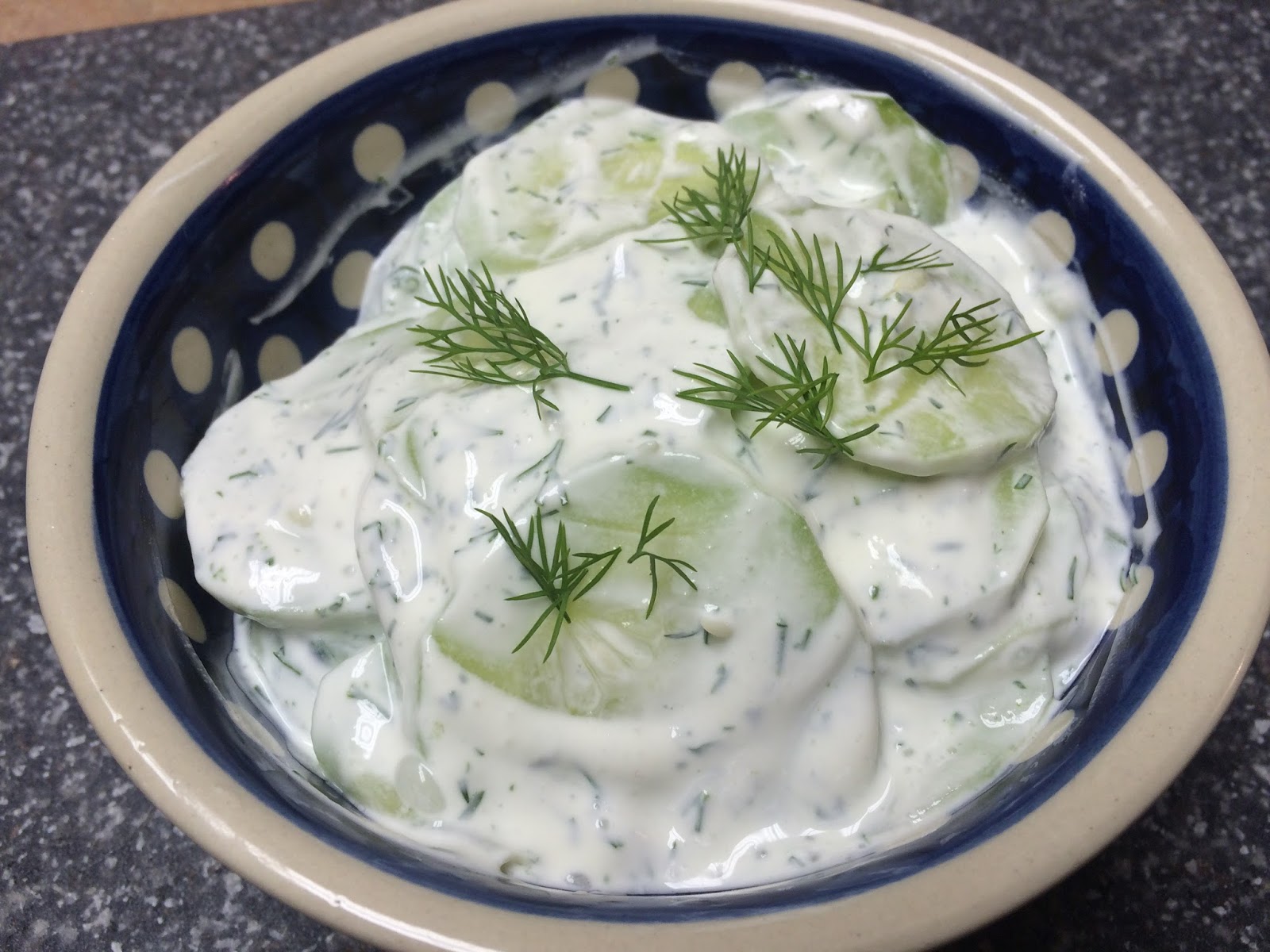
There are two foods that I associate with going to visit my relatives on the farm where my Polish American father was born and raised - and Mizeria, cucumber in a creamy dill dressing, is one.  It was a staple. From most Polish families you will hear the same. As a classic Polish salad side dish it seems very fitting for the feast day of St. John Paul II (Karol Wojtyła), October 22. And it is super simple to make - a bonus for a busy day.

Mizeria - Polish Cucumber Salad

Ingredients
  • 1 large cucumber 
  • 1 teaspoon salt
  • 1 tablespoon chopped fresh dill
  • 1/4 to 1/3 cup sour cream
  • 1 tablespoon white or cider vinegar
  • pinch of sugar
  • 1/4 teaspoon freshly ground black pepper 

Directions
Peel cucumber(s).  Slice cucumber very thinly and place in a bowl.  Sprinkle slices with salt and let sit for 30 minutes to pull the liquid. Drain water from the salted cucumbers and gently squeeze to expel any remaining water.  Pat dry with paper towel.  

Mix sour cream, vinegar, sugar, and dill in medium bowl.  Toss cucumber slices in mixture. Allow the salad to marinate in the refrigerator for at least an hour.  Taste, season with salt and freshly ground pepper as needed and serve.  Garnish with dill if desired. Serves 4 but is easily doubled or tripled. 

St. John Paul II, the Great, Pray for us!


Pin It

Wednesday, October 15, 2014

Root Vegetable Harvest Recipes for October Saints


October is late harvest time all over the world. The Polish especially have a tradition of emphasizing the and celebrating the harvest season. Late September usually brings frost, so most often only the root crops, like cabbage, turnips, beets and carrots and perhaps some grains are being harvested in October. Old Polish legends talk about harvesting these late root crops and sowing of winter wheat on or just after October 16 which is St. Hedwig’s Day or Sw. Jadwiga in Poland. She is a patroness of Poland and it is said that she sweetens these crops if they are left until that date. 

Sw. Jadwiga, jesli deszcz nie pada
To do kapusty Pan Bog miodunada.


On St. Hedwig's, if it's not raining
God grants honey to the cabbage.


Another mid-October feast is tied into Polish harvest lore. It is also said that by St. Luke's Day (Sw. Lukasz), October 18 all the work in the field should have been completed. They might chant:  "Sw. Lukasz day, co w polu szukasz?" (Translated: "On St. Luke's Day, what are you looking for in the fields?"). And of course there is St. John Paul II's feast on October 22. 


So to celebrate the late harvest season and the root vegetables, to recognize a couple October saint feast days, and give a nod to my Polish heritage, I have a couple hearty recipes to share. 


Roasted Root Vegetables 

1 T olive oil
1 small onion, sliced
4 cloves garlic, peeled and minced
2 carrots, peeled and diced
1 turnip, peeled and diced
1 yam or sweet potato, peeled and diced
1 parsnip, peeled and diced
1 t dried rosemary
1 t dried thyme
1 pinch salt
1/2 t black pepper
1-2 T balsamic vinegar, optional for drizzling.

Preheat oven to 375°F. Spray a baking sheet pan with nonstick cooking spray. Combine all ingredients in a mixing bowl and toss to combine. Place mixture on a baking sheet and bake approximately 30 minutes. Turn vegetables every 10 minutes until vegetables are tender and slightly browned. Drizzle with balsamic vinegar before serving.
Makes 6 servings.

Polish people make a lot of zupa (soups), and starting with the cold weather and the harvest, soup is a wonderful addition to any meal.  Here is one that combines some of the root vegetables that are common in Polish fare.

Cabbage Kielbasa Soup

1 small head cabbage, shredded
1 small onion, chopped
4 garlic cloves, minced
2 T olive oil
4 cups water
3 T cider vinegar
1 T brown sugar
1 pound Kielbasa sausage, halved, cut into 1/2-inch pieces
4 medium potatoes, peeled and cubed
3 carrots, chopped
1 t caraway seeds
1/2 t pepper


In a Dutch oven or large kettle, saute the cabbage, onion and garlic in oil until tender. Add water, vinegar and brown sugar to cabbage mixture.  Stir in remaining ingredients. Bring to a boil. Reduce heat; cover and simmer for 60-70 minutes or until vegetables are tender. Makes 8-10 servings.
Pin It

Wednesday, April 27, 2011

Kremówka Papieska :: Papal Cream Cake


Back in 1999, during a visit to his old home town of Wadowice, Pope John Paul II mentioned that he was very fond of the cream cake (or kremówka) that, as a child, he and his friends in school would buy from one of the bakers in the town's market after putting their money together.   The next day the entire town was arriving with kremówka, suddenly renamed Kremówka Papieska, the "Papal Cream Cake.

I have been meaning to make this cake for a couple years now, ever since running across the story and recipe at European Cuisines!  With the Beatification of Pope John Paul II coming up on May 2nd, Divine Mercy Sunday, I am finally going to try it out and thought I would share the recipe now, in case any of you would like to prepare it this weekend as well.

Kremowka Papieska - Papal Cream Cake
Source: European Cuisine

For the cake:

8 ounces butter
3 cups flour
3 tablespoons water
3 egg yolks
A pinch of salt

Grease 2 - 8" or 9" baking pans, coat with bread crumbs and set aside.  Cut the butter into the flour with a pastry blender.  Beat the egg yolks into the water: mix into the flour. Mix well. Divide in halves and spread/press each half to completely cover the bottom of one of the baking pans. Bake for approximately 30 minutes in a medium-low oven (325F / 160C): remove and let cool. Remove from pans when cooled.

For the custard cream:

2 cups milk
1/2 teaspoon vanilla extract
3/4 cup sugar
1/3 cup flour
A pinch of salt
6 egg yolks

Scald the milk and vanilla. In a heavy saucepan, combine the sugar, flour, salt, and egg yolks. Stir until very well blended (ideally, whisk to make sure there are no lumps). Add milk gradually. Cook over low flame, stirring constantly, being careful to scrape bottom of pan.

Bring to a boil and continue boiling for 3 minutes. Pour cream into a bowl and let cool. Stir occasionally until cold.

When the custard cream is cold, spread over one of the layers of baked pastry. (If the custard is at all runny, put one baked layer back in one of the baking pans and then do the spreading.) Top with the second baked layer. Dust with confectioners' sugar. Cut and serve (possibly with thick whipped cream on top, if you like)

~ • ~ • ~ • ~ • ~ • ~ • ~ • ~ • ~ • ~ • ~ • ~ • ~ • ~ • ~ 

I also recently ran across another variation that looks a little simpler to make, using frozen puff pastry for the dough:

Polish Papal Cream Cake
Source: About.com

2 sheets (1.1-pound package) frozen puff pastry dough, thawed
1 recipe Easy Pastry Cream (see below)
Confectioners' sugar

Preparation:

Heat oven to 400 degrees. Roll out each piece of puff pastry slightly to blend the seam lines. Without cutting all the way through, lightly score each pastry sheet into 9 sections. Sandwich each puff pastry sheet between two pieces of parchment paper and two cooling racks. This will keep the pastry flat but still flaky. Bake 15 minutes, remove top rack and top sheet of parchment paper. Replace rack and continue to bake until golden and crispy throughout, about 15 more minutes. Cool completely.

If you like a thick layer of filling, make a double batch of Easy Pastry Cream.

Using a 13x9-inch pan as a mold, place one layer of cooked puff pastry in the bottom of the pan. Pour hot pastry cream over it, and place second layer of cooked puff pastry on top. Refrigerate until set. When ready to serve, using the prescored marks as guides, cut into 9 pieces. Dust each piece with confectioners' sugar. Refrigerate leftovers.

Easy Pastry Cream

2 cups milk
3/4 cup sugar
1 teaspoon vanilla
Pinch salt
5 tablespoons cornstarch
6 large egg yolks (See these leftover egg white recipes.)

Preparation:

In a medium saucepan, bring milk, sugar, vanilla, salt, cornstarch and egg yolks to a boil, stirring constantly with a wire whisk. Reduce heat slightly and continue to boil 1 minute, stirring constantly with a wooden spoon to get in the corners. Take the pan off the heat and plunge it into an ice-water bath or, if you have lumps, strain it through a sieve into a pan or heatproof bowl set in ice water.

If not using the pastry cream hot as in Polish Kremówka Papieska, place a sheet of plastic wrap on the surface of the pastry cream which is cooling in the ice-water bath, and top the plastic-wrapped surface with a layer of ice cubes. Leave the ice cubes in place until the cream cools. Cover and refrigerate for up to 3 days.

~ • ~ • ~ • ~ • ~ • ~ • ~ • ~ • ~ • ~ • ~ • ~ • ~ • ~ • ~ 

And yet another variation can be found at Cafe Galicja, which is located in Pope John Paul II's hometown of Wadowice, Poland!


Additional recipes, to honor Pope John Paul II, can be found in the archives, as well as recipes for Divine Mercy Sunday
Pin It

Thursday, April 9, 2009

Festive Easter Breads and Cheese: Paska and Pascha

ETA 2013: See my updates for Paska and Pascha.

Since my family has no dominant ethnic heritage, I love to dig up cookbooks and be inspired by different cultural traditions for feast days. Florence Berger echoes my thoughts:
Being American Catholic, we can choose the best of the cultures of all the nations of the world and make them ours in Christ. We can call the songs, the stories, the dances and the foods of all peoples our own because in our American heritage there is blood and bone and spirit of these different men and women. If America is a melting pot, it can also be a cooking pot from which we women can serve up a Christian culture. (Cooking for Christ, NCRLC, 1949)
My favorite area is through festive breads (although I confess I haven't been as adventurous since my son was diagnosed with food allergies). My interest in Ukrainian psyanky (and Polish pisanki) made me interested also in the Ukrainian and Polish foods used to celebrate Easter.

One year I made this very simple Paska, Ukrainian Easter Bread from The Festive Bread Book by Kathy Cutler (1982). It's festive, but not heavy, and a perfect accompaniment to the sweet Easter cheese mold. This is usually included in the Easter Baskets brought to church for a blessing (also the Roman Ritual). I simply used a Corning Ware 1-1/2 quart round covered French White Casserole without the lid and it worked out fine (use what you have!).

Paska (Ukrainian Easter Bread)

1 egg
1 egg yolk
2 1/2 - 3 1/2 cups flour
1/4 cup sugar
1/2 teaspoon salt
1 Tablespoon active dry yeast
1 teaspoon grated lemon peel
1 teaspoon grated orange peel
1/2 teaspoon vanilla extract
1/4 cup golden raisins (I used more, up to one cup)
1/2 cup milk
4 Tablespoons unsalted butter
melted butter, if desired

Beat egg and egg yolk until fluffy and light. Add 2 cups flour, sugar, salt yeast, lemon peel, orange peel, vanilla and raisins. Mix thoroughly.

Heat milk and butter to hot (120 to 130 degrees F). Add to flour mixture. Mix thoroughly.

Add enough remaining flour to form a soft dough. Knead on lightly floured surface until smooth -- about 10 minutes.

Place in greased bowl, turning to coat top. Cover; let rise in warm place until double -- about 1 hour.

Punch down dough. Set aside a little of the dough to be used as decoration on top for the loaf. Shape the rest into a ball.

Place in greased cake pan 3 inches deep and 6 inches across or 1 quart souffle dish. Make cross of remaining piece of dough; place on top of loaf.

Cover; let rise in warm place until double -- about 30 minutes.

Bake in a preheated 350 degree oven 45-60 minutes or until done. Cool on wire rack. While still warm, brush with melted butter if desired.

The decorations on top of the loaf are very individual, and can be ornate. These hints from Ukrainian Easter by Mary Ann Woloch Vaughn are extremely helpful. I did a simple cross and made an Alpha and Omega on either side of the cross, reminiscent of the Paschal Candle decorations.

We enjoyed spreading the Easter Cheese Mold on the bread. At first I was a bit confused, as the name for the dessert cheese is Pascha (or Pashka), very close to the Ukrainian name for the bread. And "Pascha" is the Orthodox name for Easter. Once I got the names sorted out, I was convinced I had to try the cheese. I didn't have an "official" mold, so used the clean clay unglazed flowerpot as per A Continual Feast's directions. Be sure to make ahead (today or tomorrow). I omitted the candied fruit. My cheese did not mold (it didn't drain), so I ended up serving from the flowerpot. It was still delicious.

Pascha

This is an absolutely beautiful and delicious dish; versions are prepared in Poland, Russia, the Ukraine, and Latvia. It is made in a tall mold (or flower pot), then turned out onto a large platter and decorated. Cool and rich, it tastes like a cross between ice cream and cheesecake. It goes wonderfully with the sweet Easter breads, such as Kulich, or with the various Easter cakes.

1 whole egg
4 egg yolks
2 1/3 cups sugar
1 cup heavy cream
2 pounds farmer cheese (see comments)
1/2 pound sweet butter, at room temperature
1 tablespoon vanilla extract
1 1/2 cups fruit: raisins and/ or dried currants, mixed candied fruit peel
1 cup blanched almonds, chopped
2 tablespoons freshly grated orange or lemon rind
For decorating:
Candied fruit peel, maraschino cherries, or nuts
Fresh strawberries to place around the base and on top

Beat the egg and the yolks until thick and lemon-colored. Gradually add the sugar, and beat until the mixture is thick and creamy. Pour into a saucepan and add 1/2 cup of the cream.

Heat over medium-low heat, beating constantly, until the mixture begins to thicken. Do not boil. Remove the pan from the heat and continue beating until the mixture has cooled to lukewarm.

In a mixing bowl, combine the cheese, butter, the other 1/2 cup of cream and the vanilla. Cream until the mixture is smooth. Add the egg mixture, then the fruits, almonds, and orange or lemon rind. Blend thoroughly.

Line a flower pot or Pascha mold with 2 thicknesses of cheesecloth. Place the pot over a bowl (to catch liquid), and pour the Pascha mixture into the pot. Put a layer or two of cheesecloth over the top, set a plate on it and something heavy on the plate. (The purpose is to press the extra liquid out of the Pascha and into the bowl below.) Chill overnight or for a day or two.

Remove the top cheesecloth. Unmold the Pascha onto a large platter, and remove the rest of the cheesecloth.

Decorate the Pascha with the candied fruit peel or maraschino cherries or nuts to form the letters XB or CR (Christ is risen) on one side, and on the other side a cross. You may use the Western cross form or the Orthodox cross, or any other cross design that you prefer. In Russia, Pascha is often decorated with an angel and a lily, as well as the cross.

Around the base and on top of the Pascha, place fresh strawberries. Serve chilled.

Yield: 14 to 16 servings
From A Continual Feast by Evelyn Vitz

The best part after making these goodies, was arranging the Easter basket for a blessing at our parish by the pastor. I included our Easter eggs, pysanky, ham, wine, butter lamb, paska and pashka. I loved seeing all elaborate cloths and baskets and beautiful breads and goodies, and it inspired me to do more the next year.

Pictures from easteuropeanfood.about.com and FoodNetwork.com . Pin It

Wednesday, March 4, 2009

Polish Sugar Cookies


You may have noticed that there are quite a few Polish saints on the liturgical calendar. Today's feast of St. Casimir is just one of many. I keep this cookie recipe in my cookbook for just such a feast day. These are a crisp, light cookie (think lemon snickerdoodle), and they would be a perfect tea time treat, as well as a perfect companion to some lemon sherbet or vanilla ice cream for dessert. The first time I made them, I was out of vanilla (I know -- a serious baker's sin), so I substituted 1/2 t. lemon extract. I intended to make them the next time with vanilla, but we loved those lemon cookies so much, I never did try vanilla.


Lemon Polish Sugar Cookies

1 c. butter, softened
1 1/2 c. sugar, plus extra for rolling
3 egg yolks
1/2 t. lemon extract (or 1 t. vanilla)
2 c. flour
1 tsp. baking soda
1 tsp. cream of tartar

Preheat oven to 350 degrees F.
Cream sugar and butter.
Add egg yolks and vanilla (or lemon extract).
Add flour, baking soda and cream of tartar.
Mix until well combined -- dough will be stiff.
Pinch off dough and roll into 1-inch balls.
Roll in granulated sugar.
Place on ungreased cookie sheets.
Bake until set, not brown, for 10-12 minutes.


Pin It

Thursday, August 14, 2008

Feast of St. Maximilian Kolbe

A Polish meal for the feast of St. Maximilian Kolbe

Kielbasa & Veggies

8 slices thick sliced bacon, diced
2 lg. onions, chopped
1 Polish kielbasa
2 red bell peppers, cut into 1" squares
Salt & Pepper

Directions

In a large skillet or electric frypan, fry bacon until crisp. Remove and set aside. Add onion to drippings and saute until golden brown. Cook kielbasa in boiling water for 15 minutes. Drain and cut into 1/2" slices. Add kielbasa and red peppers and stir over low heat for another 10 minutes. Season to taste with salt and pepper. Pile on a serving platter and sprinkle with reserved crisp bacon.

Pierogis

8 cups all-purpose flour
4 eggs
1 (8 ounce) container sour cream
1/2 teaspoon salt
warm water
1 recipe Potato Cheese Filling

Directions

In a large bowl, beat together eggs, carton sour cream, and salt. Stir in flour and warm water. Add water until dough feels like velvet. Turn out onto a lightly floured board, and knead until smooth. Roll out to a 1/8 to 1/4 inch thickness. Cut out 3 1/2 inch circles with either the top of a glass or a biscuit cutter. Cover with waxed paper to prevent drying out if not filling immediately. Place 1 or 2 tablespoons filling on one side of a circle of dough. Fold over, and seal by pressing the edges with a fork. Repeat until ingredients are used. Bring a large pot of water to a boil. Immerse pierogi. Cook until the dumplings float to the surface.

Potato Cheese filling

4 pounds mashed potatoes
1 pound shredded Cheddar cheese
salt and pepper to taste

Directions

In a large bowl, mix together mashed potatoes and shredded Cheddar cheese. Season with salt and pepper to taste.

For dessert we are baking 2 round cakes and decorating them with white frosting and we will sprinkle one with red frosting to symbolize matrytdom, and the other one we'll leave white to symbolize purity, because Our Lady offered St. Maximillian a white crown and a white crown, asking him which one he chose and he replied, "Both." Pin It